How to Explain Your Code or Project in an English Meeting – Conversation
One of the strangest and most frustrating experiences many developers, engineers, freelancers, designers, and technical professionals face in international workplaces is realizing that building something successfully and explaining it clearly are completely different skills.
And honestly?
This realization surprises a lot of people in the beginning.
Because technically skilled professionals often spend years improving:
coding,
debugging,
problem-solving,
system design,
architecture,
deployment,
automation,
testing,
or technical workflows.
But very little time is spent learning how to talk about those things naturally in English during live meetings.
So eventually a situation happens like this:
A client joins a Zoom call.
A manager says:
“Could you walk us through the project?”
And suddenly your brain feels completely different.
Even if you built the entire system yourself.
Even if you understand every file, every API, every workflow, every database relationship, every deployment issue, and every technical decision internally.
The moment you must explain it live in English, pressure appears instantly.
And honestly, this pressure is very real.
Because explaining technical ideas during meetings is mentally exhausting in a very specific way.
Your brain is simultaneously trying to:
remember technical details,
organize thoughts logically,
translate ideas into English,
monitor grammar,
control pronunciation,
manage nervousness,
listen carefully,
maintain professionalism,
react to interruptions,
and answer questions in real time.
That is an enormous amount of cognitive pressure happening simultaneously.
Especially during international meetings where people are actively evaluating your explanation.
And one of the hardest emotional parts for many English learners is this:
Sometimes your English communication level temporarily makes you feel less intelligent than you actually are.
This feeling can become deeply frustrating.
Because internally, you may fully understand advanced technical concepts.
You may know exactly why a bug happened.
Exactly why a framework was chosen.
Exactly why a system was optimized a certain way.
Exactly why scalability became an issue.
Exactly why the architecture was structured differently.
But expressing those ideas naturally in English may still feel difficult.
So highly skilled developers sometimes accidentally sound:
hesitant,
uncertain,
overly simple,
or nervous.
Not because they lack expertise.
But because live technical communication itself is a separate professional skill.
And honestly, this creates huge anxiety for many people.
Especially in:
remote jobs,
international companies,
freelancing,
startup environments,
client-facing work,
or distributed global teams.
Because modern technical work no longer happens silently in isolation.
Today’s professionals constantly need to:
explain project updates,
present features,
discuss bugs,
justify technical decisions,
walk through code,
clarify workflows,
answer stakeholder questions,
explain delays,
describe technical limitations,
or onboard teammates.
Communication is now part of technical work itself.
And one of the biggest misunderstandings learners have is believing they need extremely advanced English vocabulary to sound professional.
So they start speaking in a strange “corporate textbook” style.
For example:
“The application infrastructure was strategically engineered for optimized scalability implementation.”
Technically impressive sounding?
Maybe.
Natural during meetings?
Not really.
Most experienced developers actually explain things much more simply:
“We changed the backend structure so the app can handle more traffic.”
That sounds:
clear,
professional,
human,
and easy to understand.
And honestly?
Simple explanations usually sound far more confident.
Because strong communication is not about sounding academically complicated.
It is about making ideas understandable.
That’s an important distinction.
Actually, if you observe experienced tech leads, senior engineers, or strong freelancers during meetings, something interesting becomes obvious very quickly.
The best communicators are usually not trying to sound smartest.
They are trying to reduce confusion.
That mindset changes everything.
Because meetings are not vocabulary competitions.
Meetings are collaborative problem-solving conversations.
And this becomes even more important in global work environments where many people in the meeting may also speak English as a second language.
Sometimes:
the client is international,
the manager is international,
the developers are international,
the designers are international,
the stakeholders are international.
So clarity becomes more valuable than linguistic complexity.
Another huge challenge many learners struggle with is interruption anxiety.
This is extremely common.
Maybe you prepared your explanation mentally.
Everything feels organized.
Then suddenly somebody interrupts:
“Wait, why did you choose that approach?”
Now your prepared script disappears instantly.
Your brain suddenly must:
think,
respond,
explain reasoning,
and speak naturally in real time.
This is where many people panic internally.
Some start speaking too quickly.
Some forget vocabulary.
Some begin rambling.
Some become overly defensive.
Some completely lose structure.
And honestly?
Even experienced professionals sometimes struggle with this.
Because meetings are dynamic human conversations.
Not rehearsed presentations.
That unpredictability creates emotional pressure naturally.
But thankfully, project explanations are actually much more structured than they appear.
Most technical explanations repeatedly follow similar patterns:
explaining the goal,
describing the problem,
explaining the solution,
discussing technologies,
explaining decisions,
describing challenges,
sharing improvements,
and answering questions.
Once you understand this structure, communication becomes dramatically easier.
Because confidence during meetings usually comes less from perfect English and more from organized thinking.
And honestly, one of the biggest mindset shifts technical professionals need is this:
Your goal is not sounding like a perfect English speaker.
Your goal is helping people understand your ideas clearly.
That changes everything psychologically.
Because once you stop trying to sound “impressive,” your communication usually becomes:
calmer,
clearer,
simpler,
and more professional automatically.
This article is going to explore how to explain your code or project naturally in English meetings, how to organize explanations clearly, how to survive unexpected questions calmly, how to explain technical ideas simply, how to sound professional without sounding robotic, how to reduce nervousness during presentations, and how to communicate confidently in real-world technical conversations.
Most importantly, we are going to approach this like an actual workplace communication skill instead of a classroom grammar exercise.
Because honestly?
In modern global work culture, your ability to explain your ideas clearly can completely change how people experience working with you
Why Technical Professionals Often Struggle During Meetings
This is extremely common.
Technical work and conversational communication require different mental strengths.
Coding is usually:
structured,
logical,
quiet,
predictable,
and internally focused.
Meetings are:
dynamic,
social,
fast-moving,
emotionally unpredictable,
and externally focused.
When coding, you can:
pause,
research,
think slowly,
debug privately,
and revise carefully.
But meetings happen live.
People interrupt.
Questions appear suddenly.
Clients react emotionally.
Managers ask for clarification.
Unexpected problems get discussed immediately.
Your brain must respond in real time.
That sudden shift creates nervousness for many technical professionals.
Especially introverts.
Especially English learners.
And honestly, struggling with live communication does not mean someone lacks intelligence.
It usually means they need more structured speaking practice.
Trying to Sound Too Advanced
One of the most common communication mistakes developers make is overcomplicating explanations.
They think professionalism means complexity.
So instead of saying:
“We fixed the login issue.”
They say:
“We implemented authentication optimization methodologies.”
That sounds unnecessarily robotic.
And honestly?
Often less confident too.
Strong technical communicators simplify difficult ideas.
That’s real communication skill.
Actually, simplicity often demonstrates deeper understanding because it means you truly understand the concept yourself.
A Simple Structure for Explaining Any Project
One of the easiest ways to feel calmer during meetings is using a repeatable explanation structure.
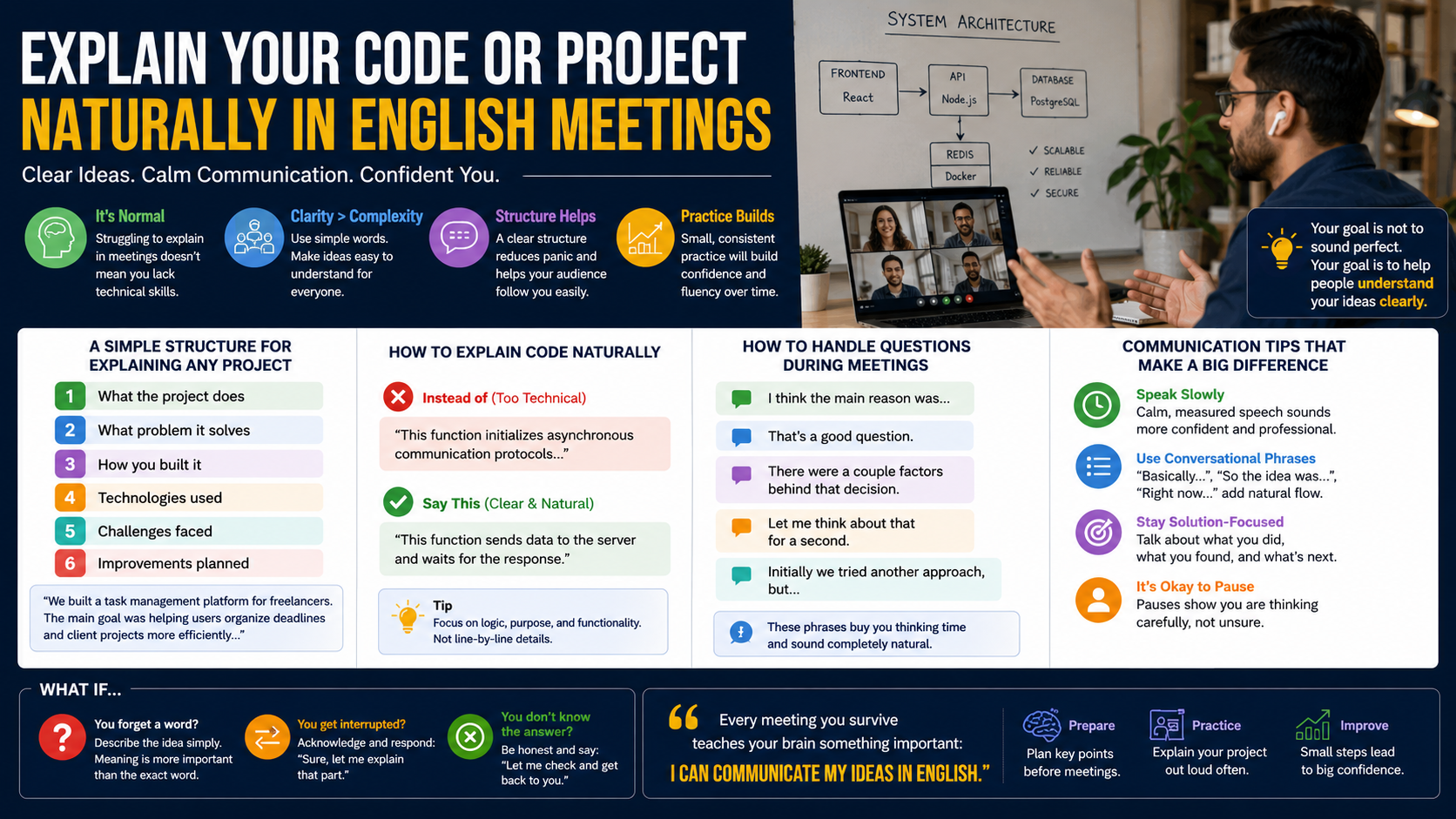
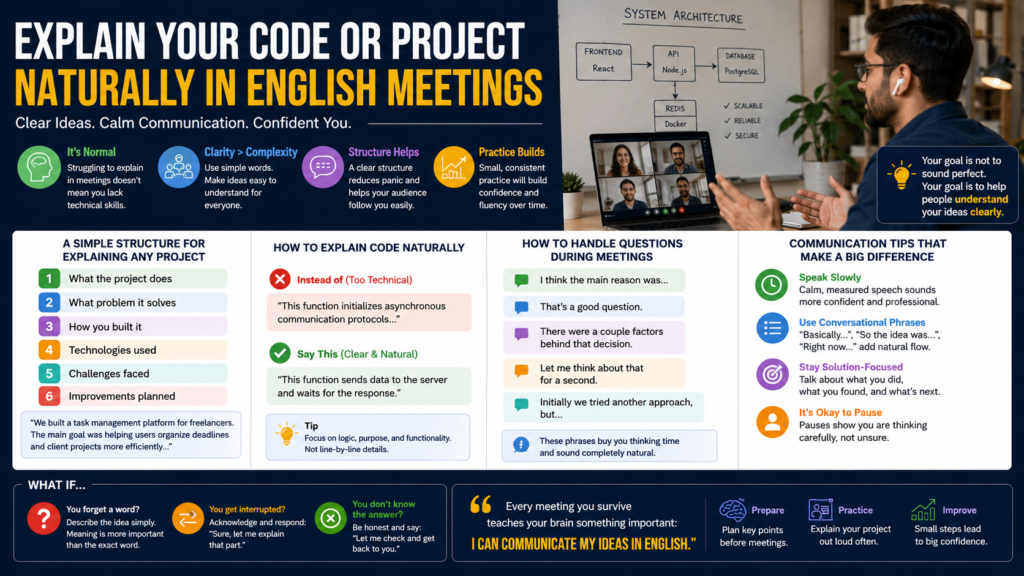
Most projects can be explained using this flow:
- What the project does
- What problem it solves
- How you built it
- Technologies used
- Challenges faced
- Improvements planned
Example:
“We built a task management platform for freelancers. The main goal was helping users organize deadlines and client projects more efficiently. The frontend was built using React, while the backend uses Node.js and PostgreSQL. One challenge was handling real-time notifications properly, so we implemented WebSockets for that functionality. Moving forward, we’re planning to add team collaboration features.”
Notice something important here.
The English is simple.
But the explanation still sounds professional.
How to Explain Code Naturally
Many learners accidentally explain code line-by-line mechanically.
But meetings usually focus more on:
logic,
purpose,
and functionality.
Instead of saying:
“This function initializes asynchronous communication protocols…”
You can say:
“This function sends data to the server and waits for the response.”
Simple explanations sound more human.
And honestly, meetings are usually about understanding overall behavior, not hearing textbook terminology constantly.
My Opinion
Honestly, many learners focus too heavily on vocabulary and not enough on structure.
But structure reduces panic dramatically.
Because once you know:
where to begin,
what comes next,
and how to organize explanations,
your brain stops panicking constantly.
That creates calmness.
And calmness improves fluency naturally.
Actually, many confident speakers are not speaking perfectly.
They simply sound organized.
That changes how people perceive them immediately.
How to Handle Questions During Meetings
Unexpected questions scare many learners.
Especially technical questions.
But honestly, professional communication does not require instant perfect answers every time.
Strong communicators buy thinking time naturally.
Useful phrases include:
“I think the main reason was…”
“That’s a good question.”
“There were a couple factors behind that decision.”
“From a performance perspective…”
“Initially we tried another approach, but…”
“Let me think about that for a second.”
These phrases create mental breathing room.
And honestly, native speakers do this constantly too.
What to Do If You Forget a Technical Word
This happens to everyone.
Even in their native language.
The important thing is not panicking.
Describe the idea simply instead.
Example:
“I forgot the exact term, but basically it handles user authentication.”
Communication is about meaning.
Not vocabulary perfection.
And honestly, most professionals care much more about understanding your logic than hearing the exact technical term immediately.
Why Speaking More Slowly Often Sounds More Professional
Many nervous learners speak too fast.
They think speed sounds fluent.
But nervous speed usually reduces clarity.
Strong communicators often sound:
calm,
measured,
and deliberate.
That creates authority naturally.
And honestly, slower speaking gives your brain extra processing time too.
Which improves sentence quality automatically.
How to Sound More Natural During Technical Discussions
Real workplace communication includes softer conversational phrases:
“Basically…”
“So the idea was…”
“At first we tried…”
“Right now…”
“The main issue was…”
“Eventually we realized…”
“These small phrases create conversational rhythm.”
Without them, explanations can sound overly mechanical.
Natural communication has movement and emotional flow inside it.
How to Explain Problems Without Sounding Panicked
Meetings often involve discussing:
bugs,
delays,
failures,
or technical issues.
Many learners become emotionally nervous during these conversations because they fear sounding incompetent.
But strong professional communication stays calm and solution-focused.
Example:
“We discovered a memory issue during testing, but we isolated the cause and implemented a fix.”
Notice the tone.
Calm.
Clear.
Controlled.
Professional.
Not emotional panic.
That builds trust quickly.
How to Handle Interruptions Calmly
Interruptions happen constantly during technical meetings.
Instead of panicking, acknowledge the question naturally.
Useful responses:
“Sure, let me explain that part.”
“Good point.”
“Actually, that connects to another issue we noticed.”
“That’s related to the scalability challenge we discussed earlier.”
Interruptions are not communication failures.
They are normal conversation flow.
How to Explain Technical Decisions Clearly
Clients and managers often ask:
“Why did you choose this approach?”
Strong answers usually include:
the reason,
the benefit,
and the tradeoff.
Example:
“We chose React because it made the UI easier to scale and maintain. It also helped speed up development since the component structure is reusable.”
Notice the explanation focuses on practical reasoning.
Not unnecessary complexity.
How to Reduce Nervousness Before Meetings
Preparation helps enormously.
Before meetings, many professionals mentally prepare:
project overview,
key features,
main challenges,
technical decisions,
future improvements,
and possible questions.
Preparation reduces panic because your brain feels organized.
And honestly, organized thinking creates confidence automatically.
How to Sound Professional Without Sounding Robotic
Many learners confuse professionalism with extreme formality.
But real meetings usually sound much more conversational.
Natural professional phrases include:
“From our side…”
“At the moment…”
“One thing we noticed…”
“The main challenge was…”
“Right now we’re focusing on…”
These sound human and professional simultaneously.
That balance matters heavily.
FAQs
What if my English is weaker than my technical skills?
This is extremely common globally. Many excellent developers communicate successfully using simple English. Focus on clarity and structure instead of perfection.
Should I memorize my project explanation completely?
Usually no. Memorized speaking often sounds robotic and becomes difficult when interrupted. Memorize structure and key points instead.
What if I don’t understand a question?
Ask for clarification calmly:
“Could you explain the question another way?”
“Just to confirm, are you asking about the backend architecture?”
Clarification is completely normal professionally.
How do I stop freezing during explanations?
Practice explaining your project out loud repeatedly. Familiarity reduces nervousness dramatically.
Is advanced vocabulary necessary?
Not really. Clear simple explanations are usually more effective during technical meetings.
How can I sound more confident?
Slow down slightly, organize explanations clearly, and avoid over-explaining unnecessarily.
What if my pronunciation isn’t perfect?
Clarity matters much more than accent perfection. International teams are already used to global English communication styles.
Should I explain every technical detail?
No. Focus on relevant logic first. Most meetings prioritize understanding over deep technical detail.
Why do I sound robotic during meetings?
Usually because you are over-monitoring grammar and trying too hard to sound formal.
What is the most important communication skill in technical meetings?
Probably structured thinking combined with clear explanation. Organized communication reduces confusion and nervousness dramatically.
CONCLUSION
Explaining your code or project in English meetings can feel intimidating in the beginning, especially when your technical understanding feels much stronger than your communication ability.
But honestly?
This experience is incredibly common.
And the important thing to remember is this:
You do not need perfect English to explain technical ideas effectively.
You need:
clear thinking,
simple explanations,
organized structure,
and calm communication.
That is what strong technical communication actually looks like.
Because professionalism is not about sounding academically complicated.
It is about helping people understand:
what you built,
why you built it,
how it works,
what challenges appeared,
and what happens next.
And thankfully, this skill improves much faster once you stop treating meetings like English exams.
Meetings are human conversations.
They naturally include:
interruptions,
questions,
clarifications,
mistakes,
pauses,
reactions,
and imperfect moments.
That is normal.
Every technical meeting you survive teaches your brain something important:
“I can communicate my ideas in English.”
And slowly, confidence stops feeling fake.
You stop translating every sentence mentally.
You stop trying to sound “perfect.”
You stop panicking every time someone asks a question unexpectedly.
Instead, you begin focusing on something much more valuable:
Helping people understand your ideas clearly.
And honestly?
That is what real communication skill actually is.