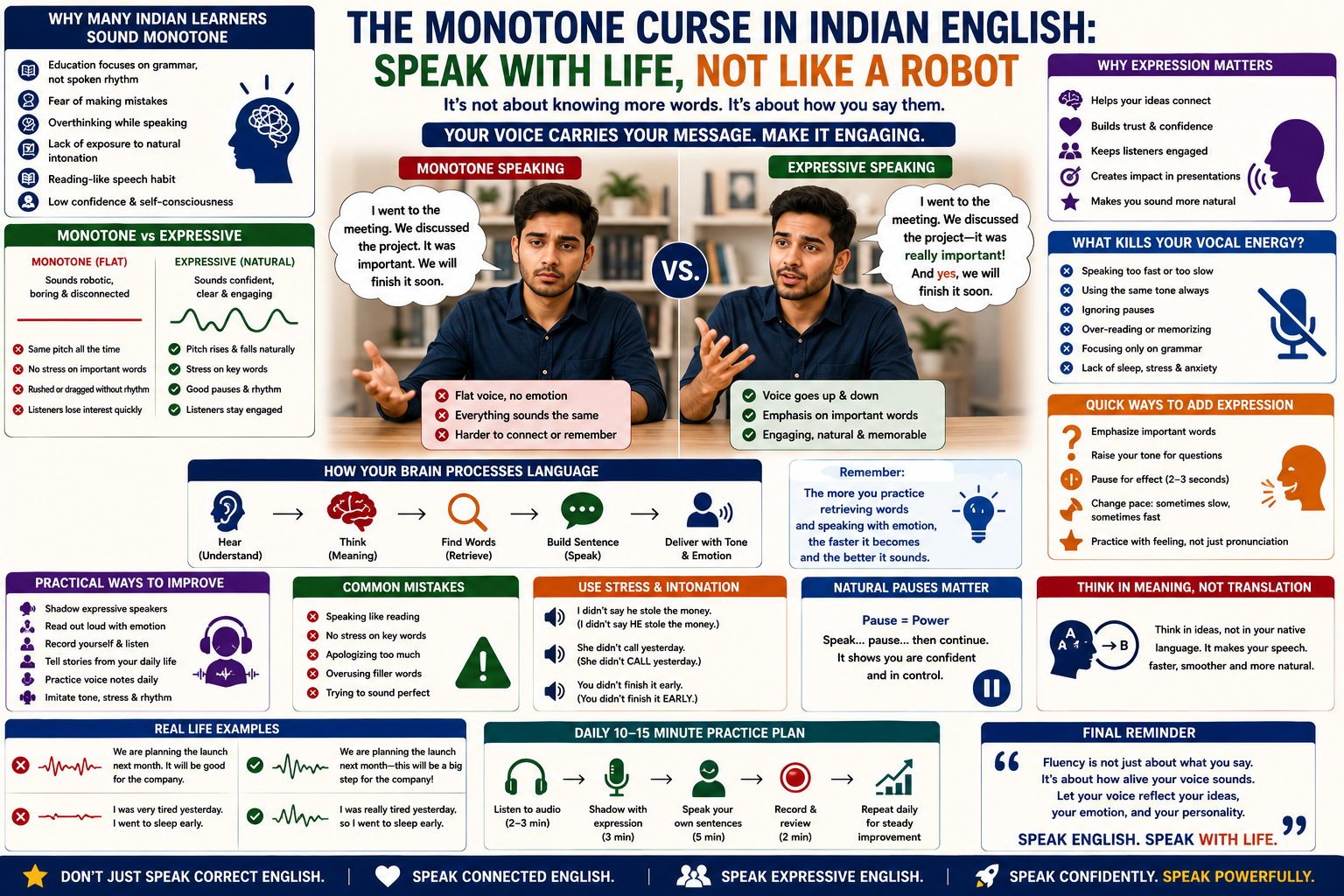
The Monotone Curse in Indian English: Why Your Voice Sounds Flat and How to Rebuild Your Spoken Vocal Rhythm
One of the most misunderstood problems in spoken English communication, especially in India, is something most learners do not even realize they are struggling with. A lot of people believe their main issue is grammar. Some think the problem is vocabulary. Others blame pronunciation, accent, confidence, hesitation, or lack of fluency. But honestly, there is another communication issue hiding underneath all of these things that quietly affects how people sound during conversations, meetings, interviews, presentations, calls, classrooms, freelancing discussions, YouTube videos, and even daily interactions. And that issue is monotone speaking.
Now the interesting part is that many people have absolutely no idea they sound monotone while speaking English. Inside their own head, they feel expressive. They feel emotionally normal. They think they are speaking correctly. But to the listener, the speech sounds flat, emotionally repetitive, mechanically paced, and strangely lifeless. The voice stays at almost the same emotional level from beginning to end without natural rises, drops, stress patterns, emotional rhythm, or conversational musicality. And because of this, even intelligent speakers sometimes accidentally sound nervous, robotic, low-energy, disinterested, underconfident, or emotionally disconnected without realizing it.
Honestly, this becomes a very painful experience for many English learners after a while because they often work extremely hard on grammar and vocabulary improvement but still feel something is “missing” in their communication. They notice native speakers sound smoother. More expressive. More natural. More engaging. More emotionally alive. Meanwhile their own English may technically be correct, but conversations still feel slightly stiff or tiring. Sometimes listeners lose focus quickly. Sometimes presentations feel less impactful. Sometimes interviews feel emotionally flat even when the content itself is strong. And the learner cannot fully understand why this keeps happening.
This issue becomes especially common in India because the education system traditionally focuses very heavily on written English instead of spoken rhythm. Students spend years learning:
grammar structures,
essay writing,
formal vocabulary,
textbook answers,
reading comprehension,
translation,
and memorization.
But very little attention is given to vocal expression, speech melody, emotional pacing, intonation, sentence stress, or conversational rhythm. As a result, many learners grow up treating English like a subject instead of a living spoken language. They become intellectually familiar with English but not vocally comfortable with it.
And honestly, this creates a strange communication imbalance.
A learner may know advanced vocabulary.
A learner may understand complex grammar.
A learner may perform well academically.
But when speaking live, the voice still sounds emotionally flat.
This is where monotone speaking begins affecting confidence psychologically too.
Because communication is not only about words.
It is also about energy.
Tone.
Emotion.
Movement.
Rhythm.
Human beings naturally respond emotionally to vocal variation. We are wired for it psychologically. Even babies react to tone before they understand language itself. When someone speaks with emotional variation, listeners subconsciously feel more engaged. More connected. More interested. But when speech becomes excessively monotone, the brain begins losing emotional stimulation during listening. The conversation starts feeling heavier mentally even if the actual information is valuable.
Now here’s something very important many learners misunderstand.
Monotone speaking does NOT mean having an Indian accent.
These are completely different things.
An Indian accent is not the problem.
India contains thousands of expressive communicators with Indian accents who sound energetic, engaging, emotionally natural, and professionally powerful while speaking English.
The real issue is vocal flatness.
And honestly, many learners confuse these things unfairly.
They think:
“My accent is the problem.”
But often the bigger issue is:
lack of vocal rhythm,
lack of emotional stress variation,
lack of tonal movement,
or overly controlled speech delivery.
This distinction matters enormously because learners sometimes waste years trying to “remove their accent” while completely ignoring vocal expression skills that would improve communication much faster.
Actually, one of the most interesting things about natural spoken English is that it behaves almost musically. Native conversational speech constantly moves emotionally:
upward,
downward,
faster,
slower,
softer,
stronger,
lighter,
heavier.
Words stretch.
Important ideas receive stress.
Emotions change pacing.
Questions rise naturally.
Excitement changes tone automatically.
Even pauses contain emotional meaning sometimes.
This movement creates conversational life.
Without it, speech begins sounding mechanical.
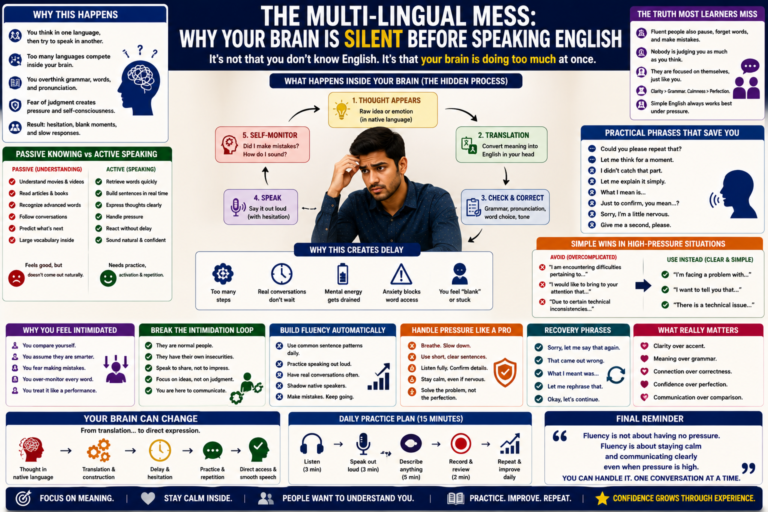
And honestly, many Indian learners unintentionally suppress this emotional movement while speaking English because they become too mentally focused on correctness. Their brain becomes so occupied with:
grammar monitoring,
pronunciation control,
sentence construction,
translation,
and mistake avoidance,
that natural emotional rhythm disappears completely.
The learner enters “performance mode” instead of communication mode.
This is extremely common.
Especially among intelligent students and professionals.
Especially among perfectionists.
Especially among people afraid of judgment.
Because when someone becomes overly self-conscious during speaking, they unconsciously tighten vocal expression. Their speech becomes safer, flatter, more controlled, and emotionally restricted.
The voice loses flexibility.
Now something very interesting happens psychologically during monotone speaking too.
The speaker themselves often becomes more tired mentally.
Because expressive speech actually helps thinking flow naturally.
Monotone speech usually indicates internal cognitive tension.
The brain is working too hard mechanically.
And this becomes even more visible during:
presentations,
meetings,
online calls,
interviews,
classroom speaking,
public speaking,
or client communication.
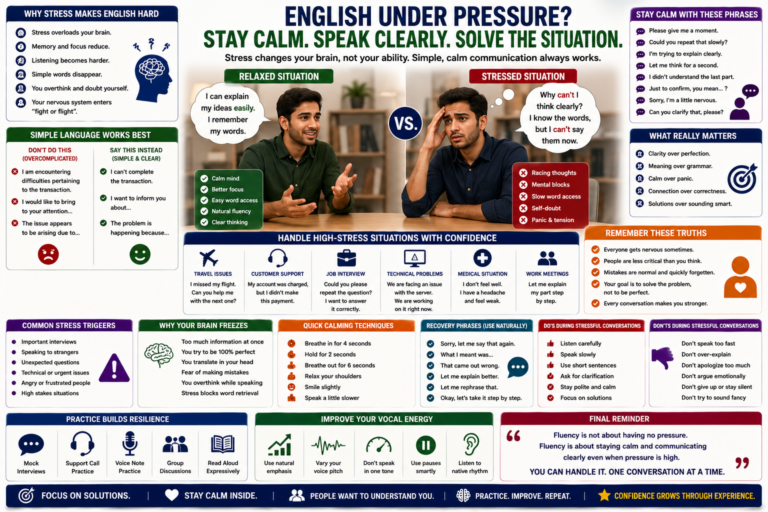
Many learners secretly experience this painful situation where they know the content of what they want to say, but while speaking English, they sound strangely disconnected from their own personality. In their native language, they may sound funny, expressive, emotional, confident, energetic, sarcastic, relaxed, or charismatic. But in English, suddenly the emotional color disappears from the voice.
And honestly, this emotional disconnect hurts confidence deeply because people begin feeling:
“This doesn’t sound like me.”
That feeling matters psychologically.
Because language is connected to identity.
When learners feel emotionally trapped while speaking English, fluency starts feeling unnatural.
Now here’s another important reality.
Many learners accidentally believe professional English means emotionally flat English.
This is a huge misconception.
They think professionalism means speaking in a very controlled, serious, formal, expressionless way.
But real professional communication still contains natural vocal variation.
Actually, strong communicators in business environments often sound highly expressive while remaining professional.
They use:
emphasis,
tone changes,
strategic pauses,
emotional contrast,
and vocal energy very intentionally.
That’s part of leadership communication.
And honestly, this is why some speakers instantly sound more engaging even before you analyze their actual words deeply. Their vocal rhythm itself keeps listeners emotionally involved.
Another major reason monotone speaking becomes common in Indian English environments is memorization culture. Many students are trained to reproduce “correct answers” instead of expressing spontaneous thought naturally. Over time, this creates a habit of reading-like speech patterns. The learner speaks as if mentally reciting prepared content instead of emotionally communicating ideas live.
This creates stiffness.
And stiffness creates monotone delivery.
Especially during interviews or presentations.
Actually, one of the clearest signs of monotone speaking is when every sentence sounds emotionally similar regardless of meaning.
Exciting information sounds flat.
Questions sound flat.
Stories sound flat.
Opinions sound flat.
Even emotional experiences sound emotionally neutral.
This makes communication harder for listeners because listeners rely heavily on vocal cues to process meaning naturally.
Now thankfully, monotone speaking is absolutely fixable.
And honestly, improvement often happens much faster than learners expect once they become aware of the issue.
Because the problem is usually not lack of intelligence.
It is lack of vocal awareness.
Most learners have simply never consciously trained:
intonation,
stress,
rhythm,
speech melody,
or emotional vocal movement before.
Once awareness develops, communication transforms surprisingly quickly.
And honestly, one of the biggest breakthroughs learners experience is realizing:
“Fluency is not only about words.”
That realization changes speaking completely.
Because suddenly learners stop obsessing only over grammar and start noticing:
tone,
energy,
musicality,
pacing,
and emotional delivery.
This creates much more natural communication.
One thing I’ve personally noticed is that some learners dramatically improve speaking confidence once they stop trying to sound “perfect” and start trying to sound emotionally alive instead.
That shift matters enormously.
Because natural communication is emotionally dynamic.
Not mechanically flawless.
Actually, if you observe real native conversations carefully, you’ll notice something fascinating:
people constantly change tone unconsciously depending on:
interest,
emotion,
surprise,
humor,
frustration,
uncertainty,
curiosity,
or excitement.
This vocal movement is what makes speech feel human.
Without it, communication feels emotionally compressed.
Another hidden problem connected to monotone speaking is listener perception. People unconsciously interpret vocal energy psychologically. A monotone speaker may accidentally sound:
less confident,
less interested,
less passionate,
less emotionally engaged,
or less socially comfortable,
even when none of those things are true internally.
That’s frustrating because the speaker’s actual intelligence may be very high.
But communication energy shapes perception heavily.
Especially in professional environments.
This becomes extremely important in:
freelancing,
international meetings,
interviews,
content creation,
public speaking,
customer communication,
teaching,
sales,
or leadership roles.
Because people remember how communication feels emotionally.
Not only what was said intellectually.
And honestly, one of the biggest reasons learners stay stuck with monotone speaking for years is because nobody points it out clearly. Teachers correct grammar. Friends notice pronunciation. But vocal rhythm problems often go undiscussed completely.
So learners continue practicing English with flat vocal patterns repeatedly.
And repetition strengthens habits neurologically.
That’s why awareness is the first breakthrough.
Once you hear the monotone pattern consciously, you cannot unhear it anymore.
Then improvement becomes possible.
This article is going to explore all of this deeply.
We’re going to talk about:
why monotone speaking becomes common in Indian English,
how educational systems influence speech rhythm,
how emotional suppression affects fluency,
why tonal variation matters psychologically,
how native conversational rhythm works,
how to sound more expressive naturally,
how to improve speech melody,
how to use stress and intonation effectively,
how confidence affects vocal energy,
and how to make spoken English feel more human instead of mechanically correct.
Most importantly, we’re going to approach this like a real communication psychology issue instead of just another pronunciation lesson.
Because honestly?
Sometimes the biggest difference between “technically correct English” and “engaging English” is not vocabulary at all.
It’s vocal life.
Understanding What Monotone Actually Means
Monotone speaking does not mean speaking quietly.
It does not mean speaking slowly.
And it definitely does not mean having an Indian accent.
Monotone simply means limited vocal variation.
The voice stays emotionally flat across sentences.
There is little change in:
pitch,
stress,
rhythm,
or emotional emphasis.
As a result, conversations feel less dynamic for listeners.
Why Monotone Speaking Becomes Common in Indian English
One major reason is educational conditioning.
Students often learn English through:
memorization,
reading aloud,
written exams,
and grammar-heavy systems.
Very little training focuses on:
intonation,
conversational rhythm,
or emotional speaking.
So learners become technically familiar with English but vocally stiff while speaking it.
The Connection Between Fear and Flat Speech
Fear affects the voice heavily.
When learners become nervous, they unconsciously tighten vocal expression.
The brain focuses on:
avoiding mistakes,
monitoring grammar,
and controlling pronunciation.
This creates emotional restriction.
And emotional restriction creates flatter speech patterns.
Why Native Conversations Sound More “Alive”
Natural spoken English constantly changes emotionally.
Questions rise.
Important words receive emphasis.
Stories speed up and slow down.
Excitement changes pacing automatically.
This variation keeps listeners engaged psychologically.
The Hidden Role of Sentence Stress
Sentence stress changes meaning dramatically.
For example:
“I REALLY wanted to try that.”
versus
“I really wanted to TRY that.”
Different stress creates different emotional focus.
Many learners never consciously train this skill
My Opinion: Over-Controlled English Sounds Less Natural
Honestly, I think many learners sound monotone because they over-control themselves constantly while speaking English.
They are trying so hard to sound correct that emotional rhythm disappears completely.
But real communication is not robotic.
Natural speech contains movement,
imperfection,
emotion,
and vocal flexibility.
How Bollywood and Native Languages Affect Rhythm
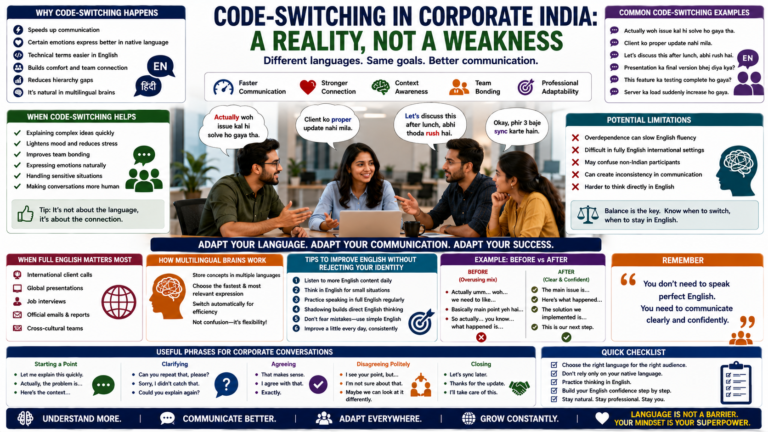
Interestingly, many Indians are highly expressive in Hindi, Tamil, Bengali, Punjabi, Marathi, Malayalam, Telugu, or other native languages.
The emotional rhythm exists naturally there.
But while speaking English, learners suddenly suppress that expressiveness because English feels “formal” psychologically.
That mental switch creates stiffness.
Practical Ways to Break Monotone Speaking
One of the best methods is shadowing emotionally expressive speakers.
Not just copying words.
Copy:
tone,
stress,
pause placement,
and emotional rhythm too.
Another powerful method is storytelling practice.
Stories naturally create vocal variation.
Why Reading Aloud Helps
Reading aloud trains:
speech flow,
intonation awareness,
and vocal movement.
But the key is expressive reading.
Not robotic reading.
Imagine emotionally communicating the text instead of merely pronouncing words correctly.
The Difference Between Confidence and Vocal Energy
Many learners think confidence means speaking loudly.
Not necessarily.
Real vocal confidence often sounds relaxed, varied, and emotionally natural.
Even soft-spoken communicators can sound highly engaging if vocal rhythm feels alive.
How Meetings Reveal Monotone Problems Quickly
During long meetings or presentations, monotone speech becomes very noticeable.
Listeners mentally disconnect faster because the brain receives less emotional stimulation from the voice.
That’s why expressive communicators often hold attention more effectively even with simple vocabulary.
Why Pauses Matter So Much
Natural speakers use pauses emotionally.
Pauses create:
emphasis,
clarity,
suspense,
and breathing rhythm.
Monotone speakers often rush continuously without emotional pacing variation.
FAQs
Is monotone speaking the same as having an Indian accent?
No. Accent and monotone delivery are completely different things.
Why does my English sound flatter than my native language?
Because you become more self-conscious and controlled while speaking English.
Can monotone speaking affect interviews?
Absolutely. Vocal energy heavily influences listener perception.
How can I improve vocal variation?
Practice expressive shadowing, storytelling, and emotional reading aloud.
Do native speakers always speak expressively?
Not constantly, but natural conversational rhythm usually contains more tonal movement than monotone speech.
Why do I sound robotic during presentations?
Usually because memorization and fear reduce emotional speaking patterns.
Is grammar the main issue behind monotone speech?
Not usually. The issue is often vocal rhythm and emotional restriction.
Can introverts still sound expressive?
Definitely. Expressiveness is not the same as loud extroversion.
Does watching English content help?
Yes, especially if you consciously observe tone and stress patterns instead of only vocabulary.
What is the fastest way to sound more natural?
Stop trying to sound perfectly controlled and start focusing on emotional communication flow.
CONCLUSION
The monotone curse in Indian English is not really about intelligence, vocabulary, or even accent.
At its core, it is usually about emotional restriction inside spoken communication.
Many learners become so focused on correctness that they accidentally remove the natural rhythm, stress, tone, and movement that make conversations feel human.
And honestly, this creates a painful disconnect sometimes because people begin sounding much flatter in English than they actually are emotionally.
But thankfully, this problem is highly trainable once awareness develops.
Because natural communication is not only about saying correct words.
It is also about:
energy,
timing,
stress,
emotion,
pause,
and vocal life.
That’s what makes speech feel engaging.
And once learners begin noticing these patterns consciously, English speaking changes dramatically.
Conversations stop feeling like textbook performance.
Instead, they begin feeling emotionally real.
You stop sounding like someone “trying to speak correct English.”
And start sounding like someone actually communicating thoughts naturally.
That transformation matters deeply.
Especially in modern professional and social life where communication energy shapes trust, connection, attention, and confidence constantly.
And honestly?
Sometimes improving fluency is not about learning more vocabulary at all.
Sometimes it’s simply about letting your voice sound alive again.