The Smart-Friend Syndrome: Why You Freeze Around Fluent English Speakers
One of the strangest emotional experiences many English learners go through is something they rarely talk about openly because honestly, it feels embarrassing to admit. It happens when they are completely comfortable speaking English alone, practicing alone, thinking alone, or even speaking confidently with certain people, but the moment they sit beside someone who speaks “better English,” their entire personality changes psychologically. Suddenly their confidence disappears. Their speaking becomes stiff. Their brain starts over-monitoring every sentence. Basic vocabulary vanishes temporarily. Even simple conversations begin feeling stressful. And the most frustrating part is that deep down they usually know they are capable of speaking much better than what is coming out in that moment.
This experience is incredibly common in schools, colleges, offices, freelancing spaces, startups, corporate meetings, coaching institutes, friend groups, and even families. Almost everybody has experienced some version of this emotional pressure at some point. Sometimes it is that one friend who speaks very fluent English naturally. Sometimes it is a colleague who sounds polished and confident during meetings. Sometimes it is a classmate who has a foreign accent. Sometimes it is a person who casually uses advanced vocabulary and speaks without hesitation. And suddenly, without realizing it consciously, your brain starts treating them like some kind of “English authority figure.”
And that psychological shift changes your communication immediately.
Now instead of communicating naturally, your brain enters performance mode.
You stop focusing on ideas.
You start focusing on mistakes.
You stop listening comfortably.
You start analyzing yourself constantly.
You stop expressing naturally.
You start trying to “sound intelligent.”
And honestly, this mental shift destroys fluency for many learners.
What makes this situation emotionally complicated is that the fear is usually not really about English itself. It is about comparison. Human beings naturally compare themselves socially. We compare confidence, intelligence, appearance, success, communication style, social status, and competence constantly. Language becomes part of that comparison too. So when somebody around us appears more fluent, our brain sometimes interprets that as evidence that they are smarter, more educated, more capable, or more socially valuable than us.
Even though logically that is not true.
And honestly, this emotional reaction becomes especially strong in countries like India where English is often connected psychologically to intelligence, professionalism, social status, education quality, career opportunities, and confidence. Because of this cultural environment, many learners grow up unconsciously believing that fluent English speakers are automatically more impressive human beings. Over time this belief becomes emotionally deep-rooted.
That’s why some learners become unusually nervous around people with strong English communication skills.
Not because they cannot speak.
But because they feel “smaller” psychologically in comparison.
And this creates a very painful internal experience sometimes.
A person may be extremely intelligent technically, creatively, emotionally, or academically, but the moment they sit beside someone who speaks smooth English confidently, they suddenly start doubting themselves entirely. Their brain starts whispering things internally like:
“What if I sound stupid?”
“What if my grammar is wrong?”
“What if they judge my accent?”
“What if my vocabulary sounds weak?”
“What if they think I’m uneducated?”
“What if I embarrass myself?”
These thoughts create enormous pressure inside the mind.
And pressure changes communication dramatically.
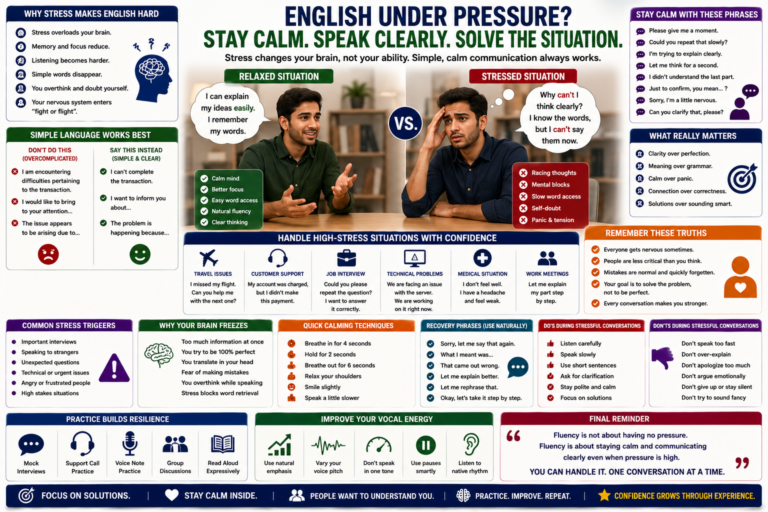
Actually, many learners do not realize how deeply emotions affect fluency. They think speaking problems are only about vocabulary or grammar, but psychology plays a massive role in conversational performance. A learner may speak comfortably in relaxed situations but struggle badly in intimidating environments because anxiety interrupts natural thinking processes.
This happens even in native languages sometimes.
People speak differently around authority figures.
Differently around attractive people.
Differently during interviews.
Differently during presentations.
Differently around highly educated individuals.
Human communication is emotional.
And English learners often underestimate that emotional dimension completely.
One of the biggest misconceptions learners have is believing fluent English speakers are constantly judging everybody’s grammar internally. But honestly, most confident English speakers are not analyzing other people nearly as much as nervous learners imagine. In fact, strong communicators are usually focused on the conversation itself, not on secretly grading every sentence someone speaks.
But anxiety creates imaginary audiences.
And suddenly every pause feels embarrassing.
Every mistake feels huge.
Every pronunciation slip feels catastrophic.
Meanwhile the other person often barely notices.
That’s an important psychological truth.
Actually, one interesting thing happens when learners finally become more confident later in life. They often realize something surprising: the people they once found “intimidating” were just normal human beings. Sometimes those fluent speakers were insecure too. Sometimes they were simply more practiced socially. Sometimes they had more exposure to English environments. Sometimes they were naturally extroverted. Sometimes they just sounded confident externally while feeling nervous internally themselves.
But nervous learners usually cannot see that.
They only see the polished surface.
And because of that, they begin idealizing fluent speakers emotionally.
This creates what I personally think is one of the biggest hidden barriers in English communication: social intimidation.
Not grammar.
Not vocabulary.
Not pronunciation.
Intimidation.
Because intimidation changes behavior instantly.
A learner who normally speaks clearly suddenly becomes quiet.
A learner who normally jokes comfortably suddenly becomes serious and robotic.
A learner who normally explains ideas well suddenly gives tiny nervous answers.
A learner who knows vocabulary suddenly forgets everything.
This is psychological shrinking.
And honestly, many learners suffer from this for years without fully understanding what is happening.
Sometimes the problem becomes so deep that learners begin avoiding certain people entirely because those people make them feel linguistically inferior. They avoid English-speaking groups. They avoid meetings. They avoid discussions. They avoid asking questions publicly. They avoid presentations. Not because they lack intelligence, but because comparison anxiety becomes emotionally exhausting.
This is why confidence in English is not only linguistic. It is emotional too.
A person can have enough English knowledge but still feel emotionally blocked socially.
And sadly, educational systems rarely discuss this honestly.
Most English learning advice focuses heavily on grammar, vocabulary, pronunciation, and fluency exercises. Those things matter, obviously. But very few people discuss the emotional intimidation many learners experience around socially confident English speakers.
And honestly, that emotional issue deserves serious attention because it affects communication quality massively.
One thing I’ve personally noticed is that many learners accidentally worsen this problem because they treat fluent speakers almost like superior beings mentally. They assume:
“They never make mistakes.”
“They always know the right words.”
“They are naturally confident.”
“They speak perfectly all the time.”
But real conversations are much messier than that.
Even highly fluent people pause.
Forget words.
Restart sentences.
Use filler words.
Change thoughts mid-sentence.
Communicate imperfectly.
That’s normal human communication.
Actually, some learners become so obsessed with sounding “smart” around fluent speakers that they stop communicating naturally altogether. Instead of expressing real thoughts simply, they start forcing complicated vocabulary unnaturally. Their speech becomes stiff because they are performing intelligence instead of communicating ideas.
Ironically, this often makes communication weaker.
Because confidence usually sounds simple.
Nervousness often sounds overly complicated.
And honestly, one of the biggest communication breakthroughs learners experience happens when they stop trying to impress fluent people and start treating them like normal humans.
That shift changes everything psychologically.
Suddenly conversations feel lighter.
More relaxed.
More natural.
You stop mentally competing every second.
You stop monitoring yourself obsessively.
You stop panicking about tiny mistakes.
Instead, you focus on the actual interaction.
That’s when fluency starts returning naturally.
Another important emotional truth is this: many learners secretly connect English performance to self-worth. This is dangerous psychologically. Because now every small mistake feels personal. Every hesitation feels like proof of inadequacy. Every difficult conversation feels emotionally threatening.
But language ability is not human value.
Fluency is a skill.
Not a measure of intelligence or worth.
And honestly, some incredibly intelligent people communicate very simply while some socially polished speakers may not necessarily possess deep understanding at all. Communication style and intelligence are not identical things.
Unfortunately, modern social media sometimes intensifies this intimidation problem too. People constantly watch polished interviews, fluent influencers, confident public speakers, and charismatic content creators online. Over time learners start believing everybody else speaks confidently except them. But social media often shows edited confidence, not real-life conversational struggle.
Real communication is much more imperfect.
Much more human.
Much more flexible.
And honestly, one of the healthiest mindset shifts learners can develop is understanding that communication is not a competition. Conversations are not IQ battles. They are shared interactions between human beings trying to exchange thoughts, feelings, ideas, information, humor, and experiences.
But intimidation makes communication feel like performance.
And performance pressure kills natural expression.
One thing that makes this issue especially painful is that learners often know exactly what they want to say internally. Their thoughts are present. Their personality is present. Their humor is present. Their intelligence is present. But intimidation creates a mental filter between thought and speech. The brain becomes hyper-aware of potential mistakes. And that self-monitoring interrupts natural flow badly.
This is why some learners later say things like:
“Why can I think clearly alone but freeze around fluent people?”
The answer is usually emotional pressure.
Not lack of intelligence.
Actually, confidence in English often improves dramatically once learners emotionally normalize fluent speakers instead of idolizing them psychologically. Because the moment you stop viewing someone as socially “above” you linguistically, your brain relaxes. And relaxed brains communicate better.
This article is going to explore all of this deeply. We’re going to talk about why fluent people feel intimidating sometimes, how comparison anxiety affects communication, how learners accidentally shrink themselves socially, how to stop over-monitoring grammar during conversations, how to communicate naturally around confident English speakers, how to rebuild relaxed conversational confidence, how to stop idealizing fluency psychologically, and how to develop a healthier emotional relationship with English communication overall.
Most importantly, we’re going to approach this honestly like a human psychological experience instead of pretending English confidence is only about vocabulary and grammar.
Because honestly?
For many learners, the real battle is not English itself.
It’s the fear of feeling smaller around people who speak it confidently.
Why Fluent English Speakers Feel Intimidating Sometimes
Human beings naturally associate confidence with competence.
When somebody speaks smoothly, calmly, and effortlessly, our brain often assumes they are highly intelligent automatically. This psychological effect happens in almost every culture.
Now combine that with English already carrying social status in many environments.
Suddenly fluent speakers begin feeling emotionally “higher” socially.
This creates nervousness instantly.
Especially for learners who already feel insecure internally about communication.
The Hidden Problem of Self-Monitoring
One of the biggest reasons learners freeze around fluent speakers is excessive self-monitoring.
Instead of focusing on conversation naturally, the brain starts analyzing everything:
grammar,
pronunciation,
sentence structure,
vocabulary choice,
accent,
mistakes,
speed,
fluency.
This destroys conversational rhythm.
Actually, natural communication requires partial mental relaxation. Over-monitoring interrupts automatic speech processes badly.
Why Comparison Destroys Fluency
Comparison shifts attention away from communication and toward self-evaluation.
Now the brain is no longer asking:
“What do I want to say?”
It starts asking:
“How do I sound?”
That small psychological shift changes everything.
Fluency becomes harder because communication stops feeling natural and starts feeling performative.
The Biggest Misconception About Fluent Speakers
Many learners secretly believe fluent English speakers never struggle socially.
But honestly, even highly fluent people experience nervousness sometimes:
during interviews,
presentations,
public speaking,
important meetings,
or emotionally stressful conversations.
Confidence is situational.
Not permanent.
My Opinion: English Intimidation Is More Emotional Than Linguistic
Honestly, I think many learners already know enough English to communicate far better than they currently do.
The bigger issue is emotional intimidation.
Once learners emotionally relax around fluent speakers, their communication quality often improves surprisingly fast.
Because relaxed brains think more clearly.
How to Stop Treating Fluent Speakers Like “Superior Humans”
This mindset shift matters enormously.
Fluent English speakers are not magical creatures.
They are normal people with communication practice.
That’s it.
Some learned earlier.
Some had better exposure.
Some grew up around English environments.
Some are naturally social.
But fluency itself does not make somebody inherently superior.
Why Simple English Often Sounds More Confident
Nervous learners often try forcing advanced vocabulary to sound intelligent.
But calm communicators usually sound simpler.
For example:
Nervous style:
“I endeavored toward communicative optimization…”
Natural style:
“I tried improving communication.”
Simple communication often sounds stronger because it feels relaxed and genuine.
How to Speak Around Fluent People Without Freezing
One powerful technique is shifting attention outward instead of inward.
Focus on:
the topic,
the other person,
the conversation,
the ideas,
the interaction itself.
Not your performance constantly.
This reduces mental pressure dramatically.
Why Humor and Personality Disappear Under Intimidation
Many learners notice something painful:
their personality disappears around fluent speakers.
They become robotic.
Quiet.
Overly formal.
Emotionally stiff.
This happens because anxiety suppresses spontaneity.
Relaxation brings personality back naturally.
How to Rebuild Conversational Confidence
Confidence grows through repeated exposure.
You do not eliminate fear completely first.
You communicate despite discomfort repeatedly until the brain slowly realizes:
“This situation is survivable.”
That’s how emotional normalization happens.
FAQs
Why do I become nervous around fluent English speakers?
Usually because your brain associates fluency with social superiority or judgment. This creates comparison anxiety and excessive self-monitoring.
Do fluent people secretly judge grammar mistakes constantly?
Usually far less than learners imagine. Most people focus mainly on the conversation itself, not on grading every sentence emotionally.
Why does my personality disappear in English sometimes?
Because anxiety interrupts spontaneity. When the brain enters performance mode, natural expression becomes harder temporarily.
Is intimidation more psychological than linguistic?
Very often yes. Many learners already know enough English but struggle emotionally under social comparison pressure.
How can I stop comparing myself constantly?
Focus more on communication goals instead of performance evaluation. Conversations are interactions, not competitions.
Why do I sound robotic around confident people?
Because you start over-monitoring language and trying too hard to sound “correct” or “intelligent.”
Does fluency automatically mean intelligence?
No. Communication skill and intelligence are related sometimes but not identical. Many intelligent people speak simply.
Can confidence improve without perfect English?
Absolutely. Calmness, clarity, and comfort often matter more socially than flawless grammar.
How can I feel more relaxed during conversations?
Practice exposure gradually and stop treating fluent speakers like authority figures psychologically.
What is the most important mindset shift here?
Probably realizing that communication is not a social worth competition. It’s simply human interaction.
CONCLUSION
The “smart-friend” intimidation experience is much more common than many learners realize.
And honestly, it has very little to do with intelligence.
Most of the time, it is emotional pressure mixed with social comparison.
That pressure changes communication completely.
Suddenly English stops feeling like expression and starts feeling like performance.
That’s when people freeze.
Overthink.
Monitor themselves constantly.
And accidentally shrink their own personality socially.
But thankfully, this pattern can change.
Because confidence in English is not about becoming a flawless speaker who never makes mistakes.
It is about becoming emotionally comfortable enough to communicate naturally despite imperfections.
That’s the real breakthrough.
And honestly, one of the biggest moments of growth happens when learners finally stop idealizing fluent speakers psychologically. You begin realizing they are normal humans too. They pause sometimes. They forget words sometimes. They feel nervous sometimes. They communicate imperfectly sometimes.
That realization removes enormous pressure mentally.
Suddenly conversations stop feeling like judgment arenas.
And start feeling human again.
That’s when your natural personality slowly returns.
Your humor returns.
Your thoughts flow more freely.
Your communication softens.
Your confidence becomes more real instead of forced.
And eventually, instead of feeling intimidated every time somebody speaks fluent English confidently, you simply think:
“Okay. They communicate well. And I can communicate too.”