What is Accent Amnesia? Why You Suddenly Overthink Pronunciation and Freeze in English Conversations
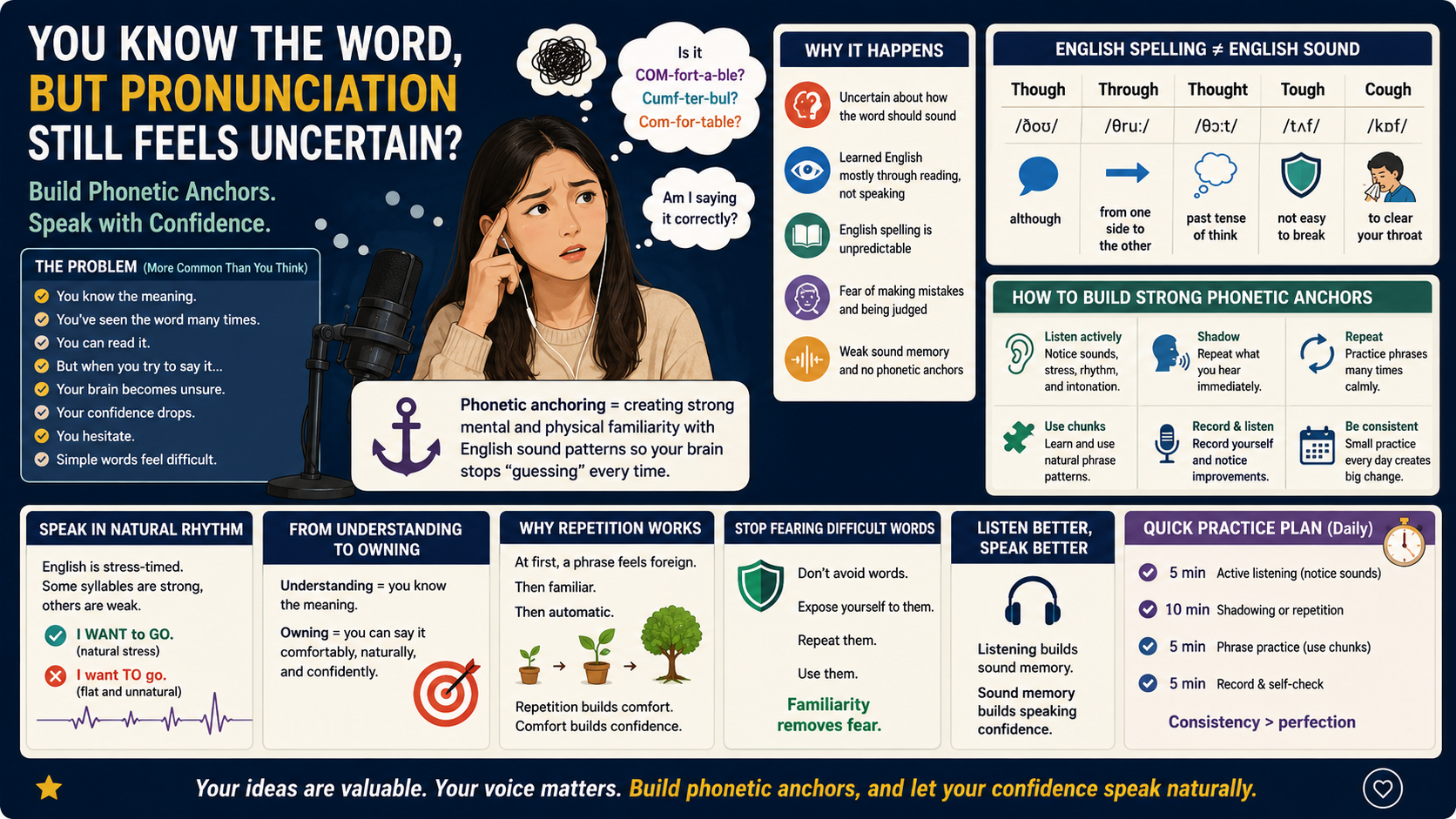
There is a very strange phenomenon that almost every English learner experiences at some point in their journey, but very few people actually know how to describe it properly, and even fewer people realize that it is completely normal. It happens in moments when a person who normally understands English quite well, who maybe even practices regularly, who maybe watches content, reads articles, and even speaks occasionally, suddenly enters a situation where their own voice does not sound like their own anymore. Not because their accent has completely disappeared in reality, but because in that exact moment their brain stops trusting their natural pronunciation memory and starts overthinking every single sound, every single word, every single syllable, and every single way they are supposed to “sound correct.”
And what makes this experience even more confusing is that it does not happen all the time. It happens randomly. Sometimes a learner can speak very smoothly alone in their room. Sometimes they can even speak confidently with friends or in casual situations. Sometimes they can record themselves and feel that they are doing reasonably well. But then suddenly, in a slightly different environment, maybe during a formal conversation, maybe during a meeting, maybe during a voice call, maybe in front of someone they consider “better” at English, or sometimes even in front of a complete stranger, their pronunciation suddenly feels unfamiliar to them.
They pause more than usual.
They become hyper-aware of their tongue movement.
They start thinking about whether their “th” sounds correct, whether their “r” is too strong, whether their vowels sound Indian, whether their sentences sound natural, whether their accent is noticeable, whether the listener is silently judging them, and in that moment, something very interesting happens inside the mind: the natural flow of speech breaks.
Not because the person forgot English.
But because they temporarily forgot their own speaking identity.
This is what I call Accent Amnesia.
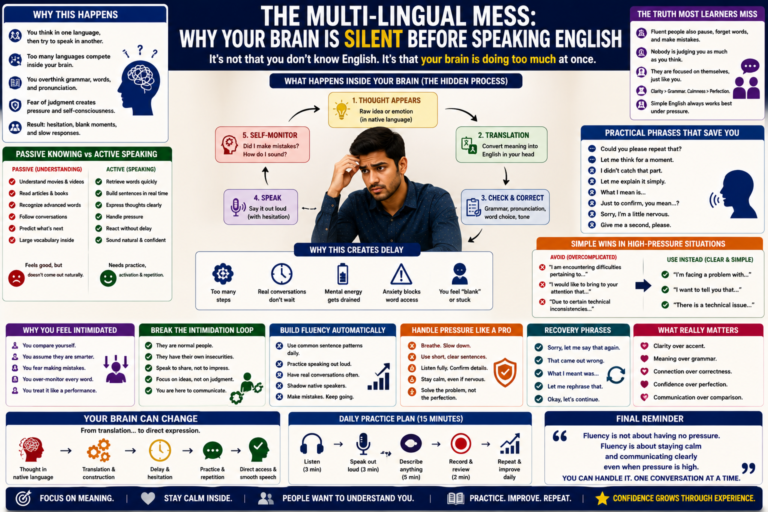
It is not a medical term, it is not a linguistic disorder, it is not something written in textbooks, but emotionally and psychologically it describes a very real experience that thousands and thousands of learners go through silently. It is the moment when your brain knows what you want to say, but suddenly forgets how you normally say it out loud in a natural rhythm. And instead of trusting your automatic speech system, your brain switches into a “manual control mode” where every word feels like it must be constructed carefully, almost like writing in real time, instead of speaking.
And this is where everything becomes mentally heavy.
Because speaking is supposed to be automatic.
But now it becomes conscious labor.
And conscious speech is always slower, more hesitant, and more fragile.
What makes Accent Amnesia even more emotionally intense is that it is deeply connected with identity insecurity. Many learners, especially in countries where English is not the first language, grow up with the idea that accent is not just about pronunciation, but about status, intelligence, education, and social perception. Over time, accent becomes emotionally loaded. It is no longer just a sound pattern. It becomes a representation of how “good” or “bad” you are at English in your own mind.
So when speaking situations arise, the brain does not only process language. It processes judgment possibilities. It starts imagining how the listener is interpreting you. It starts predicting reactions. It starts scanning for approval or disapproval. And in that mental environment, natural accent memory becomes unstable.
You do not forget English.
You forget ease.
You forget rhythm.
You forget your own voice pattern.
And instead of speaking, you start performing speech.
This is where many learners misunderstand themselves. They think, “My English is weak.” But that is not actually what is happening. Because the same person can often write perfect sentences, understand complex ideas, and even explain concepts clearly in their mind. The problem is not knowledge. The problem is retrieval under pressure. The brain has stored the language, but cannot smoothly access the “spoken version” of it because attention is divided between communication and self-monitoring.
And self-monitoring is the real enemy here.
Because the moment you start monitoring your accent while speaking, you stop actually speaking.
You start observing yourself speak.
And the moment you observe yourself too closely, natural flow collapses.
This is why many learners describe it like:
“I know English, but when I speak, I forget how I sound.”
“I feel like I lose my accent when I talk to people.”
“I start overthinking pronunciation.”
“I suddenly don’t know how to say simple words properly.”
And interestingly, this is not limited to beginners. Even intermediate and sometimes advanced learners experience this when they are under pressure or when they are in socially intimidating environments. Because Accent Amnesia is not about skill level alone. It is about psychological comfort with speaking identity.
Your brain has multiple layers of language memory. One layer is knowledge. Another layer is usage. Another layer is automatic speech patterns. And another layer is emotional confidence. When emotional confidence drops, automatic speech becomes unstable, even if knowledge remains intact.
This is why someone can say a sentence perfectly alone, but struggle to say the same sentence in a meeting.
It is not a language failure.
It is a confidence interruption.
And what makes this even more complex is that learners often try to “fix” it by focusing harder on pronunciation. But ironically, that makes the problem worse. Because pronunciation is not supposed to be controlled consciously in real-time conversation. It is supposed to be a background automatic system. When you bring it to the foreground of attention, it slows everything down.
This is similar to how walking works. You do not think about every step when you walk. If you suddenly start thinking about every muscle movement in your legs, walking becomes awkward. Speaking works the same way. Accent is supposed to be automatic. When it becomes manual, it feels unnatural.
And this is exactly what happens in Accent Amnesia moments.
Your brain stops trusting automation.
And starts overloading conscious control.
Another very important emotional layer here is comparison. When learners hear someone with a “better accent” or a more fluent-sounding voice, they unconsciously start evaluating themselves in real time. And this evaluation creates pressure. And pressure reduces fluency. And reduced fluency increases self-doubt. And self-doubt increases monitoring. And monitoring further damages natural accent flow.
It becomes a loop.
And most learners never realize they are stuck in that loop.
They think they “lost” their accent.
But actually, they are just mentally blocking it under pressure.
One of the most misunderstood truths about accent is that it is not something you switch on and off. Your accent is always there in your speech system. It is shaped by your language background, your exposure, your practice, your listening experience, and your muscle memory of speech. It does not disappear suddenly. What changes is access to it under psychological conditions.
When you are relaxed, access is smooth.
When you are anxious, access becomes fragmented.
And that fragmentation feels like “forgetting.”
But it is actually hesitation in retrieval.
And once you understand this distinction, everything becomes clearer emotionally. Because instead of thinking “I lose my accent when I speak,” you start realizing “my natural speech becomes blocked when I overthink.”
That small shift removes a lot of pressure.
Because now the problem is not identity.
The problem is condition.
And conditions can be changed.
Another thing that makes Accent Amnesia feel stronger is the desire to sound “perfect” or “neutral” or “native-like.” This desire creates internal tension. Because now every word is judged before it is spoken. Instead of speaking to communicate, learners start speaking to match an imagined standard. And that imagined standard becomes mentally heavy.
Real communication, however, is never about perfection. Even native speakers do not speak in perfect, uniform accents all the time. Their speech changes depending on mood, speed, emotion, and context. But learners often assume that fluent speakers have one fixed perfect sound that they maintain consistently. That belief increases self-pressure unnecessarily.
And pressure always interferes with natural speech memory.
This article will explore in detail how Accent Amnesia happens, why it feels so real, how psychological monitoring breaks natural speech flow, how comparison affects pronunciation confidence, why accent is more stable than it feels, how to rebuild natural speaking rhythm, and how to stop over-controlling your voice during conversations so that your natural communication identity can return.
Because honestly, the goal is not to “find a perfect accent.”
The goal is to stop forgetting your natural voice when you need it most.
Why Accent Amnesia Happens in Real Conversations
Accent Amnesia usually appears when cognitive load increases. When you are relaxed, speech flows automatically. But in real conversations, especially formal ones, your brain is already doing multiple tasks:
Understanding input
Planning response
Monitoring grammar
Tracking listener reaction
Managing anxiety
Controlling pronunciation
This overload reduces automatic speech access.
The Role of Self-Monitoring in Accent Loss
Self-monitoring is when you start listening to yourself too much while speaking. Instead of focusing on meaning, you start focusing on sound accuracy. This shifts attention inward instead of outward.
And speech becomes unnatural.
Why Your Accent Feels “Different” Under Pressure
Your accent does not change. Your delivery system changes. Stress modifies rhythm, speed, and breath control. That is why your voice feels unfamiliar to you in high-pressure moments.
The Comparison Trap
When you hear fluent speakers, your brain starts benchmarking your speech in real time. This creates anxiety loops that interrupt natural pronunciation flow.
My Opinion: Accent Stability Comes From Mental Calmness
In my experience, accent clarity improves not when learners focus harder on pronunciation, but when they stop overthinking it during speech. Calm minds automatically retrieve natural speech patterns more efficiently.
How to Restore Natural Accent Flow
Stop correcting yourself mid-sentence. Focus on meaning first. Let pronunciation follow naturally instead of forcing it consciously.
Why Trying to Sound “Perfect” Backfires
Perfection mindset creates hesitation. Hesitation destroys rhythm. And rhythm is the foundation of natural accent flow.
CONCLUSION
Accent Amnesia is not a language failure. It is a psychological interruption in natural speech access. Once learners stop over-monitoring themselves and stop fearing judgment, their natural accent flow begins to return automatically. Communication becomes smoother, lighter, and more natural again.
And the biggest realization is simple:
You are not forgetting your accent.
You are just blocking it by thinking too much while speaking.