The Medical Pronunciation Panic: How to Explain Physical Symptoms to a Doctor in English Clearly Without Memorizing Textbook Vocabulary or Freezing Under Stress
One of the most important real-life English communication skills is the ability to explain your physical symptoms clearly and accurately to a doctor. Honestly, this is not just a language skill anymore. It is a life skill. In many situations, especially during illness, pain, injury, stress, weakness, fever, infection, breathing problems, or medical emergencies, communication becomes emotionally difficult very quickly. Even native English speakers sometimes struggle to explain symptoms properly because pain itself affects thinking, memory, focus, and emotional control. When English is not your first language, the pressure becomes even heavier because now your brain is trying to manage fear, discomfort, embarrassment, listening comprehension, vocabulary, pronunciation, memory, and communication all at the same time.
Many English learners become deeply nervous before doctor appointments. Some people rehearse sentences repeatedly in their mind before entering the clinic. Others search symptoms online for hours because they are afraid of misunderstanding during the appointment itself. Many people silently worry:
- “What if I explain the wrong symptom?”
- “What if the doctor misunderstands me?”
- “What if I forget important details?”
- “What if my English becomes confusing under stress?”
- “What if I panic during the appointment?”
- “What if I don’t understand the doctor’s questions?”
- “What if I use the wrong medical words?”
- “What if I sound foolish or uneducated?”
These fears are completely understandable because medical communication naturally feels emotionally serious. Unlike casual conversations about movies, travel, or hobbies, health conversations feel high-pressure because the topic directly affects your body, comfort, safety, and sometimes even your future. You may already feel physically exhausted before the conversation even begins. You may be:
- sleep deprived
- anxious
- dizzy
- uncomfortable
- emotionally stressed
- worried about diagnosis
- afraid of bad news
- in physical pain
Under stress, even simple English sometimes feels difficult.
One thing many English learners misunderstand is believing they need advanced medical vocabulary to communicate effectively with doctors. Honestly, this is usually not true. Many successful doctor-patient conversations rely on surprisingly simple English. Doctors generally care much more about:
- clear details
- accurate timing
- symptom patterns
- severity
- honesty
than complicated vocabulary.
The real goal is NOT sounding medically sophisticated.
The real goal is communicating symptoms:
- clearly
- calmly
- accurately
- specifically
- logically
For example, compare these two explanations carefully.
Vague Version
“My stomach hurts.”
Precise Version
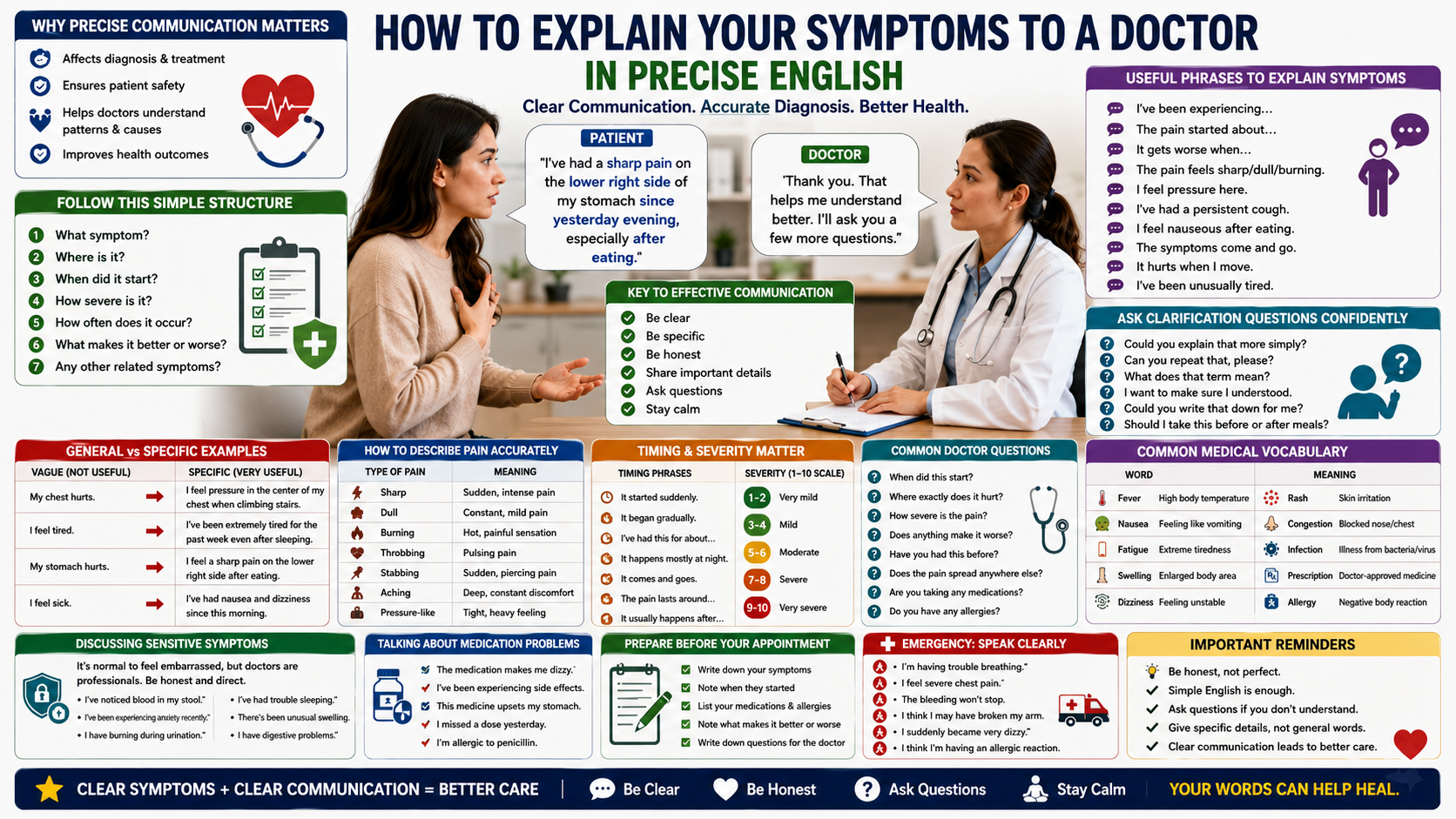
“I’ve had a sharp pain on the lower right side of my stomach since yesterday evening, especially after eating.”
The second version gives much more useful medical information even though the English is still relatively simple.
This is why precision matters more than complexity.
Doctors often need practical information like:
- where the pain is
- when it started
- how severe it feels
- what makes it worse
- what makes it better
- how often it happens
- whether symptoms are improving or worsening
Unfortunately, many learners become either:
- too vague
- too emotional
- too disorganized
during medical conversations.
Some people simply say:
“I feel bad.”
But medically, “bad” can mean hundreds of different things.
Meanwhile other patients panic and start speaking rapidly:
“My head hurts and yesterday I couldn’t sleep and maybe fever and also stomach problem and I don’t know…”
This creates confusion because the information becomes emotionally chaotic instead of structured.
Strong medical communication usually follows a simple logical structure:
- What symptom?
- Where?
- When?
- How severe?
- How often?
- What additional details?
Another challenge many learners face is embarrassment.
Some symptoms involve sensitive topics like:
- digestion
- bowel movements
- mental health
- sexual health
- body odor
- reproductive health
- skin conditions
- urinary problems
People often feel uncomfortable discussing these topics even in their native language.
In English, embarrassment sometimes becomes even stronger because learners fear:
- sounding awkward
- using wrong words
- sounding inappropriate
- misunderstanding medical questions
But honestly, doctors discuss these issues professionally every single day.
Medical professionals are trained to hear uncomfortable information calmly and objectively.
Their priority is understanding symptoms accurately, not judging your English mistakes.
Another important reality is that real-life medical English is often much simpler than textbook medical terminology.
Many learners imagine they need advanced words like:
- gastrointestinal discomfort
- cephalalgia
- hypertension
- dermatological irritation
But in real life, doctors often communicate with patients using normal practical English like:
- headache
- sore throat
- dizziness
- swelling
- coughing
- pressure
- nausea
- fatigue
- burning sensation
- chest pain
Simple clear descriptions are usually far more effective than complicated vocabulary used incorrectly.
One major problem during doctor appointments is lack of specificity.
Doctors usually need measurable information instead of general emotional descriptions.
For example:
“My pain is really bad.”
is less useful medically than:
“The pain feels sharp and comes every few minutes.”
Or:
“I’ve had a fever for three days.”
is clearer than:
“I’ve been sick for a while.”
Specificity helps doctors identify patterns and possible causes more effectively.
Another thing that surprises many English learners is that doctors often ask repetitive questions intentionally.
Some patients become nervous thinking:
“Why are they asking the same thing again?”
But doctors often repeat or rephrase questions because accurate understanding matters heavily in medicine.
They may ask:
- “When exactly did this begin?”
- “How severe is the pain?”
- “Does anything trigger it?”
- “Have you experienced this before?”
- “Does the pain spread anywhere else?”
These questions help create a clearer medical picture.
Interestingly, one of the biggest communication mistakes patients make is minimizing symptoms too much.
Some people feel uncomfortable “complaining” and say:
- “It’s probably nothing.”
- “Maybe I’m overreacting.”
- “It’s not that serious.”
even when symptoms strongly affect daily life.
Strong medical communication means being:
- honest
- accurate
- clear
—not dramatic and not dismissive.
Another challenge in English medical conversations is understanding the doctor’s explanations.
Sometimes doctors:
- speak quickly
- use unfamiliar terminology
- explain medications rapidly
- give instructions quickly
Many learners become embarrassed asking questions because they fear sounding unintelligent.
But honestly?
Asking clarification questions is extremely important in healthcare.
Useful phrases include:
- “Could you explain that more simply?”
- “Can you repeat that please?”
- “I just want to make sure I understood correctly.”
- “What does that term mean?”
- “Could you write that down for me?”
Medical communication should prioritize understanding, not pride.
This guide is going to explore:
- how to explain symptoms clearly in English
- how to describe pain accurately
- how to organize medical information logically
- how to discuss sensitive symptoms professionally
- how to ask clarification questions confidently
- how to understand common medical English
- how to communicate during emergencies calmly
- how to reduce anxiety during doctor appointments
Most importantly, we are going to approach this like real-world human communication instead of memorizing robotic textbook vocabulary.
Because honestly?
The ability to explain your health clearly may become one of the most important communication skills you ever use in life.
Why Precise Communication Matters in Medical Situations
Medical communication directly affects:
- diagnosis
- treatment
- understanding
- medication
- patient safety
If symptoms are explained vaguely, confusion happens easily.
For example:
“I feel weird.”
gives very little useful medical information.
Meanwhile:
“I feel dizzy whenever I stand up quickly.”
gives clearer direction immediately.
Doctors often rely heavily on patient descriptions because symptoms themselves provide important clues.
The clearer the communication, the easier accurate understanding becomes.
Understanding the Difference Between General and Specific Symptoms
Many learners describe symptoms too generally.
| General Description | Specific Description |
|---|---|
| “My chest hurts.” | “I feel pressure in the center of my chest when climbing stairs.” |
| “I feel tired.” | “I’ve been extremely fatigued for the past week even after sleeping.” |
| “My stomach hurts.” | “I feel a sharp pain on the lower right side after eating.” |
| “I feel sick.” | “I’ve had nausea and dizziness since this morning.” |
Specificity improves medical communication dramatically.
Practical English Phrases for Explaining Symptoms
Useful phrases include:
- “I’ve been experiencing…”
- “The pain started about three days ago.”
- “It gets worse at night.”
- “The pain feels sharp/dull/burning.”
- “I feel pressure here.”
- “I’ve had a persistent cough.”
- “I feel nauseous after eating.”
- “I’ve been unusually tired.”
- “The symptoms come and go.”
- “It hurts when I move.”
These phrases sound:
- natural
- medically useful
- clear
- professional
How to Describe Pain Accurately
Doctors often ask about:
- location
- severity
- frequency
- type of pain
Common pain descriptions include:
| Pain Type | Meaning |
|---|---|
| Sharp | Sudden intense pain |
| Dull | Constant mild pain |
| Burning | Hot painful sensation |
| Throbbing | Pulsing pain |
| Stabbing | Sudden piercing pain |
| Aching | Deep constant discomfort |
| Pressure-like | Tight heavy feeling |
Examples:
- “It feels like a dull ache in my lower back.”
- “There’s a sharp pain near my shoulder.”
- “I feel burning in my chest after eating.”
These descriptions help doctors understand symptoms better.
How to Explain Symptom Timing Clearly
Timing is extremely important medically.
Useful phrases:
- “It started suddenly.”
- “It began gradually.”
- “I’ve had this for about a week.”
- “The symptoms are getting worse.”
- “It happens mostly at night.”
- “It comes and goes.”
- “The pain lasts around ten minutes.”
- “It usually happens after meals.”
These details help identify patterns.
How to Discuss Severity Naturally
Doctors often ask:
“How bad is the pain from 1 to 10?”
You can answer:
- “Around a 3.”
- “Probably a 7 when it gets severe.”
- “It’s mild but constant.”
- “It becomes much worse at night.”
- “The pain is manageable during the day.”
This helps communicate intensity accurately.
Realistic Doctor Conversation Example
Patient
“I’ve had a sore throat and fever since Monday.”
Doctor
“Have you experienced coughing as well?”
Patient
“Yes, especially during the night.”
Doctor
“Does swallowing feel painful?”
Patient
“Yes, it hurts whenever I eat or drink.”
Simple.
Natural.
Medically useful.
How to Talk About Sensitive Symptoms Professionally
Many people feel embarrassed discussing:
- bowel movements
- digestion
- anxiety
- reproductive health
- urinary issues
But doctors discuss these topics professionally every day.
Simple calm communication works best.
Examples:
- “I’ve noticed blood in my stool.”
- “I’ve been experiencing anxiety recently.”
- “I’ve had trouble sleeping.”
- “There’s been unusual swelling.”
- “I feel burning during urination.”
No need for shame or dramatic wording.
My Opinion
Honestly, many learners try too hard to sound “medically advanced.”
But simple precise English usually works much better.
Doctors care more about:
- accuracy
- timing
- symptom details
than impressive vocabulary.
For example:
“I feel short of breath after climbing stairs.”
is much more useful than trying complicated medical terminology incorrectly.
Clear communication matters more than sounding academic.
How to Ask Clarification Questions
If you do not understand the doctor, ask calmly.
Useful phrases:
- “Could you explain that again?”
- “What does that mean exactly?”
- “Can you say that more simply?”
- “I want to make sure I understood.”
- “Could you repeat the medication instructions?”
- “Should I take this before or after meals?”
Understanding matters more than pretending.
How to Prepare Before a Doctor Appointment
Preparation reduces anxiety significantly.
Before appointments, it helps to note:
- symptoms
- timing
- medications
- allergies
- recent changes
- questions
This helps communication stay organized instead of emotional and chaotic.
Symptom Notes Table
| Symptom | When It Started | Severity | Triggers |
|---|---|---|---|
| Headache | 3 days ago | Moderate | Bright lights |
| Fever | Yesterday | Mild | Constant |
| Cough | 2 weeks ago | Severe at night | Cold air |
| Chest Pressure | 1 week ago | Moderate | Exercise |
Organized information improves communication quality dramatically.
How to Handle Emergency Communication
During emergencies, communication becomes even more important.
Useful emergency phrases:
- “I’m having trouble breathing.”
- “I feel severe chest pain.”
- “I think I may have broken my arm.”
- “The bleeding won’t stop.”
- “I suddenly became dizzy.”
- “I think I’m having an allergic reaction.”
Clear direct communication matters heavily in emergencies.
Understanding Common Doctor Questions
Doctors often ask predictable questions.
| Doctor Question | Purpose |
|---|---|
| “When did this start?” | Timing |
| “Where exactly does it hurt?” | Location |
| “How severe is the pain?” | Intensity |
| “Does anything make it worse?” | Triggers |
| “Have you had this before?” | Medical history |
| “Are you taking any medications?” | Treatment safety |
Recognizing these patterns reduces anxiety.
How to Stay Calm During Medical Conversations
Stress often affects communication badly.
Some patients:
- forget details
- speak too quickly
- jump between symptoms randomly
Try slowing down mentally and focusing on:
- What happened
- When it started
- Where it hurts
- How severe it feels
Simple organized communication usually works best.
Common Medical Vocabulary Table
| Word | Meaning |
|---|---|
| Fever | High body temperature |
| Nausea | Feeling like vomiting |
| Fatigue | Extreme tiredness |
| Swelling | Enlarged body area |
| Dizziness | Feeling unstable |
| Rash | Skin irritation |
| Congestion | Blocked nose/chest |
| Infection | Illness from bacteria/virus |
| Prescription | Doctor-approved medicine |
| Allergy | Negative body reaction |
These practical words cover many medical situations.
Common Mistakes During Doctor Conversations
Mistake 1: Being Too Vague
“I feel strange.”
Too unclear.
Mistake 2: Minimizing Symptoms
“It’s probably nothing.”
Even when symptoms are serious.
Mistake 3: Pretending to Understand
Always ask clarification questions if confused.
Mistake 4: Jumping Randomly Between Symptoms
Structured communication improves understanding.
How to Sound More Natural During Appointments
Natural conversational phrases include:
- “Honestly, it’s been getting worse.”
- “I wasn’t too worried initially.”
- “It started pretty suddenly.”
- “I’ve never experienced this before.”
- “It feels worse after eating.”
- “That’s when I started noticing it.”
These expressions sound realistic and human.
Health Conversations in English
Mental health discussions can feel emotionally difficult.
Useful phrases include:
- “I’ve been feeling anxious lately.”
- “I’ve had trouble sleeping.”
- “I feel emotionally exhausted.”
- “I’ve been struggling with stress.”
- “I feel overwhelmed most days.”
Simple honest communication works best.
How to Discuss Medication Problems
Useful phrases:
- “The medication makes me dizzy.”
- “I’ve been experiencing side effects.”
- “This medicine upsets my stomach.”
- “I missed a dose yesterday.”
- “I’m allergic to penicillin.”
Medication communication should always be clear and accurate.
FAQs
Do I need advanced medical vocabulary?
No. Simple clear English is usually much more effective.
What is the biggest medical communication mistake?
Usually being too vague about symptoms.
How can I explain pain clearly?
Describe:
- location
- type
- severity
- timing
- triggers
Is it okay to ask doctors to repeat themselves?
Absolutely. Understanding medical information is extremely important.
How can I reduce nervousness during appointments?
Prepare symptom details beforehand and focus on simple explanations.
What if I forget English words?
Use simpler descriptions. Clarity matters more than advanced vocabulary.
Should I mention small symptoms too?
Yes, especially if related to the main issue.
How do I discuss embarrassing symptoms?
Calmly and directly. Doctors handle sensitive topics professionally every day.
Why do doctors ask repetitive questions?
Because accurate medical understanding requires confirmation.
What is the most important medical communication skill?
Clear specific symptom explanation.
Conclusion
Explaining symptoms to a doctor in precise English is one of the most valuable real-world communication skills because health situations require:
- clarity
- accuracy
- understanding
- honesty
During medical conversations, the goal is NOT sounding academically impressive or using complicated medical terminology.
The goal is helping healthcare professionals understand your condition clearly enough to support you properly.
The good news is that effective medical English is often much simpler than learners imagine.
Most successful doctor-patient conversations rely on:
- clear symptom descriptions
- specific timing
- pain explanation
- honest communication
- clarification questions
Strong medical communication focuses on precision, not perfection.
And honestly, once learners stop trying to sound “medically advanced,” communication usually improves dramatically.
Simple organized explanations often work far better than complicated vocabulary used nervously or incorrectly.
Over time, as you practice describing symptoms more clearly, your confidence grows naturally.
You stop panicking about finding perfect words.
You stop feeling embarrassed asking questions.
You stop minimizing important symptoms out of nervousness.
Instead, communication becomes:
- calmer
- clearer
- more structured
- more effective
That clarity can make an enormous difference during some of the most important conversations of your life.