English Under Pressure: Why Your Fluency Disappears When Stress Enters and How to Handle Brain Freeze
There is a huge difference between speaking English comfortably and speaking English under pressure, but honestly, most learners do not fully realize this in the beginning. A person may understand movies, watch interviews, read articles, type messages confidently, and even hold normal conversations without major problems, but the moment stress enters the situation, everything suddenly changes emotionally. The brain becomes noisy. Thoughts become scattered. Listening becomes harder. Simple words disappear unexpectedly. Sentences that normally feel easy suddenly feel difficult. And many learners become deeply frustrated during these moments because they start believing their English ability was never real in the first place. They think their fluency was fake. They think they are “not good at English.” But honestly, in many cases, the real problem is not English itself. The real problem is pressure.
And this distinction matters enormously because high-stress English is psychologically very different from relaxed English. During calm situations, the brain has time to think slowly, organize ideas, remember vocabulary, and process conversations comfortably. But stressful situations completely change the emotional environment inside the mind. Suddenly communication no longer feels casual. It feels important. It feels urgent. It feels risky. And once the brain starts treating communication like danger, fluency often changes dramatically.
This is why many English learners experience strange emotional contradictions. They may speak naturally while practicing alone in their room, but freeze during job interviews. They may communicate confidently through text messages, but panic during live calls. They may understand almost everything in YouTube videos, but suddenly struggle understanding a support agent during an urgent banking issue. They may explain ideas comfortably to friends, but forget basic vocabulary while presenting during meetings.
And honestly, these experiences create enormous self-doubt because learners often compare their stressed performance against their calm performance without understanding how heavily emotion affects communication. They think: “Why am I forgetting everything?” “Why does my brain stop working?” “Why can’t I think clearly?” “Why does my English disappear during pressure situations?”
But the important thing to understand is this: stressful communication changes the brain for almost everyone. Even native speakers sometimes struggle speaking clearly during emotionally intense moments. People forget words. They restart sentences. They lose concentration. They speak too fast. They misunderstand things. They panic slightly. That is normal human psychology. Now imagine experiencing all of that while also operating in a second language. Of course it feels difficult sometimes.
Actually, one of the biggest hidden problems in traditional English education is that learners are rarely trained for emotional communication. Most English learning environments focus heavily on controlled situations: grammar exercises, prepared speeches, textbook conversations, written tests, memorized vocabulary, and structured classroom responses. But real life often works very differently. Real communication is emotional, unpredictable, messy, and dynamic. Sometimes people interrupt you unexpectedly. Sometimes conversations move too fast. Sometimes emotions become intense. Sometimes misunderstandings happen. Sometimes pressure suddenly appears without warning.
And modern life creates these situations constantly.
A freelancer suddenly loses internet during an important international meeting and now must explain the issue quickly in English while feeling stressed internally.
A traveler misses a connecting flight and must suddenly speak with airport staff while tired, frustrated, and overwhelmed.
A job seeker attends an interview where the interviewer unexpectedly changes topics rapidly and asks difficult questions.
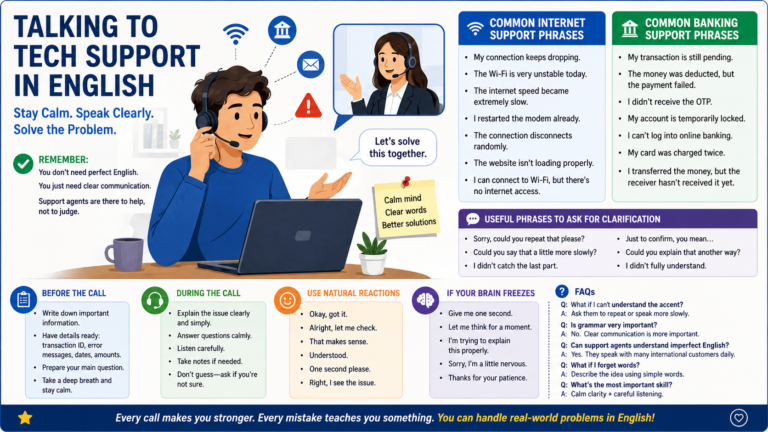
A customer discovers unauthorized activity inside a bank account and must contact support immediately.
A developer must explain a production issue to international clients while the entire team waits for answers.
A student attends a visa interview where every answer suddenly feels emotionally important.
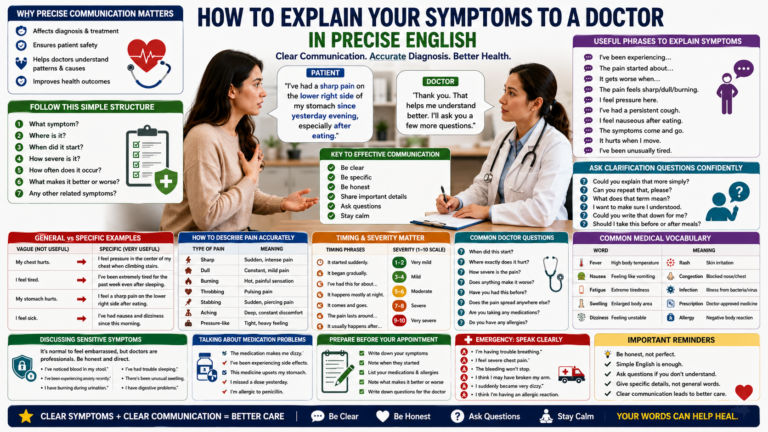
A patient tries to explain symptoms during a medical emergency in another country.
A professional receives unexpected criticism during a meeting and must respond calmly in English without sounding emotional.
These situations are psychologically different from normal English practice because the emotional stakes feel real. And once emotions become intense, language access often changes.
This is something many learners misunderstand deeply. They assume communication ability should remain perfectly stable all the time. But human communication has always been emotional. Stress affects memory, concentration, listening, confidence, and processing speed. This is why people often struggle even in their native language during high-pressure moments. Sometimes someone becomes angry and suddenly cannot explain themselves clearly. Sometimes nervousness causes people to forget obvious information. Sometimes anxiety makes listening harder. Sometimes panic causes people to speak too quickly and confuse themselves further.
That is not stupidity.
That is nervous system overload.
And honestly, many English learners become much calmer once they understand this psychologically because they stop treating stressful speaking moments as proof of permanent failure. Instead, they begin understanding something important: communication under pressure is its own separate skill.
That realization changes everything.
Because once learners understand this, they stop obsessing only over grammar and vocabulary and begin focusing on emotional communication ability too. They begin realizing that surviving stressful conversations calmly matters more than sounding academically perfect.
Actually, one of the most interesting things about high-stress communication is that simplicity becomes more powerful during pressure. Many learners accidentally make communication harder because they panic internally and start trying too hard to sound “professional” or “advanced.” Their sentences become overly complicated because they believe sophisticated English sounds more intelligent during important situations.
But real professionals usually communicate more simply during pressure.
Think about doctors during emergencies.
Think about pilots during technical issues.
Think about customer support teams handling urgent problems.
Think about managers during crises.
Think about technical teams during outages.
Their communication usually becomes shorter, clearer, and more direct.
Why?
Because clarity matters more than elegance when pressure increases.
For example, many nervous learners might say something like:
“I am currently encountering difficulties associated with my financial transactional accessibility.”
But calm real-world communication usually sounds more like:
“My payment failed and the money was deducted.”
Simple communication works better because stressed brains process simple information faster.
And honestly, this is one of the biggest mindset shifts learners need. Communication during stressful situations is not about performance. It is about functionality.
That difference matters enormously psychologically.
A lot of learners secretly approach stressful English situations like exams. They feel as if every sentence is being judged. They become hyperaware of grammar mistakes. They over-monitor pronunciation. They panic about vocabulary. And because of this, their brain becomes overloaded very quickly.
Meanwhile, strong communicators often focus on something much simpler: solving the situation.
That calm problem-solving mindset changes communication completely.
Another important thing many learners need to hear is this: support agents, interviewers, international clients, doctors, airport staff, and global professionals already communicate with people from different language backgrounds constantly. Different accents are normal. Different speaking styles are normal. Imperfect English is normal. Most people are not expecting movie-level fluency during stressful real-life situations.
What usually matters more is whether communication remains understandable and emotionally manageable.
Can you explain the problem clearly?
Can you ask questions calmly?
Can you clarify misunderstandings?
Can you follow instructions carefully?
Can you stay respectful under pressure?
Those things matter far more in real life than flawless grammar.
And honestly, one of the biggest emotional breakthroughs many learners eventually experience is realizing that communication can still succeed even when English is imperfect.
That realization reduces fear dramatically.
Because fear itself often creates half the communication problem.
Many learners mentally panic before stressful conversations even begin. Their brain starts imagining disaster scenarios:
“What if I don’t understand the accent?”
“What if I freeze?”
“What if they ask unexpected questions?”
“What if I sound stupid?”
“What if I cannot explain the issue properly?”
“What if my grammar becomes embarrassing?”
These thoughts activate stress before the conversation even starts.
Then once the interaction begins, the nervous system is already overloaded.
Actually, one of the biggest reasons learners struggle during high-pressure English situations is not lack of knowledge but excessive self-monitoring. They are trying to simultaneously:
listen carefully,
translate mentally,
build correct grammar,
monitor pronunciation,
manage nervousness,
predict judgment,
and solve the actual real-world problem.
That is a massive amount of mental pressure.
Especially in live conversations where responses happen quickly.
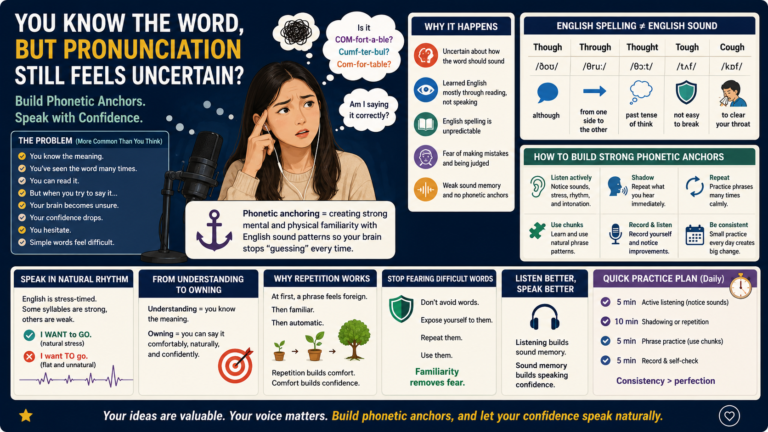
This is why many learners suddenly experience “brain freeze” moments where they know the idea internally but cannot access the English words smoothly enough under pressure.
And honestly, this experience is incredibly common.
Even highly intelligent professionals experience it.
Developers.
Designers.
Freelancers.
Managers.
Students.
Engineers.
Writers.
Doctors.
Almost everybody who communicates internationally experiences stressful language moments sometimes.
But thankfully, this skill improves much faster once people stop chasing perfection and start training emotional communication resilience instead.
Because confidence during high-stress English situations usually develops through repeated exposure, not through waiting to magically become fearless.
People become calmer after surviving difficult conversations repeatedly.
That is how the nervous system learns safety.
Every stressful conversation that you survive teaches your brain something important:
“I can handle this situation.”
And slowly, pressure starts feeling less dangerous.
You stop panicking as quickly.
You recover from mistakes faster.
You ask for clarification more comfortably.
You stop treating every small misunderstanding like disaster.
You stop expecting perfect performance from yourself constantly.
Instead, communication begins feeling more human.
More manageable.
More realistic.
And honestly, one of the strongest communication habits people can develop during stressful situations is learning how to slow down mentally.
Nervous learners often speak too fast because anxiety creates urgency internally. They think fast speaking sounds fluent. But under stress, speed usually damages clarity. Strong communicators often do the opposite. They slow down slightly. They pause intentionally. They simplify sentences. They focus on calmness instead of performance.
That calmness changes how people experience you professionally.
Actually, calm communicators often sound more trustworthy even with simpler English because emotional steadiness creates confidence psychologically.
And this matters enormously in modern global life because stressful English situations are becoming increasingly common.
Remote work.
International freelancing.
Global customer support.
Online banking.
International travel.
Video meetings.
Cross-border collaboration.
Digital business.
All of these systems constantly create real-world communication pressure.
Which means learning how to communicate under stress is no longer some rare advanced skill.
It is practical modern survival communication.
And honestly, one of the most empowering realizations learners eventually experience is this:
You do not need perfect English to survive difficult situations successfully.
You need understandable English.
You need emotional calmness.
You need practical communication tools.
You need the ability to continue communicating even while nervous.
That is real confidence.
Not the absence of fear.
The ability to function despite fear.
This article is going to explore all of this deeply. We are going to talk about why stressful situations affect English differently, how pressure changes the brain during communication, how to survive interviews more calmly, how to explain emergencies clearly, how to communicate during technical problems, how to handle angry conversations professionally, how to ask for clarification without embarrassment, how to recover after mistakes naturally, how to stop freezing mentally during pressure situations, and how to build real emotional communication resilience in English.
Most importantly, we are going to approach this like real life instead of textbook fantasy.
Because honestly, the goal is not sounding like a perfect English robot during stressful moments.
The goal is staying calm enough to communicate clearly when life becomes difficult.
And that skill can completely change how confidently you move through the modern world.
Why Stress Changes Your English Completely
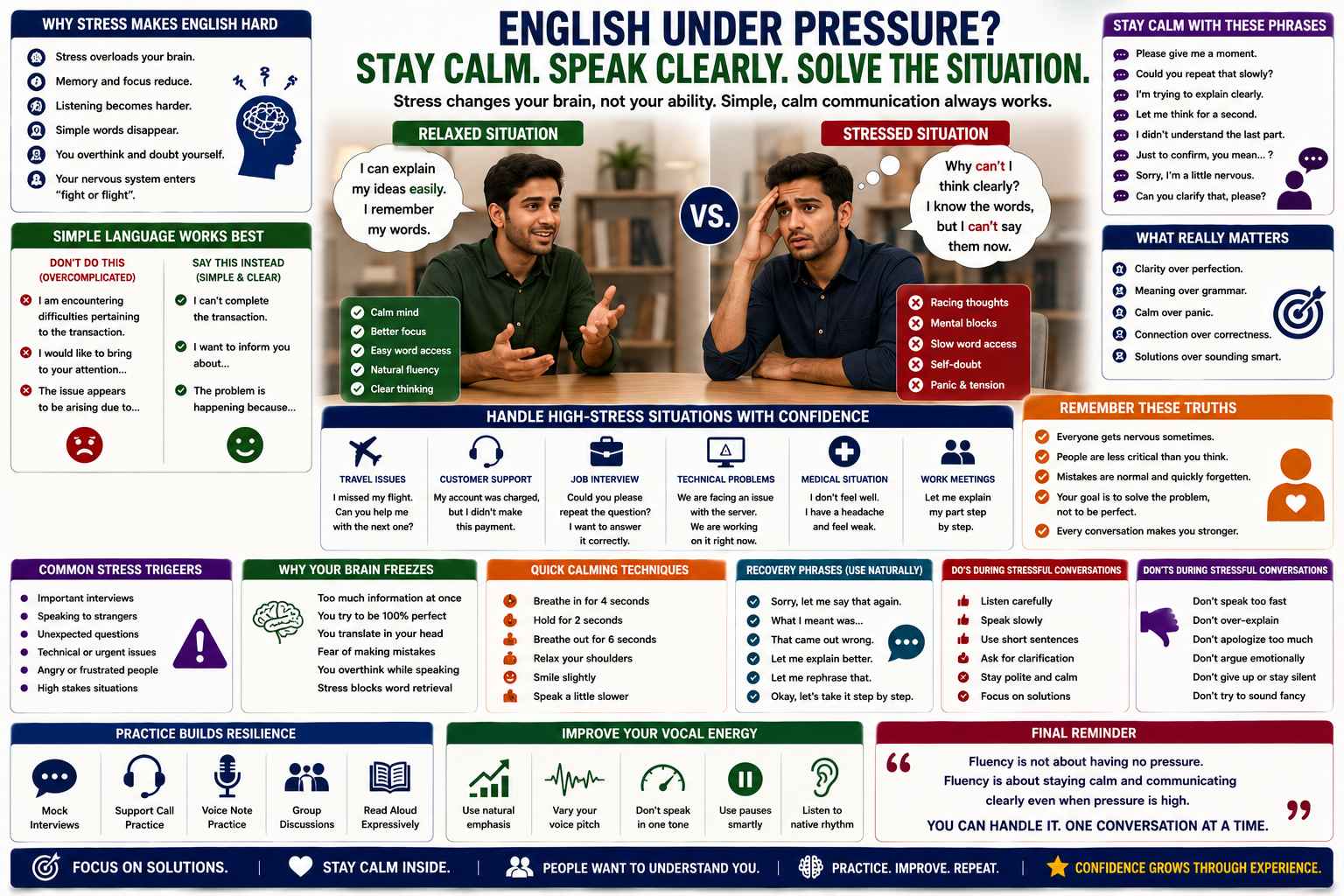
One of the biggest misconceptions learners have is believing fluency should feel identical in every emotional situation. But human communication has never worked that way. Stress changes the brain dramatically. Under pressure, the nervous system prioritizes emotional survival instead of relaxed language organization. That affects memory access, concentration, listening ability, pronunciation, sentence structure, and confidence simultaneously.
This is why learners often say things like:
“I forgot everything suddenly.”
“My mind went blank.”
“I know the word but I can’t remember it.”
Actually, the language knowledge usually still exists. The problem is temporary stress overload.
Understanding this psychologically reduces panic enormously because learners stop treating stressful communication moments as proof that they are “bad at English.”
Common High-Stress English Situations
Modern life constantly creates pressure-based communication situations.
Examples include:
job interviews,
visa interviews,
airport problems,
customer complaints,
technical emergencies,
medical conversations,
public speaking,
banking issues,
urgent client meetings,
internet failures,
online scams,
unexpected questions,
or difficult workplace discussions.
These situations feel emotionally intense because consequences matter.
And once emotional pressure increases, fluency often changes too.
Why Simplicity Works Better Under Pressure
Many learners accidentally make communication harder by trying too hard to sound advanced during stressful moments.
But honestly, simple communication is much more effective during pressure.
For example:
Complicated:
“I am encountering irregularities pertaining to account accessibility.”
Simple:
“I can’t access my account.”
Simple language reduces mental pressure for both people.
And clarity usually solves problems faster.
Practical English Phrases for Stressful Situations
Useful communication phrases create emotional stability.
Examples:
“Please give me a moment.”
“Could you repeat that slowly?”
“I’m trying to explain clearly.”
“Sorry, I’m a little nervous.”
“Let me think for a second.”
“I didn’t understand the last part.”
“Could you clarify that?”
“Let me confirm I understood correctly.”
These phrases buy thinking time naturally and reduce conversational pressure.
My Opinion: Emotional Control Matters More Than Perfect Grammar
Honestly, I think emotional regulation is one of the most underrated English communication skills.
Many learners obsess over grammar perfection while completely ignoring emotional communication habits.
But during stressful situations, calmness often matters much more than perfect sentence structure.
A calm communicator with imperfect grammar usually sounds more trustworthy than a panicking communicator using advanced vocabulary.
Because communication is psychological first.
And emotionally stable communication creates clarity automatically.
How to Stop Freezing During Pressure Situations
Freezing usually happens because the brain becomes overloaded.
The learner is simultaneously:
thinking,
translating,
monitoring grammar,
managing nervousness,
predicting judgment,
and trying to respond instantly.
That creates mental overload.
One helpful strategy is simplifying communication mentally.
Focus on meaning first.
Not perfection.
Short clear sentences work surprisingly well during stressful moments.
Why Listening Becomes Harder Under Stress
Stress affects listening ability too.
Many learners think only speaking becomes difficult, but concentration weakens heavily during pressure.
People miss instructions.
Forget details.
Lose focus halfway through explanations.
This is normal.
One extremely useful communication habit is confirming information calmly.
For example:
“Just to confirm, the meeting is tomorrow at 4 PM?”
“Let me make sure I understood correctly.”
These habits reduce misunderstandings significantly.
How to Handle Angry Conversations Professionally
Angry or frustrated conversations are emotionally difficult for many learners.
Especially customer complaints, workplace conflicts, or urgent technical situations.
The key is staying solution-focused instead of emotionally reactive.
Useful phrases include:
“I understand your frustration.”
“Let’s solve this step by step.”
“I’m trying to help.”
“I understand the concern.”
“Let me look into this.”
Calm communication reduces emotional tension quickly.
Why Speaking More Slowly Sounds More Professional
Many nervous learners speak too fast because anxiety creates urgency internally.
But fast speech often reduces clarity.
Strong communicators usually speak more deliberately during pressure situations.
That gives the brain more processing time and improves sentence quality naturally.
And honestly, calmer speech usually sounds more confident too.
How to Recover Naturally After Mistakes
Many learners panic after making one small mistake.
Then mentally they remain stuck replaying the mistake while the conversation continues.
But real communication moves forward quickly.
Useful recovery phrases include:
“Sorry, let me say that again.”
“That came out wrong.”
“What I meant was…”
Simple recovery habits improve conversational resilience enormously.
FAQs
Why does my English disappear during stressful situations?
Usually because stress overload affects memory access and processing speed temporarily. Your English knowledge normally still exists.
Is it normal to freeze during interviews or emergencies?
Absolutely. High-pressure situations affect communication for many people, including native speakers.
FAQ 3: How can I stay calmer while speaking English under pressure?
Slow down slightly, focus on breathing, and use shorter simpler sentences.
Should I use advanced vocabulary during stressful conversations?
Usually no. Clear simple communication works much better under pressure.
Why do I understand English but struggle responding quickly?
Because listening and speaking are different mental skills. Stress slows sentence-building temporarily.
What if I completely forget important vocabulary?
Describe the idea using simpler words. Communication is about meaning, not perfect vocabulary recall.
How can I improve high-stress English specifically?
Practice realistic situations repeatedly:
mock interviews,
support calls,
urgent conversations,
or difficult discussions.
Repeated exposure builds emotional comfort.
Is accent important during stressful situations?
Clarity matters far more than accent perfection.
How do professionals stay calm during difficult conversations?
Usually through repeated experience, emotional regulation, preparation, and exposure.
What is the most important communication skill during stressful situations?
Probably emotional calmness combined with simple clear communication.
CONCLUSION
English for high-stress situations feels difficult because pressure changes communication psychologically.
But honestly, many learners become unnecessarily discouraged because they mistake stress reactions for permanent language failure.
The truth is much simpler.
Human beings communicate differently under pressure.
That is normal.
The important thing is not becoming perfectly fearless.
The important thing is learning how to continue communicating even while nervous.
That is real confidence.
Because successful communication during stressful moments usually depends on:
clarity,
calmness,
simple language,
careful listening,
and emotional control.
Not perfect grammar.
Not advanced vocabulary.
Not fake confidence.
And honestly, once learners stop treating stressful conversations like performance exams, communication often improves dramatically.
They stop obsessing over every tiny mistake.
They stop panicking after forgetting one word.
They start focusing on solving situations instead of sounding perfect.
And slowly, stressful English situations begin feeling more manageable.
More human.
More survivable.
Every difficult conversation teaches the brain something important:
“I can handle this situation.”
And eventually, English stops feeling like danger during stressful moments.
It simply becomes another tool you can use to move through real life calmly and confidently.