How to Return a Faulty Product in English: Professional Phrases, Calm Communication, and Vocabulary for Smart Customer Service Interactions
One of the most emotionally uncomfortable real-life English situations for many learners is returning a faulty product at a store, customer service desk, shopping counter, electronics showroom, repair center, or online pickup point. Honestly, this situation feels stressful even for many native English speakers because product return conversations naturally involve frustration, money, expectations, disappointment, company policies, and possible disagreement. When English is not your first language, the pressure often becomes much stronger because now you are not only dealing with the actual product problem itself, but also trying to explain the issue clearly, understand fast English responses, remain emotionally calm, sound professional, and avoid confusion during a live interaction.
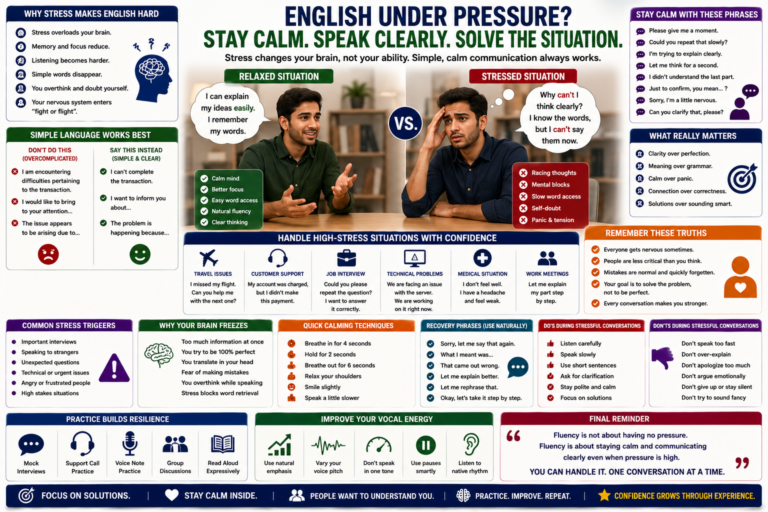
Many English learners become nervous before these conversations even begin. Their mind immediately starts creating stressful thoughts:
- “What if they refuse the refund?”
- “What if my English sounds weak?”
- “What if I cannot explain the problem correctly?”
- “What if they ask technical questions I don’t understand?”
- “What if the employee speaks too quickly?”
- “What if I sound rude accidentally?”
- “What if they think I damaged the product myself?”
- “What if they refuse to help me?”
Because of these fears, many people either avoid returning products completely or become emotionally frustrated very quickly during the interaction.
This happens constantly in real life.
Someone orders headphones online that stop working after two days.
A customer buys a phone charger that overheats unexpectedly.
A laptop arrives with a damaged screen.
A blender suddenly stops functioning after one use.
A customer receives the wrong clothing size.
A smartwatch battery drains unusually fast.
An online order arrives incomplete or broken.
These situations are extremely common in modern shopping culture, especially with:
- online shopping
- ecommerce platforms
- large retail chains
- international shipping
- electronics purchases
However, one important thing many learners misunderstand is that return conversations are usually normal business interactions.
Store employees and customer service representatives handle returns every single day.
Most companies already have established systems for:
- refunds
- exchanges
- repairs
- replacements
- store credit
- warranty claims
In many situations, the employee is not personally fighting against you.
They are simply:
- understanding the issue
- following company policy
- checking purchase information
- processing available solutions
Another major misunderstanding is believing strong communication means sounding aggressive.
Some customers think they must become emotionally forceful to be taken seriously:
- “This product is garbage!”
- “Your company wasted my money!”
- “This is ridiculous!”
- “I demand a refund immediately!”
But honestly, calm professional communication usually works much better than emotional confrontation.
Employees are generally more willing to help customers who sound:
- cooperative
- respectful
- calm
- organized
- solution-focused
This does NOT mean being weak or passive.
It simply means communicating frustration professionally instead of emotionally exploding.
Compare these two approaches carefully.
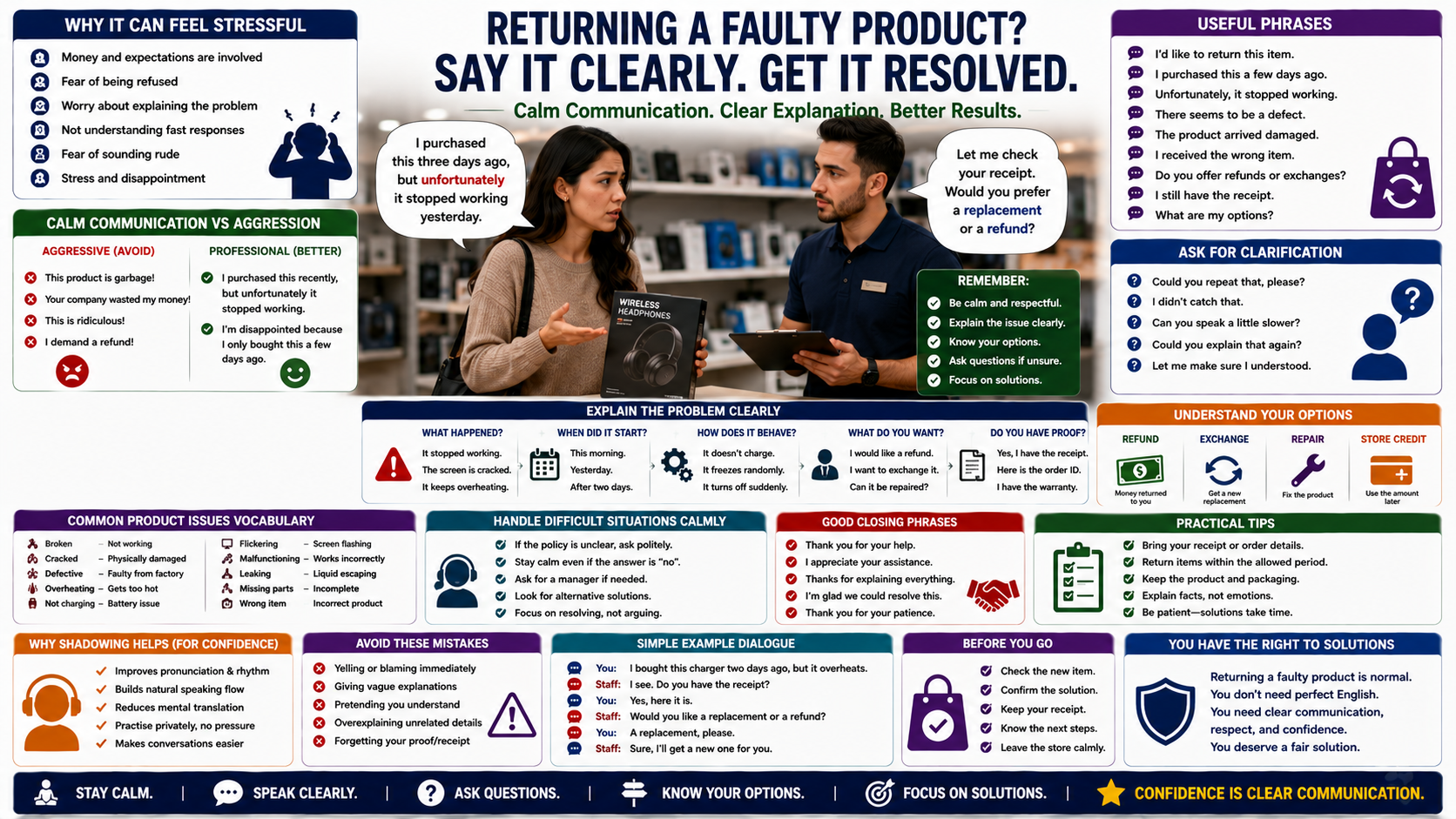
Aggressive Version
“This thing is completely useless and your products are terrible.”
Professional Version
“I purchased this three days ago, but unfortunately it stopped working properly yesterday.”
Both communicate dissatisfaction.
But emotionally, they create completely different interactions.
The second version sounds:
- mature
- calm
- cooperative
- solution-focused
Professional communication usually creates smoother problem-solving.
Another challenge many learners face is vocabulary anxiety.
People worry:
- “I don’t know technical English.”
- “What if I cannot describe the problem?”
- “What if I use the wrong words?”
But honestly, most return conversations rely on surprisingly simple practical vocabulary.
Common words include:
- broken
- cracked
- damaged
- leaking
- overheating
- defective
- malfunctioning
- not charging
- stopped working
- wrong item
- missing parts
- incorrect size
Clear practical explanation matters much more than complicated vocabulary.
Another important thing to understand is that customer service conversations often follow predictable patterns.
Usually employees ask:
- what happened
- when you purchased the item
- whether you have the receipt
- what issue occurred
- what solution you want
Because these conversations follow common structures, learners can become dramatically more confident simply by practicing realistic patterns beforehand.
Another psychological issue many learners struggle with is guilt.
Some people feel uncomfortable requesting refunds because they fear sounding demanding or “difficult.”
But returning genuinely faulty products is normal customer behavior.
If a product is:
- defective
- damaged
- incorrect
- unsafe
- malfunctioning
customers usually have every right to discuss the issue respectfully.
Strong communication means explaining problems clearly without unnecessary emotional escalation.
Another major challenge in modern shopping environments is speed.
Employees at busy stores often:
- speak quickly
- ask short rapid questions
- multitask
- move through procedures fast
Learners may understand English perfectly during slow YouTube lessons but suddenly panic during fast real-world interactions.
This creates mental overload because the brain starts focusing more on fear than actual understanding.
However, one extremely important professional communication skill is learning how to slow conversations down politely.
Useful phrases include:
- “Could you repeat that please?”
- “Sorry, I didn’t catch that.”
- “Can you speak a little slower?”
- “I just want to make sure I understood correctly.”
- “Could you explain that again?”
Strong communication is NOT pretending to understand everything instantly.
Strong communication means making sure understanding actually happens.
Another thing many learners underestimate is emotional tone.
Customer service employees often respond much more positively when customers sound:
- calm
- respectful
- patient
- reasonable
Even if the situation is frustrating internally, emotional self-control usually improves communication quality dramatically.
This does not mean hiding frustration completely.
It simply means expressing it professionally.
For example:
“I’m a little disappointed because I only bought this recently.”
sounds much calmer and more effective than:
“This company always sells terrible products.”
Another challenge is understanding store policies.
Different stores may offer:
- refunds
- exchanges
- repairs
- warranty service
- replacement products
- store credit
- partial refunds
Learners often become confused by these options because customer service English can feel unfamiliar.
This guide is going to explore:
- how to explain product issues clearly in English
- how to request refunds professionally
- how to ask for replacements naturally
- how to handle difficult conversations calmly
- how to understand common customer service vocabulary
- how to ask clarification questions confidently
- how to negotiate solutions respectfully
- how to sound natural during real-life return conversations
Most importantly, we are going to approach this like practical human communication instead of robotic textbook English.
Because honestly?
The ability to solve frustrating real-life problems calmly and confidently in English is one of the strongest signs of true conversational control.
Why Product Return Conversations Feel Emotionally Difficult
Returning products naturally creates emotional pressure because:
- money is involved
- expectations were disappointed
- uncertainty exists about the outcome
People naturally worry:
- “Will they believe me?”
- “Will they refuse the return?”
- “Will this become an argument?”
- “Will I lose my money?”
For English learners, language pressure adds another layer of stress.
Many people mentally prepare for conflict before the interaction even starts.
But honestly, most product return situations are routine business processes.
Understanding this psychologically helps reduce anxiety significantly.
Why People Become Emotional During Customer Service Situations
When products fail unexpectedly, people often feel:
- disappointed
- frustrated
- cheated
- annoyed
- stressed
Especially if:
- the product was expensive
- the issue happened quickly
- the product was important
- the return process feels inconvenient
These emotions are normal.
But experienced communicators understand something important:
Emotional control improves problem-solving quality.
Employees usually respond more positively to calm clear communication than aggressive frustration.
Calm Communication vs Aggressive Complaining
Many customers mistakenly think aggression creates faster results.
Sometimes the opposite happens.
Aggressive communication often creates emotional defensiveness immediately.
Compare these examples carefully.
Aggressive
“This product is terrible and your company wasted my money.”
Professional
“I purchased this recently, but unfortunately it stopped functioning properly.”
The second version sounds:
- calmer
- clearer
- more solution-focused
Strong communication usually focuses on:
- the issue
- the timeline
- the desired solution
instead of emotional attacks.
Common Product Problems Vocabulary
| Problem | Meaning |
|---|---|
| Broken | Not functioning |
| Cracked | Physically damaged |
| Defective | Faulty from manufacturing |
| Overheating | Becoming too hot |
| Not charging | Battery issue |
| Flickering | Screen flashing problem |
| Malfunctioning | Working incorrectly |
| Leaking | Liquid escaping |
| Missing parts | Incomplete package |
| Wrong item | Incorrect product received |
These simple words handle most customer service situations effectively.
Practical English Phrases for Returning a Faulty Product
Useful natural phrases include:
- “I’d like to return this item.”
- “I purchased this a few days ago.”
- “Unfortunately it stopped working.”
- “There seems to be a defect.”
- “The product arrived damaged.”
- “I received the wrong item.”
- “Do you offer refunds or exchanges?”
- “I still have the receipt.”
- “It’s not functioning properly.”
- “I’d like to know what my options are.”
These phrases sound:
- natural
- professional
- respectful
- realistic
How to Explain Product Problems Clearly
Specific explanations improve communication dramatically.
Instead of:
“It doesn’t work.”
Try:
- “The battery no longer charges after ten minutes.”
- “The screen started flickering yesterday.”
- “The headphones stopped connecting through Bluetooth.”
- “The blender suddenly stopped turning on.”
- “The charger overheats while charging.”
Clear details help employees understand problems faster.
Real-Life Return Conversation Example
Electronics Store Example
Customer
“Hi, I purchased these headphones three days ago, but unfortunately the left side stopped working yesterday.”
Employee
“Do you still have the receipt?”
Customer
“Yes, I brought it with me.”
Employee
“Would you prefer a replacement or refund?”
Customer
“A replacement would be great if possible.”
Simple.
Natural.
Professional.
Clothing Store Example
Customer
“Hello, I ordered this jacket online, but I received the wrong size.”
Employee
“Would you like to exchange it?”
Customer
“Yes please, if the correct size is available.”
Notice how simple English works perfectly.
Why Tone Matters More Than Fancy Vocabulary
Many learners worry too much about advanced English.
But customer service conversations depend much more on:
- tone
- clarity
- politeness
- emotional control
than complicated vocabulary.
Even basic English sounds professional when delivered calmly.
My Opinion
Honestly, one thing many people learn over time is that emotional control matters heavily during customer service interactions.
Employees are human beings too.
If customers approach aggressively immediately, conversations often become tense very quickly.
Meanwhile calm respectful communication usually creates more cooperative energy.
This does NOT mean accepting unfair treatment silently.
It simply means staying emotionally controlled while explaining the issue clearly.
That balance is powerful.
How to Ask for a Refund Politely
Many learners fear sounding demanding.
But professional refund requests usually sound simple and calm.
Useful examples:
- “Would it be possible to get a refund?”
- “I’d prefer a refund if possible.”
- “Could we process a replacement or refund?”
- “What refund options are available?”
- “Would a refund be possible in this situation?”
These phrases sound:
- confident
- polite
- professional
Refund vs Exchange vs Store Credit
| Option | Meaning |
|---|---|
| Refund | Money returned |
| Exchange | Product replacement |
| Store Credit | Money usable later in same store |
| Repair | Product fixed |
| Warranty Service | Manufacturer support |
Understanding these terms helps conversations feel much easier.
How to Handle Store Policies Calmly
Sometimes stores have:
- return deadlines
- receipt requirements
- exchange-only rules
- warranty limits
Instead of reacting emotionally immediately, strong communicators ask clarification questions calmly.
Examples:
- “Could you explain the policy?”
- “What options are available?”
- “Is there another solution possible?”
- “Could we look into this further?”
- “Would speaking with a manager help?”
Professional conversation usually creates better outcomes than emotional escalation.
How to Ask Someone to Repeat Information
Fast English feels difficult for many learners during customer service conversations.
Useful phrases include:
- “Sorry, could you repeat that?”
- “I didn’t quite understand.”
- “Can you explain that again?”
- “Could you speak a little slower please?”
- “Let me make sure I understood correctly.”
These are completely normal communication strategies.
Even native speakers ask for repetition constantly.
How to Sound More Natural During Conversations
Real customer service conversations often include relaxed natural expressions:
- “Honestly…”
- “To be fair…”
- “I just bought this recently.”
- “That’s a little disappointing.”
- “I wasn’t expecting this issue.”
- “It worked fine at first.”
These small phrases make communication sound more human and natural.
Common Mistakes During Product Return Conversations
Mistake 1: Becoming Emotional Too Quickly
Aggressive tone often creates defensive interactions.
Mistake 2: Giving Vague Explanations
“This thing is broken.”
Too unclear.
Better:
“The screen freezes after five minutes.”
Mistake 3: Pretending to Understand Policies
Always ask clarification questions if confused.
Mistake 4: Overexplaining Unrelated Details
Strong communication stays focused on:
- what happened
- when
- desired solution
Clarity matters most.
How to End Conversations Politely
Strong communicators also end interactions professionally.
Useful closing phrases:
- “Thank you for your help.”
- “I appreciate your assistance.”
- “Thanks for explaining everything.”
- “I’m glad we could resolve this.”
- “Thank you for your patience.”
These small phrases leave positive final impressions.
FAQs
Is it rude to return a faulty product?
No. Returning defective products is a normal customer service process.
Do I need advanced technical English?
Not at all. Simple practical explanations work very well.
How can I sound more confident?
Focus on calm factual explanation instead of emotional frustration.
What if I cannot understand the employee?
Politely ask them to repeat or slow down.
How do I request a refund professionally?
Use calm phrases like:
“Would it be possible to receive a refund?”
What if the employee refuses the return?
Stay calm and ask about:
- alternative options
- manager assistance
- warranty solutions
Should I sound angry so they take me seriously?
Usually no. Calm professionalism often creates better cooperation.
What is the biggest communication mistake?
Usually emotional aggression or unclear explanations.
How can I explain technical issues simply?
Describe:
- what happened
- when it started
- what the product is doing incorrectly
What is the most important skill during return conversations?
Clear calm communication combined with emotional control.
Conclusion
English conversations for returning a faulty product at a store or customer service counter may feel stressful initially, especially when money, disappointment, frustration, and language pressure combine together at the same time. But honestly, most customer service interactions are simply problem-solving conversations. Employees usually want to:
- understand the issue
- follow company procedures
- find practical solutions professionally
The good news is that you do NOT need perfect English or advanced vocabulary to handle these situations successfully.
Most effective return conversations rely on:
- clear explanations
- specific details
- calm emotional tone
- respectful communication
- solution-focused thinking
Strong communication is NOT about sounding aggressive or dominant.
It is about sounding:
- clear
- calm
- confident
- organized
- emotionally controlled
Over time, as you practice these real-world conversation patterns, your confidence naturally grows.
You stop panicking before customer service interactions.
You stop overthinking every sentence.
You stop feeling helpless when problems happen unexpectedly.
Instead, communication becomes:
- calmer
- clearer
- more structured
- more natural
- more professional
And honestly?
That confidence changes far more than shopping conversations.