How to Practice American English Schwa Sound and Vowel Reduction Like Native Speakers
Learning American English pronunciation can feel surprisingly frustrating even for learners who already know grammar rules, sentence structure, and thousands of English words. Many people spend years studying English in school, practicing tenses, memorizing vocabulary, reading articles, and watching English videos, yet they still struggle when they hear native American speakers talking naturally. The moment real conversations begin, everything suddenly sounds different. Words seem shorter, faster, softer, and sometimes almost unrecognizable. Learners often feel confused because the English they studied in books sounds completely different from the English spoken in movies, podcasts, interviews, YouTube videos, and daily conversations.
This experience is extremely common. In fact, one of the biggest shocks for English learners happens when they realize that understanding written English and understanding spoken English are two very different skills. Someone may read an English article comfortably but still struggle while listening to a casual American conversation. This creates frustration and self-doubt. Many learners begin thinking their listening skills are weak or that native speakers intentionally speak too fast. However, the truth is much simpler. The biggest difference between textbook English and real spoken American English is pronunciation rhythm, connected speech, and vowel reduction.
Native American speakers do not pronounce every word clearly and separately the way learners often expect. Instead, they naturally connect sounds together, reduce weaker syllables, soften vowels, shorten grammar words, and focus only on the stressed parts of a sentence. This creates the smooth musical rhythm that makes American English sound natural and fluent. Because learners are usually trained to pronounce every word carefully according to spelling, real conversations can feel difficult to follow at first.
At the center of this entire pronunciation system is one small but incredibly powerful sound called the schwa.
The schwa sound is considered the most common sound in the English language, especially in spoken American English. Native speakers use it constantly during daily conversations, often without even realizing it. It appears in thousands of common words and plays a huge role in making speech sound relaxed and natural. Yet despite its importance, many learners never properly study it. Traditional English education focuses heavily on grammar, vocabulary, writing, and reading comprehension, but very little time is spent teaching how spoken English actually works in real life.
That is why many learners develop a speaking style that sounds overly formal, robotic, or stiff. They pronounce every vowel strongly because they are reading directly from spelling. But native speakers do not speak that way in casual conversations. Instead, they stress important syllables and reduce weaker ones. This process is called vowel reduction, and the schwa sound is the heart of that process.
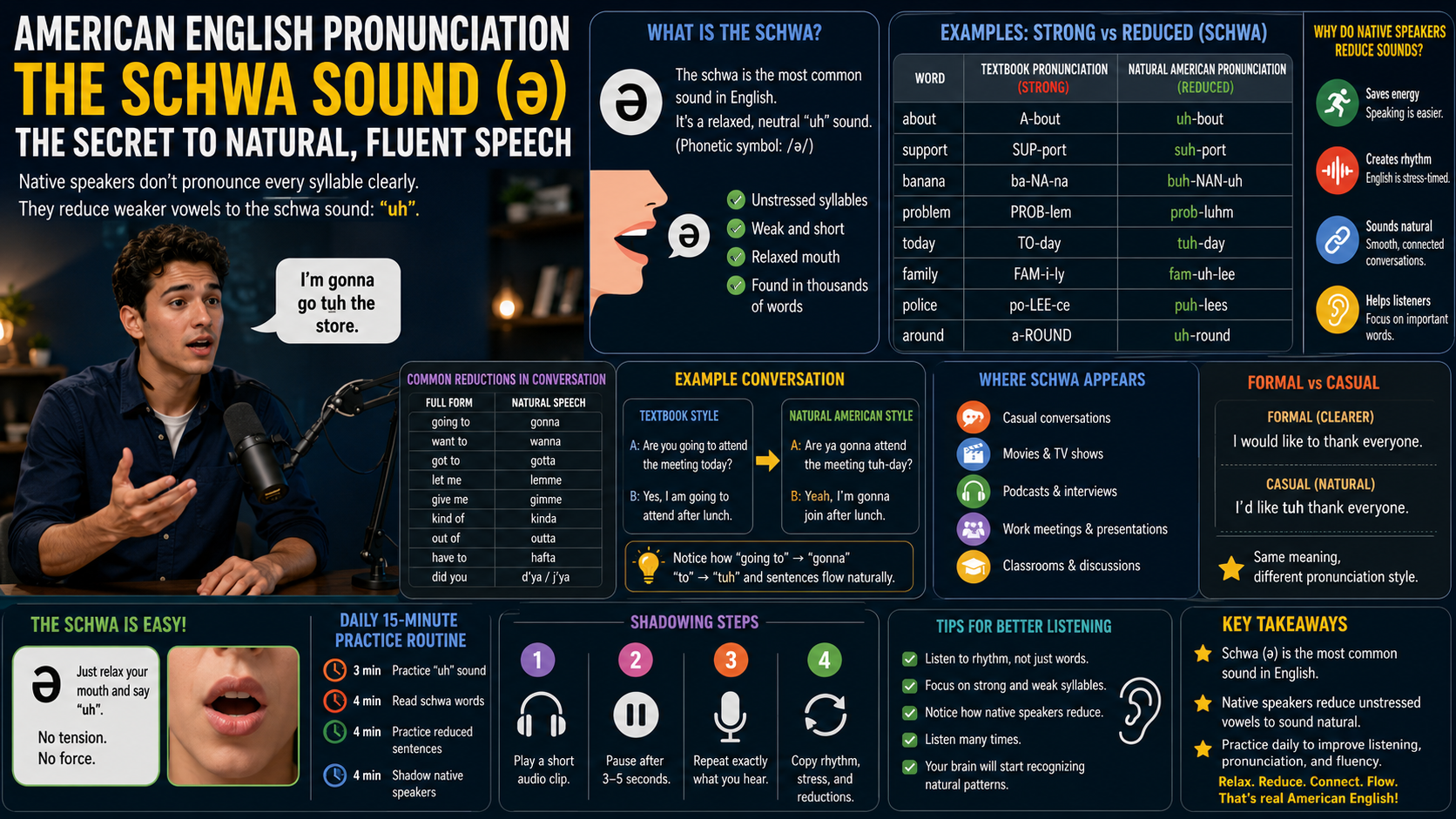
The schwa is represented by the phonetic symbol /ə/, and it sounds like a relaxed “uh.” It is soft, weak, and effortless. Unlike strong vowel sounds such as “ee,” “aa,” or “oo,” the schwa requires almost no tension in the mouth. Native speakers use it when syllables are unstressed or less important. That is why words often sound different from their spelling. For example, the word “about” is not usually pronounced as “A-bout” in natural speech. Instead, it sounds more like “uh-bout.” Similarly, “support” becomes “suh-port,” and “banana” sounds like “buh-NAN-uh.”
At first, learners may feel surprised by this because they expect vowels to sound exactly the way they are written. In many languages, pronunciation follows spelling very closely, so learners naturally apply the same logic to English. But English pronunciation depends much more on rhythm and stress than on perfect spelling pronunciation. Once learners understand this idea, American English begins making much more sense.
One major reason native speakers seem fast is not because they are speaking extremely quickly, but because they are reducing sounds constantly. Small grammar words like “to,” “for,” “of,” “can,” and “and” often become weaker during natural conversations. For example, “to” frequently becomes “tuh,” “for” becomes “fer,” and “can” may sound like “kuhn.” These reductions create smoother speech flow and save effort while speaking. Native speakers naturally prioritize comfort and rhythm over perfect pronunciation of every letter.
The schwa also plays a huge role in listening comprehension. Many learners struggle with movies and podcasts because their brains expect words to sound exactly like dictionary pronunciation. But real spoken English rarely sounds like isolated dictionary words. Instead, conversations contain reductions, connected speech, stress changes, contractions, and rhythm patterns. Once learners train themselves to hear schwa sounds and reduced vowels, listening becomes much easier because the brain starts recognizing real spoken patterns instead of textbook pronunciation.
Another important thing to understand is that mastering the schwa does not mean copying a fake American accent. The goal is not to sound artificial or dramatic. The goal is simply to understand how natural spoken English flows. Even learners who keep their original accent can sound smoother and more fluent once they learn vowel reduction properly. Small pronunciation improvements can create a huge difference in clarity and confidence.
The good news is that the schwa sound itself is very easy to produce. In fact, pronunciation teachers often call it the “lazy sound” because your mouth stays relaxed while saying it. There is no strong mouth movement or tension. The difficulty lies not in making the sound, but in knowing where native speakers use it and developing the habit of reducing unstressed vowels naturally during speech.
In this complete guide, you will learn everything about practicing American English vowel reduction using the schwa sound. You will understand why native speech sounds different from textbook English, how stress patterns work, why vowels become weaker, how connected speech changes pronunciation, and how you can train your ears and mouth to sound more natural. You will also explore real-life examples, pronunciation drills, shadowing techniques, listening exercises, sentence reduction patterns, formal versus casual pronunciation differences, common learner mistakes, and daily practice methods that can dramatically improve your spoken American English.
Most importantly, this guide will help you stop thinking of English as separate dictionary words and start hearing it as connected natural speech. Once that shift happens, American English becomes far less confusing and far more enjoyable to learn.
Why Native American English Sounds So Fast
If you have ever listened to native American English speakers and thought:
- “Why do they speak so fast?”
- “Why do words sound different from spelling?”
- “Why can I understand subtitles but not real conversations?”
- “Why do movies feel harder than English textbooks?”
- “Why do native speakers swallow words?”
then the biggest reason is usually one thing:
The Schwa Sound.
The schwa is one of the main secrets behind natural spoken American English.
Without understanding it:
- Your pronunciation may sound robotic
- Every vowel may sound too strong
- Sentences may feel unnatural
- Native speech may seem impossible to catch
- Conversations may sound blurry
- Listening practice may feel frustrating
But once you understand schwa and vowel reduction, suddenly:
- American English starts sounding slower
- Conversations become clearer
- Sentences become easier to break apart
- Pronunciation becomes smoother
- Your accent sounds more natural
- Listening confidence improves dramatically
And the best part?
The schwa sound is actually very simple.
What Is the Schwa Sound?
The schwa sound is the most common sound in American English.
It sounds like:
“uh”
Phonetic symbol:
/ə/
It is:
- weak
- relaxed
- soft
- unstressed
Examples:
| Word | Natural Pronunciation |
|---|---|
| about | uh-bout |
| support | suh-port |
| banana | buh-NAN-uh |
| problem | prob-luhm |
| today | tuh-day |
| around | uh-round |
| police | puh-lees |
| family | fam-lee |
Notice something important here:
Native speakers are NOT pronouncing every vowel strongly.
Instead, they relax weaker syllables.
That relaxation is called:
Vowel Reduction.
What Is Vowel Reduction?
Vowel reduction happens when vowels become weaker during speech.
Instead of pronouncing every syllable clearly, native speakers reduce less important sounds.
This creates natural rhythm.
For example:
Robotic Pronunciation
“BAN-AN-A”
Natural American Pronunciation
“buh-NAN-uh”
The first and last vowels become schwa sounds.
That reduction makes speech faster and smoother.
Why Native Speakers Reduce Sounds
Speaking continuously requires physical effort.
Native speakers naturally try to:
- save energy
- reduce effort
- maintain rhythm
- speak smoothly
That is why casual speech becomes relaxed.
Imagine saying this sentence robotically:
“I AM GOING TO THE STORE.”
Now hear the natural American version:
“I’m gonna go tuh the store.”
Notice:
- “going to” became “gonna”
- “to” became “tuh”
This is normal spoken English.
English Is Stress-Timed
One of the biggest pronunciation secrets in English is stress rhythm.
English is not spoken with equal force on every syllable.
Some syllables are:
- stressed
- louder
- stronger
- clearer
Others are:
- weak
- softer
- shorter
- reduced
Weak syllables often become schwa sounds.
Example:
Photograph
PHO-to-graph
The middle syllable becomes weaker
Why Many Learners Sound Robotic
Many learners pronounce English directly from spelling.
Example:
Robotic
“I WANT TO GO TO THE MARKET.”
Every word receives equal power.
But native speakers stress only important words.
Natural
“I wanna go tuh the market.”
The sentence flows naturally
The Relaxed Mouth Technique
Schwa is a relaxed sound.
Your mouth should stay neutral.
Do NOT force the vowel.
Not:
- “AAAA”
- “EEEE”
Just:
“uh”
Very soft.
Very relaxed.
That is why schwa is sometimes called:
Mirror Practice Exercise
Stand before a mirror.
Relax:
- jaw
- tongue
- lips
Now repeat slowly:
“uh… uh… uh…”
Do not tense your face.
The sound should feel effortless.
Practice this daily for 3 minutes.
Real-Life Example: Why Schwa Matters
Imagine two people speaking English.
Person 1
Pronounces every word strongly.
Person 2
Uses natural reductions and rhythm.
Who sounds more fluent?
Usually Person 2.
Even if grammar is identical.
Why?
Because natural English depends heavily on rhythm and reduction.
Words Where “A” Becomes Schwa
Many words with “a” use schwa in unstressed syllables.
| Word | Natural Sound |
|---|---|
| about | uh-bout |
| around | uh-round |
| away | uh-way |
| alone | uh-lone |
| amazing | uh-may-zing |
Conversation Example
Formal Textbook Style
“I am about to leave.”
Natural American Style
“I’m uh-bout tuh leave.”
Small reduction.
Big difference.
Words Where “O” Becomes Schwa
| Word | Natural Pronunciation |
|---|---|
| problem | prob-luhm |
| freedom | free-duhm |
| lesson | less-uhn |
| harmony | har-muh-nee |
Casual Conversation Example
Robotic
“I have a problem with my reservation.”
Natural
“I have a prob-luhm with my reservation.”
This is how native conversations sound.
Words Where “U” Becomes Schwa
Just like the vowels “a” and “o,” the vowel “u” also often becomes a schwa sound in natural American English. Native speakers usually reduce the vowel when the syllable is unstressed. This is one reason why many English words sound softer and smoother during real conversations compared to textbook pronunciation.
Here are some common examples:
| Word | Natural American Pronunciation |
|---|---|
| support | suh-port |
| suppose | suh-pose |
| success | suhk-cess |
| supply | suh-ply |
| survive | ser-vive |
| suggest | suh-gest |
Notice something interesting here. The spelling stays the same, but the pronunciation changes because the stress moves to another syllable. Native speakers focus on the stronger syllable and relax the weaker vowel into a schwa.
For example:
Textbook Pronunciation
“SUP-PORT”
Natural American Pronunciation
“suh-PORT”
The first syllable becomes softer because the stress is on “PORT.”
This pattern appears everywhere in American English.
The Secret Rhythm of American English
One of the biggest differences between fluent speakers and learners is rhythm. American English is not spoken word by word like many learners expect. Instead, it moves like music. Some syllables receive strong beats while others become weak and reduced.
That is why native speech feels smooth.
For example, look at this sentence:
“I want to go to the store.”
A learner may pronounce every word equally:
“I WANT TO GO TO THE STORE.”
But native American rhythm sounds more like this:
“I WANNA GO tuh the STORE.”
Notice:
- “want to” becomes “wanna”
- “to” becomes “tuh”
- important words receive stronger stress
- weaker words shrink
This stress pattern creates the musical rhythm of English.
Without rhythm, pronunciation may still be understandable, but it often sounds robotic or unnatural.
Why Native Speakers Sound Fast
Many learners believe Americans simply speak too quickly.
But speed is only part of the story.
The real reason native English sounds fast is because:
- vowels reduce
- sounds connect
- words blend together
- unstressed syllables become shorter
For example:
Written Sentence
“What are you doing?”
Natural American Speech
“Whaddaya doin?”
This sounds completely different from textbook pronunciation, but native speakers hear it naturally because connected speech and schwa reduction are normal parts of spoken English.
At first, learners may feel shocked because they expect every word to sound separate and clear. However, real spoken English prioritizes rhythm and flow instead of perfect pronunciation of every letter.
Connected Speech and Schwa Together
The schwa sound becomes even more powerful when combined with connected speech.
Connected speech means native speakers join words together naturally instead of stopping after every word.
Example:
Robotic Speech
“Did… you… eat… yet?”
Natural American Speech
“Jeet yet?”
What happened here?
- “Did you” blended together
- vowels reduced
- sounds connected
- rhythm became smoother
This happens constantly in real conversations.
That is why listening becomes easier once you train your ears for reductions.
Most Common Reduced Forms in American English
You will hear these every day in movies, podcasts, interviews, and conversations.
| Full Form | Natural Spoken Form |
|---|---|
| going to | gonna |
| want to | wanna |
| got to | gotta |
| let me | lemme |
| give me | gimme |
| kind of | kinda |
| out of | outta |
| have to | hafta |
These reductions happen because native speakers naturally simplify pronunciation during casual speech.
Real-Life Conversation Example
Formal Textbook English
Person A:
“Are you going to attend the meeting today?”
Person B:
“Yes, I am going to attend after lunch.”
Now listen to how Americans may actually say it casually.
Natural American Conversation
Person A:
“Are ya gonna attend the meeting tuh-day?”
Person B:
“Yeah, I’m gonna join after lunch.”
This is real spoken English rhythm.
Notice how:
- “you” became “ya”
- “going to” became “gonna”
- “today” became “tuh-day”
These small reductions make speech flow naturally.
Why Listening Practice Often Fails
Many learners spend hours watching English content but still struggle to improve listening.
Why?
Because they listen only for vocabulary.
Native speech is not just vocabulary.
It is:
- rhythm
- stress
- reductions
- connected sounds
- schwa patterns
If your brain expects textbook pronunciation, real speech will always feel difficult.
But once you start recognizing reduced vowels and schwa sounds, your listening improves much faster.
Suddenly:
- movies feel clearer
- podcasts sound slower
- conversations become understandable
This is one of the biggest breakthroughs in English learning.
Formal vs Casual Pronunciation
American English changes depending on the situation.
During presentations or speeches, pronunciation becomes clearer.
During casual conversations, reduction becomes stronger.
For example:
Formal Speech
“I would like to thank everyone.”
Casual American Speech
“I’d like tuh thank everyone.”
Both are correct.
The situation changes pronunciation style.
Why Schwa Improves Your Accent Naturally
Many learners think improving pronunciation means copying a fake American accent.
That is not true.
Accent improvement happens naturally when:
- rhythm improves
- stress becomes correct
- vowels reduce naturally
- speech becomes relaxed
The schwa helps your English sound smoother without forcing an artificial accent.
Even small reduction improvements can make your speech sound much more natural.
Common Beginner Mistakes
Mistake 1: Pronouncing Every Vowel Strongly
Robotic
“TO-DAY”
Natural
“tuh-DAY”
Native speakers focus stress only on important syllables.
Mistake 2: Speaking Too Stiffly
Many learners keep their mouth tense while speaking English.
But American English is relaxed.
The schwa sound works best when:
- jaw stays loose
- lips stay neutral
- speech flows naturally
Mistake 3: Ignoring Stress Patterns
Some learners focus only on individual words.
But English pronunciation depends heavily on sentence rhythm.
Stress matters more than perfect spelling pronunciation.
Shadowing Technique for Schwa Practice
One of the best pronunciation methods is:
Shadowing.
This technique is used by many advanced language learners.
Here is how it works.
Step 1
Play a short audio clip from a native speaker.
Use:
- interviews
- podcasts
- YouTube videos
- Netflix scenes
Step 2
Pause after 3–5 seconds.
Step 3
Repeat exactly what you heard.
Copy:
- rhythm
- stress
- pauses
- reductions
- connected speech
Do NOT focus only on words.
Copy the sound flow.
This trains your ears and mouth together.
Beginner Shadowing Sentences
Practice these daily.
Sentence 1
Textbook
“What are you doing?”
Natural
“Whaddaya doin?”
Sentence 2
Textbook
“I am going to the store.”
Natural
“I’m gonna go tuh the store.”
Sentence 3
Textbook
“Did you eat yet?”
Natural
“Jeet yet?”
Repeat these aloud multiple times until they feel natural.
How to Practice Schwa Daily
The biggest mistake learners make is practicing only occasionally.
Pronunciation improves through consistent repetition.
Even 15 minutes daily can create huge improvement over time.
Simple 15-Minute Daily Routine
| Time | Activity |
|---|---|
| 3 Minutes | Practice “uh” sound slowly |
| 4 Minutes | Read schwa words aloud |
| 4 Minutes | Practice reduced sentences |
| 4 Minutes | Shadow native speakers |
Consistency matters more than long study sessions.
Real-Life Situations Where Schwa Appears
The schwa sound exists almost everywhere in spoken English.
You will hear it during:
- office conversations
- airport announcements
- customer service calls
- movies
- interviews
- restaurants
- podcasts
- classrooms
- business meetings
- YouTube videos
Once your ears recognize schwa, you start hearing it constantly.
Listening Like a Native Speaker
Native speakers do not listen word by word.
They listen in rhythm groups.
For example:
Instead of hearing:
“I / am / going / to / the / store”
they hear:
“I’m gonna go tuh the store”
This is why fluent listeners process English faster.
They recognize speech patterns instead of individual dictionary words.
The Psychology of Relaxed Pronunciation
Many learners try too hard while speaking English.
They:
- overpronounce vowels
- tense their mouth
- focus too much on perfection
But natural American English is relaxed.
Fluency grows when speech becomes comfortable and rhythmic.
The schwa teaches your mouth to relax.
And relaxed speech sounds more fluent.
FAQ Section
What is the schwa sound in simple words?
The schwa is a soft “uh” sound used in weak or unstressed syllables in English words.
Example:
about → “uh-bout”
Why is the schwa important in American English?
Because native speakers use it constantly during real conversations. It helps speech sound smooth, relaxed, and natural.
Why do Americans reduce words so much?
Reduction makes speech easier and faster. Native speakers naturally save energy by weakening less important syllables.
Is schwa used only in casual speech?
No. It appears in both formal and casual speech, although casual conversations usually contain stronger reductions.
Can I sound fluent without learning schwa?
You can still communicate, but your speech may sound robotic or overly formal. Schwa helps create natural rhythm.
How long does it take to improve pronunciation?
With daily practice, many learners notice improvement within a few weeks, especially in listening comprehension.
Should I copy every American reduction?
No. Focus first on understanding reductions. Over time, natural usage will develop gradually.
My Opinion on Learning Schwa
Many learners spend years trying to improve English through grammar exercises alone, but pronunciation rhythm often receives very little attention. In reality, pronunciation patterns like schwa and vowel reduction are some of the biggest differences between textbook English and real spoken English. Once learners understand this system, English stops feeling random and starts feeling predictable.
The schwa is not just another pronunciation topic. It is one of the foundations of natural spoken English. Understanding it can completely change the way you hear, understand, and speak American English.
Real-Life Use of Schwa
Imagine watching a Netflix show and suddenly understanding conversations more clearly because your ears now recognize reductions.
Imagine speaking English during office meetings and sounding smoother because your rhythm improved.
Imagine feeling less nervous during conversations because native speech no longer feels impossibly fast.
That is the real power of learning schwa and vowel reduction.
It improves:
- listening
- pronunciation
- speaking confidence
- conversation flow
- accent naturalness
all together.
Conclusion
The schwa sound is one of the most important pronunciation features in American English, yet it is often ignored by learners. Native speakers constantly reduce vowels and weaken unstressed syllables to create smooth natural rhythm. Without understanding this system, spoken English can feel too fast and confusing. But once you begin recognizing schwa patterns, everything slowly becomes clearer.
You start hearing real English differently.
Movies become easier.
Podcasts feel slower.
Conversations make more sense.
Most importantly, your own speech starts sounding smoother and more natural because you stop pronouncing every word like a textbook.
Remember:
Fluent English is not about speaking every word perfectly.
It is about:
- rhythm
- stress
- relaxed pronunciation
- connected speech
- natural flow
And the schwa sound sits at the center of all of these.