Mastering Casual Small Talk Before a Zoom or Teams Meeting Starts – Professional Conversation
One of the most underestimated communication skills in modern professional life is the ability to handle casual small talk naturally before an online meeting officially begins. Honestly, many people spend years improving presentations, technical vocabulary, interview skills, emails, reports, negotiation techniques, and formal business English, but they completely ignore the tiny conversational moments that happen before the “real meeting” starts. Ironically, those informal few minutes often shape professional comfort, emotional connection, and workplace impressions far more than people realize.
In today’s remote work culture, millions of professionals interact daily through platforms like Zoom, Microsoft Teams, Google Meet, Slack, and countless other virtual collaboration tools. Before meetings officially begin, there is usually a strange transitional period where participants slowly join the call, test microphones, adjust cameras, sip coffee, check internet connections, or wait for key attendees to arrive. During this time, conversations often become casual and informal:
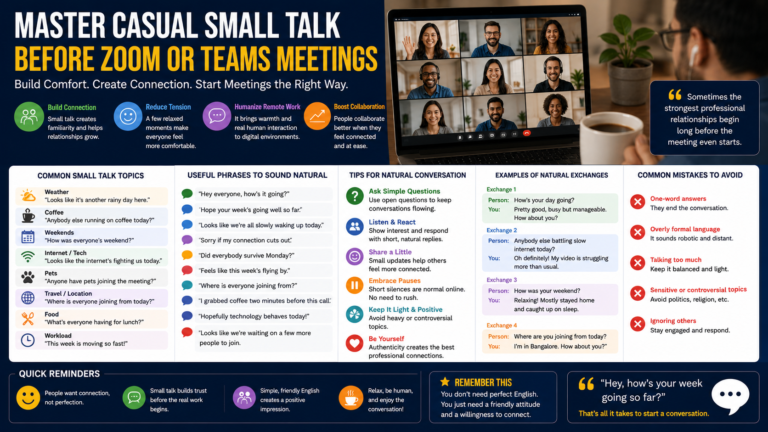
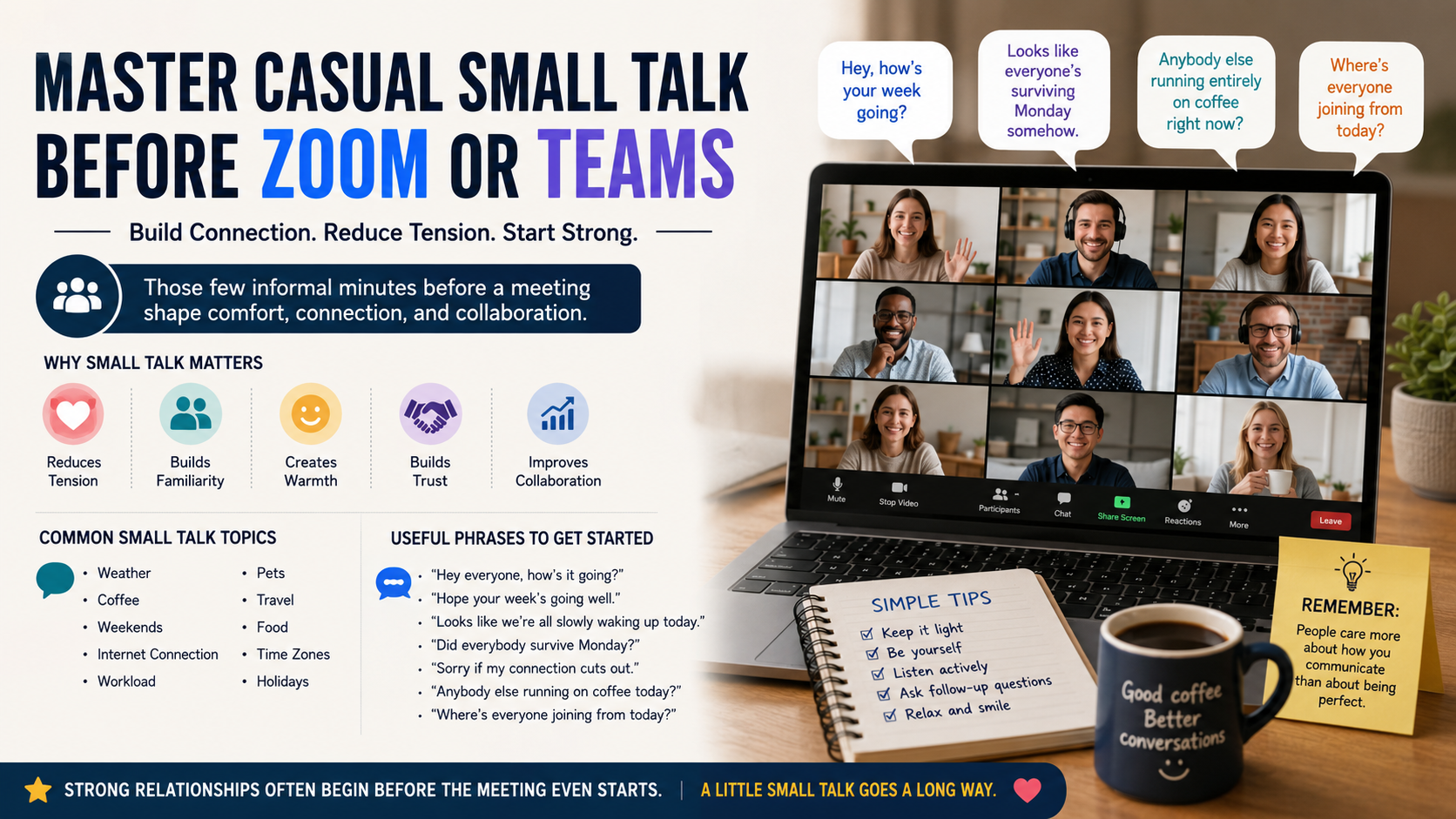
“Hey, how’s your week going?”
“Looks like everyone’s surviving Monday somehow.”
“Sorry, my internet’s a little unstable today.”
“Anybody else running entirely on coffee right now?”
“Where’s everyone joining from today?”
These conversations may seem simple on the surface, but emotionally they play an incredibly important role. They reduce tension. They create familiarity. They humanize remote work. They help people transition from isolation into collaboration. And honestly, in remote environments where coworkers may never physically meet each other, these tiny moments often become one of the main ways professional relationships slowly develop.
For many English learners, however, small talk feels surprisingly stressful — sometimes even more stressful than the actual business discussion itself.
And honestly, this confuses a lot of learners.
During formal meetings, at least there is structure. You usually know the topic, vocabulary, expectations, and purpose. Maybe the discussion is about project timelines, client updates, coding issues, marketing campaigns, sales reports, or product launches. Your brain can prepare mentally.
But small talk feels emotionally unpredictable.
Someone casually asks:
“So, how’s your day going so far?”
And suddenly your brain freezes completely.
Not because the English is difficult.
But because spontaneous casual conversation requires a different communication skill entirely.
Many learners understand the sentence perfectly yet still panic internally:
“How long should my answer be?”
“Should I sound formal?”
“What if I sound awkward?”
“What if nobody responds?”
“What if my joke sounds strange?”
“What if I say too much?”
“What if I sound too quiet?”
“What if I create awkward silence?”
This mental pressure is extremely common.
Another important reason small talk feels difficult is because traditional English education rarely teaches it realistically. Most learners spend years studying grammar rules, essay writing, vocabulary memorization, reading comprehension, and scripted textbook conversations. But real workplace communication is messy, spontaneous, emotional, and unscripted.
Real professionals rarely speak like English-learning textbooks during casual meetings.
Nobody says:
“Greetings colleagues. I hope this meeting finds you in excellent condition today.”
Instead, real workplace English sounds much more relaxed:
“Hey everyone, hope your week’s going alright.”
“Looks like we’re all half asleep today.”
“Sorry if my camera lags a little today.”
Simple.
Natural.
Human.
And honestly, that emotional naturalness matters enormously.
One major misunderstanding many learners have is thinking small talk exists to exchange important information. But actually, small talk is usually more about emotional atmosphere than information itself. Human beings naturally feel more comfortable working together after a few moments of relaxed interaction. Small talk softens the emotional transition into professional discussions.
Imagine joining a meeting where ten people silently stare at their screens for five minutes waiting awkwardly for the manager to begin.
Emotionally, the atmosphere feels cold immediately.
Now compare that to:
“Morning everyone.”
“How’s everybody surviving this week?”
“Looks like the whole internet’s struggling today.”
Suddenly the emotional environment feels lighter and more comfortable.
This matters more than many professionals realize because workplace communication is not only about productivity. It is also about emotional energy. People naturally prefer collaborating with individuals who feel approachable, calm, relaxed, and easy to communicate with.
Unfortunately, many English learners accidentally create emotional distance during small talk because they become too robotic, too formal, or too silent. They focus so heavily on speaking “correctly” that they forget conversations are human interactions first.
For example:
Person: “How’s your day going?”
Learner: “My productivity levels remain acceptable.”
Technically understandable?
Yes.
Natural workplace small talk?
Not really.
Meanwhile, a more natural response sounds like:
“Pretty good honestly. Busy, but manageable.”
Simple conversational English often sounds more confident than overly formal English.
Another challenge is fear of silence.
Many learners panic emotionally if a conversation pauses for even two seconds. They immediately think:
“Now I need to say something.”
“This silence is awkward.”
“What if everybody thinks I’m weird?”
“What if I ruin the atmosphere?”
But honestly, pauses are completely normal during virtual meetings.
People are:
connecting microphones,
answering notifications,
adjusting audio,
checking messages,
joining late,
or dealing with internet lag.
Strong communicators do not panic every time a conversation becomes quiet briefly.
Another reality of remote work is that small talk has become more important than ever before because online work removes countless natural human interactions that physical offices used to provide automatically.
In traditional offices, people casually connect:
while grabbing coffee,
walking between rooms,
eating lunch,
waiting for elevators,
passing desks,
or leaving meetings together.
Remote work removes most of these spontaneous human moments.
Because of this, the few minutes before Zoom or Teams meetings often become one of the only opportunities for informal relationship-building.
And honestly?
Strong professionals understand this deeply.
They know that casual conversations help teams feel:
more connected,
more collaborative,
less isolated,
and more emotionally comfortable working together.
This does not mean becoming fake, overly extroverted, or endlessly talkative.
It simply means learning how to participate naturally in small moments of human interaction.
Another thing that surprises many learners is that good small talk usually sounds very simple. You do not need brilliant humor, advanced vocabulary, or endlessly interesting stories.
Most workplace small talk revolves around ordinary everyday topics:
coffee,
weather,
weekends,
internet problems,
pets,
travel,
food,
workload,
time zones,
holidays,
or simple life updates.
The real skill is not complexity.
The real skill is emotional ease.
And honestly, once learners stop treating small talk like a dangerous English performance test, conversations become dramatically easier. You slowly realize something important:
People are usually not expecting perfection.
They are simply looking for relaxed human interaction.
This article is going to explore how to master casual small talk before Zoom or Teams meetings, how to sound natural instead of robotic, how to continue conversations comfortably, how to reduce nervousness, how to survive awkward silences calmly, how to ask simple conversational questions naturally, and how to build stronger professional relationships through relaxed everyday English.
Most importantly, we are going to approach this like real-world human communication instead of artificial textbook dialogue.
Because honestly?
Sometimes the strongest professional relationships begin long before the actual meeting even starts.
Why Small Talk Matters More Than Most People Think
Many professionals underestimate how psychologically important casual workplace interaction really is.
They think:
“Let’s skip the small talk and just start the meeting.”
But human communication does not work like machines.
People naturally collaborate better when emotional comfort exists first.
Small talk helps:
reduce tension,
build familiarity,
create warmth,
and establish conversational comfort.
Especially in remote work environments, these tiny interactions slowly build trust over time.
For example, if someone remembers:
your dog,
your city,
your weekend plans,
or your coffee obsession,
future conversations automatically feel more human and connected.
Strong workplace communication is not only technical.
Relationship comfort matters too.
Why English Learners Freeze During Casual Conversation
One major reason learners panic during small talk is unpredictability.
Formal meetings follow structure:
deadlines,
reports,
updates,
presentations,
technical discussion.
But casual conversation moves randomly:
weekends,
weather,
internet issues,
food,
pets,
sports,
vacations,
coffee,
or random jokes.
Your brain must respond instantly and naturally.
That feels mentally exhausting initially.
Another problem is overthinking.
Some learners internally try building grammatically perfect sentences before speaking. Meanwhile casual conversations move quickly.
By the time the learner mentally prepares the “perfect” sentence, the topic already changed.
Natural conversation depends more on flow than perfection.
The Most Common Workplace Small Talk Topics
The good news?
Professional small talk is actually extremely repetitive.
The same topics appear constantly.
Common examples include:
- weather
- coffee
- weekends
- travel
- internet connection
- workload
- pets
- time zones
- food
- holidays
- technical problems
- meeting schedules
Examples:
“Looks like everyone’s internet is struggling today.”
“Anybody else completely dependent on coffee this morning?”
“How’s everyone’s week going so far?”
“Feels like this month is moving ridiculously fast.”
These conversations are intentionally light.
You do not need deep intellectual responses.
Practical English Phrases for Casual Zoom or Teams Small Talk
Useful natural workplace phrases include:
- “Hey everyone, how’s it going?”
- “Hope your week’s going well.”
- “Looks like we’re all slowly waking up today.”
- “Sorry if my connection cuts out.”
- “Did everybody survive Monday?”
- “Feels like this week’s flying by.”
- “Where’s everyone joining from?”
- “I literally grabbed coffee two minutes before this call.”
- “Hopefully technology behaves today.”
- “Looks like we’re waiting on a few more people.”
These sound relaxed and conversational instead of robotic.
And honestly, native speakers use these patterns constantly.
My Opinion
Honestly, one thing many English learners desperately need to hear is this:
People usually care much more about conversational comfort than grammatical perfection during small talk.
If you sound:
friendly,
relaxed,
engaged,
and approachable,
small grammar mistakes rarely matter much.
But if you sound emotionally stiff, terrified, or robotic, even perfect grammar can feel awkward.
Real communication is emotional first and grammatical second.
That mindset shift helps many learners relax enormously.
How to Keep Small Talk Flowing Naturally
One extremely useful conversation skill is learning how to ask simple follow-up questions.
For example:
Person: “I had a really busy weekend.”
You: “Oh really? What kept you busy?”
Or:
Person: “It’s raining nonstop here.”
You: “Same honestly. Feels like it’s been raining forever.”
Conversation survives through:
small reactions,
curiosity,
and emotional engagement.
You do not need brilliant questions.
Simple interest works surprisingly well.
Why One-Word Answers Kill Conversations
Many nervous learners accidentally end conversations immediately by answering too briefly.
Example:
“How was your weekend?”
“Good.”
Conversation dies instantly.
Instead, slightly expand:
“Pretty good actually. Mostly relaxed and caught up on sleep.”
Now the other person has something to continue.
Strong small talk usually creates tiny conversational openings naturally.
How Humor Helps During Online Meetings
Light humor often makes virtual meetings feel dramatically more comfortable.
Examples:
“I think my coffee is working harder than I am today.”
“My laptop almost gave up on life this morning.”
“Looks like the internet’s fighting everybody today.”
These tiny comments create warmth and emotional relaxation.
You do not need stand-up comedy skills.
Even mild playful comments improve conversational energy.
How to Handle Awkward Silence Calmly
Awkward silence scares many learners unnecessarily.
But honestly?
Small pauses are completely normal during online meetings.
People may be:
muted,
connecting,
typing,
multitasking,
joining late,
or experiencing lag.
You do not need to panic and fill every silence immediately.
Sometimes smiling calmly is enough.
Emotionally comfortable communicators do not fear tiny pauses constantly.
How to Sound More Natural Instead of Scripted
Real workplace English often includes relaxed conversational expressions like:
- “Honestly…”
- “Pretty much…”
- “More or less…”
- “At this point…”
- “To be fair…”
- “Basically…”
Example:
“Honestly, this week’s been pretty hectic.”
This sounds much more human than:
“My schedule has been significantly demanding this week.”
Natural simplicity usually sounds more confident.
How Introverts Can Handle Small Talk Comfortably
Many people think successful small talk requires extreme extroversion.
Not true.
You do not need to dominate conversations.
Even simple participation matters.
For example:
“Hey everyone, hope your day’s going well.”
That alone already creates positive conversational energy.
Small talk success is not about talking constantly.
It is about participating comfortably.
How to Join Conversations Without Feeling Awkward
Some learners hesitate because they feel they are “interrupting” casual conversation.
But online meetings naturally involve overlapping interaction.
Simple entry phrases work well:
- “Oh, same here honestly.”
- “I was just about to say that.”
- “That reminds me…”
- “Yeah, I’ve noticed that too.”
These help conversations feel collaborative instead of forced.
Why Small Talk Builds Professional Visibility
Interestingly, casual conversation often affects workplace visibility more than many professionals realize.
People naturally remember coworkers who seem:
warm,
engaged,
relaxed,
and approachable.
This does not mean becoming fake or overly social.
It simply means participating enough that people experience you as human instead of invisible.
And honestly?
That matters professionally.
FAQs
Why is small talk important before meetings?
Because it reduces tension, builds familiarity, and creates emotional comfort before work discussions begin.
What if I don’t know what to say?
Use universal topics like:
weather,
coffee,
weekends,
internet problems,
or workload.
How can I sound more natural in English?
Focus less on perfect grammar and more on relaxed conversational flow.
Is it okay to make grammar mistakes during small talk?
Absolutely. Casual conversations are emotionally focused, not grammar-focused.
How do I stop freezing during conversations?
Practice common small talk patterns repeatedly until they feel automatic.
What topics should I avoid professionally?
Avoid:
politics,
religion,
extremely personal topics,
or highly controversial subjects.
How can I continue conversations naturally?
Ask simple follow-up questions and react genuinely to what people say.
What if the conversation becomes awkward?
Stay calm. Small pauses happen naturally in virtual meetings constantly.
Do introverts struggle more with small talk?
Sometimes, but successful small talk does not require being loud or extremely social.
What is the biggest small talk mistake learners make?
Usually sounding overly robotic or overthinking every sentence instead of communicating naturally.
CONCLUSION
Mastering casual small talk before Zoom or Teams meetings may seem like a tiny professional skill on the surface, but honestly, it has a surprisingly powerful impact on workplace communication and relationship-building.
These small informal moments help people feel:
comfortable,
connected,
relaxed,
and emotionally ready for collaboration.
And thankfully, good small talk does not require advanced vocabulary, complicated grammar, or perfect pronunciation.
Most workplace conversations revolve around simple human experiences:
coffee,
weather,
weekends,
technology problems,
workload,
travel,
pets,
and daily life.
The real skill is emotional ease.
The more you practice these tiny interactions, the less your brain treats them like dangerous English performance situations.
Slowly:
you stop overthinking every sentence,
you stop fearing awkward silence,
you stop panicking about tiny mistakes,
and conversations begin feeling natural instead of stressful.
And honestly?
That comfort changes professional communication dramatically because people begin experiencing you not only as a worker or employee, but as someone approachable, relaxed, collaborative, and genuinely pleasant to interact with.
Sometimes professional trust does not begin with massive presentations or technical brilliance.
Sometimes it begins with one very simple sentence before the meeting even starts:
“Hey, how’s your week going so far?”