The Passive Vocabulary Trap: Why You Understand English but Struggle to Speak It Naturally
One of the strangest and most emotionally frustrating experiences English learners go through is realizing they understand far more English than they can actually speak. This creates a very confusing internal conflict because from the outside, it may look like the learner “knows English.” They can watch interviews. They can understand YouTube videos. They can read articles. They can follow podcasts. They can recognize advanced words during conversations. Sometimes they even understand complex discussions surprisingly well. But the moment they try to speak, something strange happens. Their brain suddenly feels empty. The vocabulary disappears. The sentence becomes blurry. Simple words stop arriving naturally. And the learner sits there thinking: “Wait… if I already know these words, then why can’t I use them while speaking?”
Honestly, this problem is far more common than people realize. In fact, millions of English learners around the world secretly experience the exact same frustration every single day. They spend years consuming English content through movies, social media, articles, songs, gaming, freelancing work, online videos, or educational platforms. Over time, their understanding improves dramatically. Their passive vocabulary becomes huge. They recognize words instantly when other people use them. They understand emotional tone. They understand jokes. They understand context. Sometimes they can even predict what someone is about to say next in English conversations. But despite all this understanding, speaking still feels strangely limited.
And honestly, this emotional gap between understanding and speaking can become deeply discouraging after a while because learners begin questioning themselves psychologically. They think things like:
“Maybe my English is fake.”
“Maybe I don’t actually know English.”
“Maybe I’m just memorizing.”
“Why can I understand but not speak?”
“Why does my brain stop working during conversations?”
“What’s wrong with me?”
This emotional confusion becomes even worse when learners compare themselves to others online. They see people speaking confidently on social media, during interviews, or in videos, and suddenly their own speaking ability feels painfully inadequate. They forget that communication ability is not built only through understanding input. It also depends heavily on output training, emotional comfort, speaking exposure, retrieval speed, conversational repetition, and neurological activation patterns.
And honestly, this is where one of the biggest misunderstandings about language learning begins.
Many people assume that if they keep consuming enough English content, speaking ability will automatically appear one day like magic. They think fluency is something that “arrives” naturally after enough listening and reading. But real communication does not work that way. Understanding language and actively producing language are two very different neurological processes.
This distinction is incredibly important.
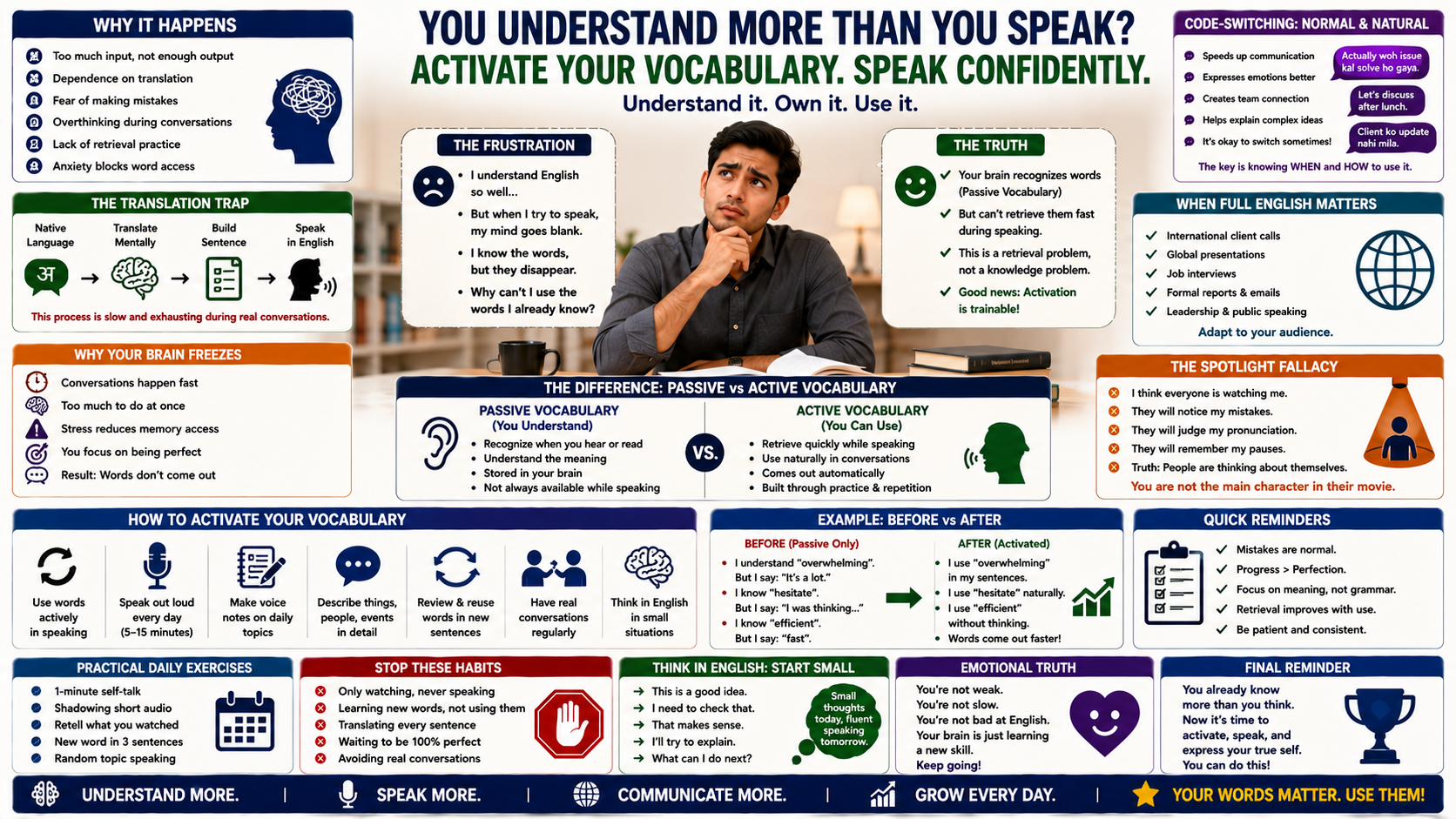
Because passive vocabulary and active vocabulary are not the same thing.
Passive vocabulary includes words your brain recognizes when you hear or read them.
Active vocabulary includes words your brain can retrieve quickly and use naturally during real-time communication.
And honestly, the difference between those two systems is massive psychologically.
For example, imagine someone watching English content for years. They may recognize words like:
“overwhelming,”
“efficient,”
“awkward,”
“hesitate,”
“frustrating,”
“approach,”
“eventually,”
“comfortable,”
“confidence,”
or “opportunity.”
The moment they hear these words, their brain understands them instantly.
But then during conversation, instead of using those words naturally, they suddenly speak with much simpler vocabulary because those advanced words remain trapped inside passive recognition instead of active production.
This creates an incredibly strange experience where learners sound much “weaker” while speaking than they actually are mentally.
And honestly, this affects confidence heavily.
Because people begin feeling intellectually disconnected from their own communication ability.
Inside their mind, they understand much more than they can express.
That gap hurts emotionally.
Especially for intelligent learners.
Especially for professionals.
Especially for freelancers, developers, students, creators, or remote workers who interact internationally.
Because communication ability shapes how people experience you professionally and socially.
Now here’s something extremely important that many learners do not realize:
This problem is not a sign of failure.
It is actually a sign of progress.
Yes, seriously.
A large passive vocabulary usually means your brain has already absorbed a huge amount of English exposure successfully.
The issue is not lack of knowledge.
The issue is activation.
Your brain recognizes the vocabulary, but it has not yet built strong automatic pathways for real-time conversational retrieval.
That’s a very different problem.
And honestly, it’s a much more solvable problem than many learners imagine.
Because vocabulary activation is trainable.
Your brain can absolutely learn how to convert passive vocabulary into active speaking vocabulary over time.
But this process requires a different approach from traditional studying.
This is where many learners accidentally waste years.
Instead of activating vocabulary through usage, they continue endlessly consuming more input:
more videos,
more podcasts,
more articles,
more vocabulary lists,
more grammar lessons,
more passive exposure.
But very little actual retrieval practice.
Very little speaking activation.
Very little emotional usage.
Very little real conversational repetition.
So their passive vocabulary keeps growing larger and larger while their active speaking vocabulary remains stuck at a much smaller level.
This creates a strange imbalance.
The learner becomes intellectually advanced in understanding but emotionally weak in expression.
And honestly, one of the most frustrating parts of this experience is that learners often know the exact word AFTER the conversation ends.
This happens constantly.
During the conversation, the brain freezes.
Later while walking, showering, eating, or lying in bed, suddenly the perfect word appears naturally.
And the learner thinks:
“WHY didn’t my brain remember this earlier?”
Again, this is not intelligence failure.
This is retrieval-speed training.
Your brain simply has not practiced pulling that vocabulary out under live conversational pressure yet.
Because real-time speaking is fast.
Conversations move quickly.
Your brain must:
understand,
react,
retrieve vocabulary,
build sentences,
monitor tone,
manage confidence,
process emotions,
and continue listening simultaneously.
That’s an enormous cognitive workload.
Especially in a second language.
And honestly, emotional pressure makes this even harder.
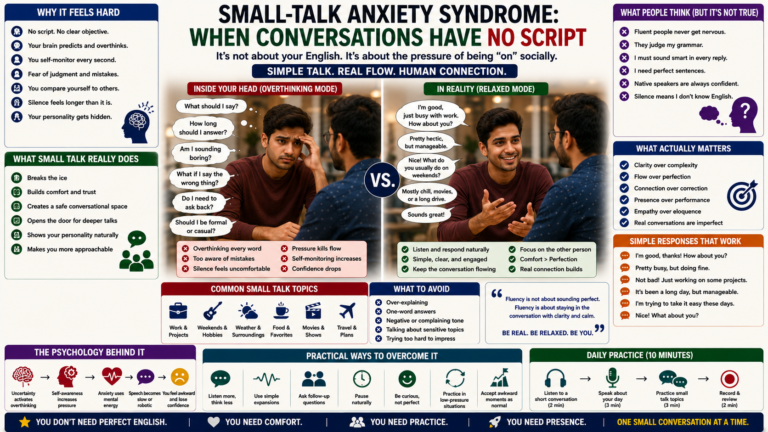
Many learners become so afraid of mistakes during speaking that their brain partially shuts down retrieval systems under stress.
This is psychological.
Not intellectual.
Actually, something very interesting happens neurologically during stressful conversations. The brain prioritizes survival and emotional safety over smooth linguistic retrieval. So even vocabulary you know very well suddenly becomes inaccessible temporarily because anxiety interrupts automatic access pathways.
This is why some learners speak much better alone than during real conversations.
Alone, there is no judgment pressure.
No social tension.
No interruption fear.
No embarrassment risk.
So vocabulary flows more naturally.
But once real human interaction begins, nervousness interferes with retrieval speed.
This explains why many learners feel:
“I know English in my head but not in my mouth.”
Honestly, that sentence perfectly describes passive vocabulary imbalance.
And here’s another extremely important reality many people misunderstand:
Speaking ability is not built only through learning new words.
It is built through repeated retrieval of words you already know.
That distinction changes everything.
Because some learners already know enough vocabulary to communicate quite effectively right now.
The real problem is automatic access.
Their brain has not yet converted those words into emotionally comfortable speaking tools.
This is similar to physical exercise in some ways.
Reading vocabulary is like watching fitness videos.
Actually using vocabulary during conversations is like training muscles physically.
Recognition alone does not create automatic performance.
Repetition creates automaticity.
And honestly, this is why children learn languages differently from many adult learners.
Children repeatedly USE vocabulary emotionally in real situations.
Adults often repeatedly STUDY vocabulary intellectually without enough natural activation.
That difference matters enormously.
One thing I’ve personally noticed is that many learners become addicted to passive improvement because it feels emotionally safer. Watching English content feels comfortable. Reading feels comfortable. Listening feels comfortable. But speaking creates vulnerability. It creates exposure. It creates emotional uncertainty.
So learners unconsciously avoid the exact activity that activates vocabulary most effectively.
And then they become trapped in endless preparation mode.
Always learning.
Never activating.
Always consuming.
Rarely producing.
This creates the illusion of progress without conversational transformation.
Now obviously, input still matters enormously.
Listening and reading are incredibly important.
Passive vocabulary growth is valuable.
But eventually the brain needs output pressure too.
Because activation happens through usage.
And honestly, one of the biggest mindset shifts learners need is understanding this:
You do not activate vocabulary by memorizing harder.
You activate vocabulary by retrieving faster.
That changes how you approach speaking completely.
Instead of obsessing over learning endless new words, you start focusing on repeatedly USING words you already recognize.
This is where fluency begins accelerating dramatically.
Because active vocabulary grows through repetition under real conditions.
Another emotional issue connected to passive vocabulary is perfectionism.
Many learners refuse to use partially learned vocabulary because they are afraid of using it incorrectly.
So the brain never gets practice.
The learner waits until the word feels “perfectly mastered.”
But real communication does not work that way.
Native speakers themselves experiment with language constantly.
Fluency grows through imperfect usage.
Not perfect preparation.
Actually, many confident English speakers are not necessarily people with the biggest vocabulary.
Often they are simply people who comfortably activate the vocabulary they already know.
That’s a huge difference.
Some learners know 20,000 words passively but use only 2,000 actively.
Meanwhile another learner may know fewer words overall but activate them confidently and naturally during conversation.
The second learner often sounds more fluent socially.
That’s why vocabulary activation matters so much.
And honestly, another major problem learners face is emotional over-monitoring during conversations.
While speaking, they constantly think:
“Is this grammar correct?”
“Is this pronunciation okay?”
“Does this sound natural?”
“Am I speaking too slowly?”
“Did I use the wrong tense?”
“Was that word appropriate?”
This mental self-monitoring consumes cognitive energy.
And when cognitive overload increases, retrieval speed decreases.
So ironically, trying too hard to sound perfect often blocks vocabulary access further.
That’s why relaxed communicators often sound more fluent.
Their brain is not fighting itself constantly.
Now thankfully, passive vocabulary activation is extremely trainable once learners understand the psychology behind it.
Your brain already contains much more English than you think.
The goal is teaching your nervous system how to access that vocabulary comfortably during live communication.
That requires:
repetition,
retrieval practice,
emotional exposure,
context usage,
pattern familiarity,
and conversational confidence.
Not endless memorization.
Not perfection obsession.
Not intellectual over-analysis.
This article is going to explore all of this deeply.
We’re going to talk about:
why passive vocabulary becomes trapped,
how the brain retrieves language,
why conversations create blank moments,
how emotional pressure blocks vocabulary,
how to activate known words naturally,
how to train faster retrieval,
how to reduce translation dependence,
how to stop freezing during conversations,
and how to finally make your spoken English sound closer to your real mental understanding.
Most importantly, we’re going to approach this like a real psychological communication issue instead of a textbook vocabulary problem.
Because honestly?
Many learners already know far more English than they realize.
The real challenge is helping that English finally come out naturally when it matters.
Understanding Passive vs Active Vocabulary
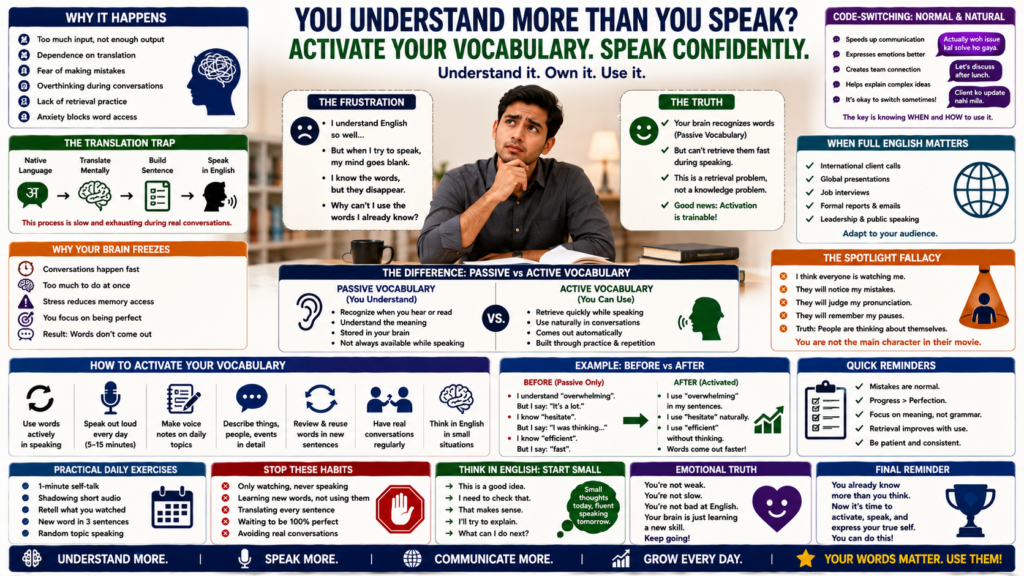
One of the most important concepts in language learning is understanding the difference between passive vocabulary and active vocabulary.
Passive vocabulary includes words you recognize and understand when other people use them.
Active vocabulary includes words you can retrieve quickly and use naturally yourself during conversation.
This distinction explains why some learners understand advanced English but still speak very simply.
For example, you may understand words like:
“complicated,”
“frustrated,”
“hesitation,”
“efficient,”
“pressure,”
or “overwhelming.”
But during live speaking, your brain may choose simpler replacements because those advanced words are not fully activated yet.
That does not mean you do not know the vocabulary.
It means retrieval pathways are still weak.
Why Your Brain Freezes During Conversations
This is extremely common.
Conversations happen in real time.
There is no pause button.
Your brain must:
listen,
understand,
build responses,
retrieve vocabulary,
monitor pronunciation,
and manage emotions simultaneously.
That creates pressure.
Under pressure, retrieval becomes slower.
Especially if your brain still depends heavily on mental translation.
Many learners experience this exact pattern:
After the conversation ends, suddenly the perfect vocabulary appears naturally.
Why?
Because emotional pressure disappeared.
Your brain relaxed.
And relaxed brains retrieve vocabulary more efficiently.
The Translation Trap
One of the biggest reasons passive vocabulary stays inactive is constant translation dependence.
Many learners think like this internally:
Native language → English conversion → Sentence building → Speaking
This process is slow.
It overloads working memory.
And it blocks automatic vocabulary retrieval.
Activated vocabulary works differently.
The word appears directly through meaning and context without conscious translation.
That’s why repeated conversational exposure matters so much.
Why Listening Alone Is Not Enough
Many learners consume endless English content but rarely speak.
This grows passive recognition beautifully.
But recognition is not production.
Watching fitness videos does not build muscles automatically.
Similarly, listening alone does not build fluent retrieval automatically.
The brain needs output pressure.
Speaking trains retrieval speed.
The Emotional Side of Vocabulary Activation
This topic is deeply psychological.
Fear blocks retrieval.
Perfectionism blocks retrieval.
Social anxiety blocks retrieval.
Over-monitoring blocks retrieval.
Actually, many learners already know enough English to communicate much better than they currently do.
But emotional tension interrupts access.
That’s why relaxed environments often improve speaking dramatically.
Practical Ways to Activate Passive Vocabulary
One of the best methods is repetition through personal speaking.
Take vocabulary you already recognize and intentionally use it repeatedly in:
voice notes,
self-talk,
shadowing,
conversations,
journal speaking,
or daily narration.
Repetition strengthens retrieval pathways.
Another powerful method is contextual reuse.
Instead of memorizing isolated words, repeatedly use vocabulary inside emotional situations and realistic sentences.
Learners Already Know More Than They Think
Honestly, I think many learners underestimate their English ability severely.
The problem is not always knowledge.
Often it is access speed.
I’ve seen learners understand advanced discussions beautifully while still claiming:
“My English is terrible.”
But actually, their passive understanding proves massive progress already happened.
The next stage is activation.
And activation usually develops much faster than people expect once speaking becomes consistent.
Why Speaking Imperfectly Helps More Than Silent Perfection
Many learners wait too long before speaking because they want “perfect readiness.”
But activation grows through imperfect usage.
Every awkward conversation strengthens retrieval pathways.
Every speaking attempt teaches the brain faster access.
Fluency is built through repeated survival of imperfect communication.
How Small Conversational Phrases Build Fluency
Strong communicators often rely heavily on repeated conversational chunks:
“That makes sense.”
“Honestly…”
“Exactly.”
“I was thinking the same thing.”
“To some extent…”
“At first…”
These repeated patterns reduce cognitive pressure because the brain stops building everything from scratch constantly.
Why Introverts Often Build Huge Passive Vocabulary
Interestingly, introverted learners often consume massive amounts of English privately:
videos,
podcasts,
reading,
gaming,
articles,
online communities.
So their passive vocabulary becomes very advanced.
But because social speaking exposure stays limited, activation develops more slowly.
This creates a huge understanding-speaking imbalance.
How to Train Faster Retrieval
Speed matters.
Vocabulary activation improves through rapid low-pressure repetition.
Good exercises include:
30-second speaking challenges,
fast self-explanations,
daily voice notes,
describing random objects quickly,
or explaining daily routines repeatedly.
The goal is not perfection.
The goal is retrieval speed.
FAQs
Why can I understand English but not speak fluently?
Because passive understanding and active production are different brain skills. You may recognize vocabulary well but still lack fast retrieval pathways for live conversation.
Does passive vocabulary still matter?
Absolutely. Large passive vocabulary is a strong sign of language exposure and progress. It creates the foundation for future activation.
How do I activate vocabulary faster?
Use words repeatedly in speaking situations. Retrieval practice matters more than endless memorization.
Why do words appear after conversations end?
Because emotional pressure disappears. Relaxed brains retrieve vocabulary more efficiently.
Should I stop consuming English content?
No. Input remains important. But balance input with active output practice.
Is translation slowing me down?
Often yes. Heavy mental translation creates delay and cognitive overload during speaking.
Can anxiety block vocabulary retrieval?
Definitely. Stress heavily affects speaking fluency and word access.
Why do I sound simpler than my understanding level?
Because your active vocabulary is smaller than your passive vocabulary currently.
Is speaking alone useful?
Very useful. Self-speaking trains retrieval without social pressure.
What matters more: learning new words or activating old ones?
For many intermediate learners, activating existing vocabulary creates bigger speaking improvement than constantly learning new vocabulary.
CONCLUSION
Passive vocabulary activation is one of the most misunderstood parts of language learning because many learners assume understanding English automatically means speaking ability should already feel natural.
But real communication is more complex than that.
Your brain may already contain thousands of English words emotionally, intellectually, and contextually.
The challenge is not always learning more.
Sometimes the challenge is learning how to access what you already know under real conversational pressure.
And honestly, that changes everything psychologically.
Because suddenly you stop seeing yourself as “bad at English.”
Instead, you realize:
“My brain is still building retrieval speed.”
That feels very different emotionally.
It creates hope.
It creates direction.
And most importantly, it creates a much healthier learning mindset.
Because vocabulary activation is trainable.
Every conversation strengthens retrieval.
Every voice note strengthens retrieval.
Every awkward speaking moment strengthens retrieval.
Every imperfect sentence teaches the brain faster access pathways.
That’s how fluency grows.
Not magically.
Not instantly.
But gradually through repeated activation experience until one day something surprising happens:
Words stop feeling trapped inside your head.
And instead of only understanding English around you…
You finally begin expressing your own thoughts naturally too.