The Hidden Exhaustion of English Speaking: How to Stop Translating Inside Your Head and Break Micro-Translation Fatigue
Most exhausting hidden struggles many English learners experience is something that almost nobody talks about properly: constantly translating inside your head while trying to communicate. Honestly, this mental habit silently drains energy from conversations more than people realize. A learner may technically “know English,” may understand grammar reasonably well, may recognize vocabulary, may even perform well in written exercises, but during real conversations their brain becomes trapped in an exhausting internal translation process that makes communication feel slow, stressful, and emotionally tiring.
This experience is incredibly common.
Actually, many learners spend years thinking their problem is vocabulary, pronunciation, confidence, or grammar when the deeper issue is something much more psychological and automatic:
their brain never fully learned how to process English directly.
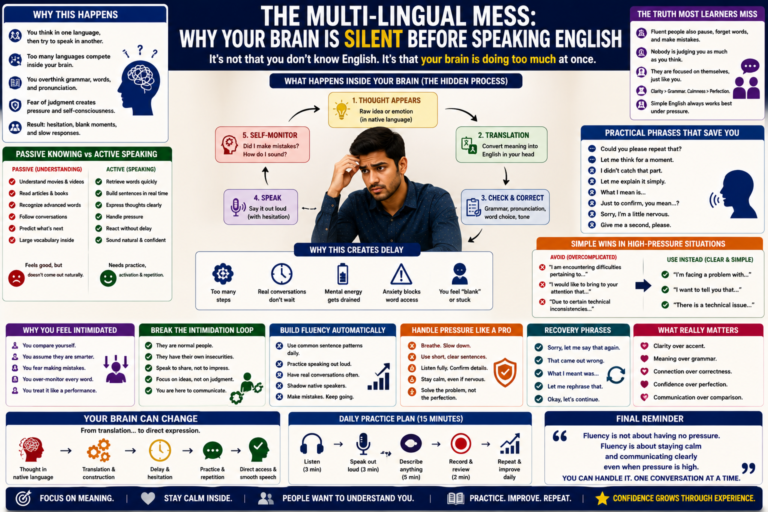
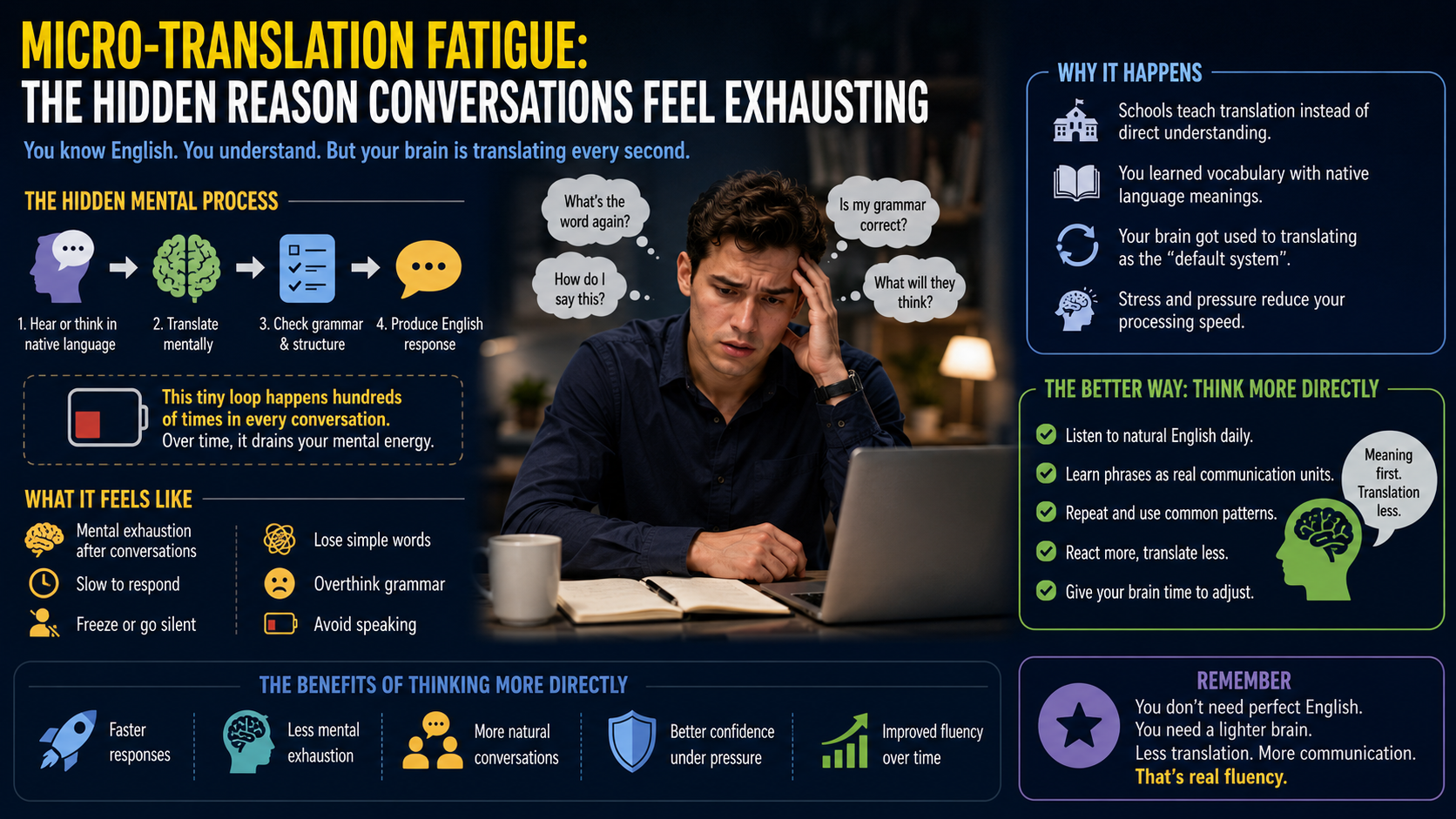
Instead, almost every sentence follows a hidden mental path:
Native language → Translation → Grammar checking → English output
And this process becomes mentally exhausting over time.
Especially during live conversations.
Because real conversations move fast.
People react quickly.
Topics change suddenly.
Questions appear unexpectedly.
Emotions affect thinking.
And while all of that is happening, the learner’s brain is still trying to manually convert thoughts word-by-word internally.
That creates what we can call:
micro-translation fatigue.
The exhaustion that comes from constantly translating tiny pieces of language mentally during communication.
And honestly, many learners do not even realize how much energy this habit consumes until they start reducing it.
One reason this issue becomes so frustrating is because learners often feel confused by their own inconsistency. Sometimes they understand English perfectly while watching videos quietly alone. Sometimes reading feels comfortable. Sometimes listening feels manageable. But during real conversations, especially stressful ones, everything suddenly becomes slower and harder again.
Why?
Because passive understanding and active communication are very different mental experiences.
During passive activities like watching YouTube or reading articles, your brain has time.
You can pause mentally.
You can infer meaning slowly.
You can relax.
But conversations demand instant processing.
And if your brain still depends heavily on internal translation, the pressure increases dramatically.
Actually, one of the biggest emotional signs of micro-translation fatigue is this strange feeling many learners experience after long English conversations:
mental exhaustion.
Not normal tiredness.
Cognitive tiredness.
Sometimes after a 30-minute English call, learners feel like their brain completed a difficult exam instead of a normal human conversation. They may need silence afterward. Their concentration drops. Their confidence decreases temporarily. Some even avoid future conversations because the mental effort feels overwhelming.
And honestly?
This experience is extremely understandable.
Because translation-heavy communication forces your brain to multitask constantly.
Imagine what is happening internally during even a simple conversation:
You hear English.
Your brain converts it into your native language.
You understand the meaning.
You think of a response in your native language.
Then mentally convert it into English.
Then monitor grammar.
Then monitor pronunciation.
Then worry about mistakes.
Then continue listening while still building your response.
That is an enormous amount of cognitive activity happening in seconds.
No wonder conversations feel exhausting sometimes.
And unfortunately, traditional language education accidentally reinforces this habit heavily.
Many school systems teach English through translation instead of direct understanding.
Students memorize vocabulary by pairing words with native-language meanings.
Grammar explanations happen through native-language comparisons.
Sentences are translated back and forth repeatedly.
Exams reward perfect conversion accuracy.
Over time, learners unknowingly train their brain to depend on translation as the “main operating system” for English.
But real fluency works differently.
Strong conversational speakers usually process meaning much more directly.
Not perfectly.
Not magically.
But more automatically.
For example, when native speakers hear:
“How’s your day going?”
They do not mentally translate every word individually.
The sentence arrives as one emotional meaning instantly.
Strong second-language speakers gradually develop something similar.
The phrase stops feeling like separate vocabulary pieces.
Instead, it becomes one familiar conversational idea.
That shift changes communication dramatically.
Because fluency is not only about vocabulary size.
It is also about processing efficiency.
And honestly, one of the biggest breakthroughs learners experience is the moment English stops feeling like constant decoding and starts feeling more immediate emotionally.
This is why some learners with “smaller vocabulary” actually sound more fluent than learners with advanced grammar knowledge. The more fluent-sounding learner often processes language faster and more directly instead of translating every piece consciously.
Another important thing to understand is that micro-translation fatigue becomes much worse under emotional pressure.
During relaxed situations, your brain may translate reasonably well.
But during:
meetings,
interviews,
support calls,
presentations,
live conversations,
or arguments,
the translation system often collapses partially.
Why?
Because stress reduces mental processing capacity.
And now your brain is trying to:
understand English,
manage emotions,
build responses,
and maintain confidence
all simultaneously.
That overload creates freezing.
Many learners mistakenly think:
“My English disappeared.”
But usually the problem is not missing knowledge.
The problem is mental overload caused by translation dependency under pressure.
Actually, this explains why some learners communicate much better through text than speech.
Text gives time.
Translation can happen slowly.
Editing is possible.
Mistakes can be corrected quietly.
But spoken conversation removes that safety buffer.
Everything becomes real-time.
And honestly, one of the most emotionally frustrating experiences happens when learners know exactly what they want to say in their native language but cannot convert it fast enough into English during live conversation.
That delay creates embarrassment sometimes.
Some learners become silent.
Others oversimplify constantly.
Some panic internally.
Some avoid speaking entirely.
And over time, many people begin assuming:
“I’m just bad at speaking English.”
But often the deeper issue is not lack of intelligence or lack of effort.
It is simply overdependence on internal translation.
The good news is that this can absolutely improve.
Because the brain is trainable.
You can gradually reduce translation dependency by exposing yourself to more direct English processing experiences. You can teach your brain to connect English directly with ideas, emotions, reactions, and situations instead of constantly routing everything through your native language first.
And honestly, this process feels strange at first because many learners are deeply emotionally attached to translation habits. Translation feels safe. Familiar. Controlled. Direct processing initially feels uncomfortable because your brain temporarily loses its old support system.
But over time something very interesting happens.
English begins feeling lighter mentally.
Conversations stop feeling like constant mental mathematics.
You react faster.
You hesitate less.
Listening improves.
Confidence improves.
And perhaps most importantly:
communication becomes less exhausting.
This article is going to explore all of this deeply.
We’re going to talk about:
why micro-translation fatigue happens,
why conversations become mentally draining,
how translation dependency affects fluency,
why some learners freeze during conversations,
how to reduce mental conversion habits,
how to think more directly in English,
how emotional pressure affects processing speed,
how to train automatic reactions,
and how to make English communication feel more natural instead of mentally overwhelming.
Most importantly, we’re going to approach this like a real cognitive and emotional process instead of just a grammar problem.
Because honestly?
Sometimes the biggest obstacle in English communication is not missing vocabulary.
It is the invisible exhaustion created by translating every tiny thought inside your head all day long.
Understanding What Micro-Translation Fatigue Actually Is
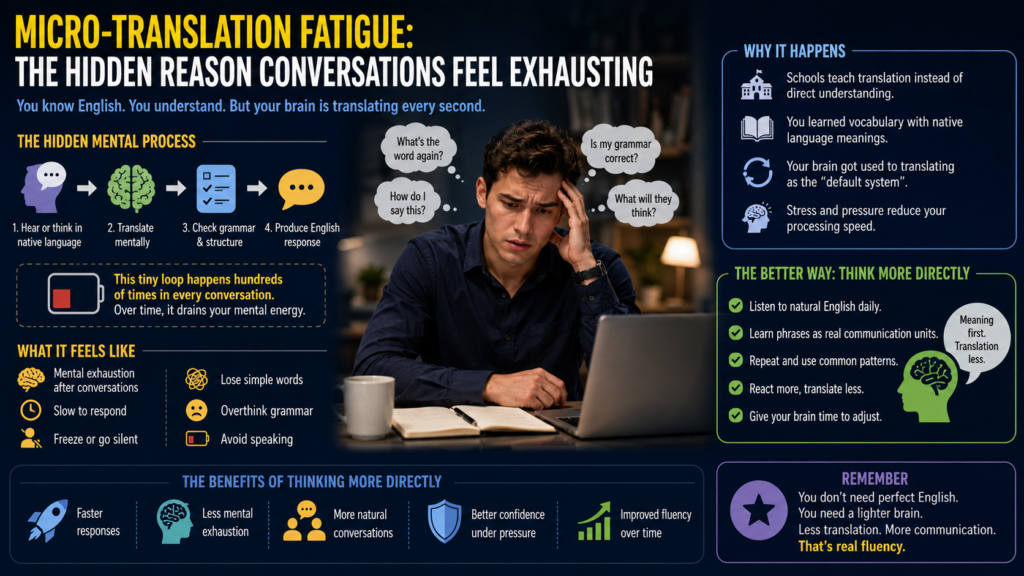
Micro-translation fatigue happens when your brain continuously performs small internal translation tasks during communication.
Not big textbook translations.
Tiny ones.
Constantly.
For example:
Someone says:
“What have you been working on lately?”
Your brain internally performs multiple fast conversions:
“What” → native meaning
“Working on” → contextual meaning
“Lately” → time meaning
Then your brain builds a response internally in your native language before converting it back into English.
All of this may happen within seconds.
But repeated hundreds of times daily, it becomes mentally exhausting.
Especially during long conversations.
And honestly, many learners do not notice this consciously because the process became automatic over years of study.
Why Schools Accidentally Create Translation Dependency
Traditional language learning often trains students to rely on translation constantly.
For example:
English word → native-language meaning
English sentence → translated sentence
Grammar rule → native-language comparison
This system helps beginners initially because translation creates understanding quickly.
But later, many learners never fully move beyond it.
Their brain keeps depending on translation as a permanent communication tool instead of temporary training support.
That creates slow processing.
And slow processing creates conversational stress.
Especially in live speaking situations.
Why Conversations Feel So Exhausting Sometimes
Many learners secretly wonder:
“Why do I feel mentally tired after speaking English?”
The answer is often cognitive overload.
Translation-heavy communication consumes enormous mental energy because your brain handles:
listening,
translating,
grammar monitoring,
sentence building,
pronunciation,
and emotional regulation simultaneously.
Even introverted native speakers sometimes feel socially tired after conversations.
Now add second-language translation processing on top of that.
Of course exhaustion happens.
And honestly, this is why some learners avoid English conversations unconsciously. Their brain begins associating English communication with mental fatigue.
The Difference Between Understanding and Processing
This distinction is extremely important.
Many learners actually understand more English than they think.
The problem is not always understanding.
The problem is processing speed.
For example, when reading slowly, learners may understand perfectly.
But during fast conversations, understanding collapses partially.
Why?
Because translation takes time.
And conversations rarely pause for your internal conversion process.
Strong conversational fluency depends heavily on faster meaning recognition.
Not perfect grammar knowledge alone.
Why Learners Freeze During Live Conversations
Freezing usually happens when translation demand exceeds processing capacity.
Your brain becomes overloaded temporarily.
This often happens during:
interviews,
meetings,
unexpected questions,
phone calls,
or emotionally stressful moments.
You may know the vocabulary.
Know the grammar.
Know the topic.
But your internal translation system cannot keep up fast enough under pressure.
That creates silence.
And honestly, many learners misinterpret this as:
“My English is terrible.”
But usually the deeper issue is mental overload, not missing intelligence.
Signs You’re Experiencing Micro-Translation Fatigue
Some very common signs include:
- Feeling mentally exhausted after conversations
- Translating almost every sentence internally
- Understanding slowly but struggling with speed
- Freezing during live speaking
- Needing extra time to respond
- Feeling more comfortable texting than speaking
- Building sentences first in your native language
- Losing track during fast conversations
- Feeling overwhelmed during group discussions
- Overthinking grammar constantly
If several of these feel familiar, translation dependency may be a major factor.
And honestly, this is extremely common worldwide.
Why Direct Thinking Feels Difficult Initially
Many learners say:
“I want to think in English directly, but I can’t.”
Actually, this is normal.
Your brain prefers familiar systems.
Translation feels safe because your native language already contains emotional certainty and automatic meaning.
Direct English processing initially feels unstable.
Your brain temporarily loses its “mental safety net.”
But gradual exposure changes this over time.
The goal is not forcing yourself violently to “think only in English.”
The goal is slowly reducing unnecessary translation dependence through repetition and familiarity.
My Opinion
Honestly, I think many learners accidentally increase mental exhaustion by monitoring grammar too aggressively during conversation.
Their brain becomes trapped in multiple simultaneous tasks:
translation,
grammar correction,
pronunciation checking,
word selection,
confidence management.
That overload destroys conversational flow.
Meanwhile many fluent communicators use simpler structures automatically without obsessing over perfection constantly.
Simple automatic English usually creates smoother conversations than overly monitored English.
How to Reduce Translation Dependency Gradually
The solution is not “stop translating immediately.”
That rarely works.
Instead, you gradually increase direct exposure to familiar English patterns.
For example:
instead of translating:
“How are you?”
Your brain eventually recognizes it instantly as one emotional interaction.
The same thing happens with:
“No problem.”
“That makes sense.”
“I’m not sure.”
“Sounds good.”
“Let me check.”
These become automatic conversational units over time.
This reduces processing load dramatically.
Why Repetition Matters So Much
Repetition trains automatic recognition.
Actually, strong conversational fluency often depends less on knowing infinite vocabulary and more on deeply familiarizing common language patterns.
The more often your brain hears:
“That’s a good point.”
“I’ll take a look.”
“Give me a second.”
“I’m working on it.”
The less translation becomes necessary.
Meaning recognition becomes immediate instead of analytical.
That changes fluency enormously.
How Listening Helps More Than Many Learners Realize
Listening trains direct processing.
Especially natural conversational listening.
Because your brain gradually learns:
rhythm,
tone,
reaction patterns,
common sentence structures,
emotional meanings,
and conversational flow.
This is why heavy exposure to authentic spoken English often improves fluency faster than endless grammar memorization alone.
Your brain starts recognizing patterns automatically instead of translating manually.
Why Introverts Often Experience This More Intensely
Interestingly, introverted learners sometimes experience micro-translation fatigue more strongly because they often process conversations deeply internally.
Many introverts naturally analyze language carefully.
That careful mental processing can increase over-monitoring during communication.
Especially under pressure.
And honestly, introverts are often extremely intelligent communicators internally.
Their challenge is usually processing speed under live social conditions, not lack of understanding.
How Emotional Pressure Slows English Processing
Stress affects working memory.
And working memory is crucial during second-language conversations.
When anxiety increases, your brain temporarily loses processing efficiency.
That’s why learners often:
forget familiar words,
freeze suddenly,
or struggle with simple sentences under pressure.
It’s not because knowledge disappeared.
It’s because emotional overload interrupted processing speed.
This happens even in native languages sometimes.
Why Simpler English Often Sounds More Fluent
Many learners try building complicated sentences because they want to sound advanced.
But under pressure, complex construction increases translation load heavily.
Simple communication reduces cognitive stress.
For example:
Instead of:
“I was attempting to determine the underlying cause…”
You can simply say:
“I was trying to figure out the problem.”
Shorter.
Cleaner.
Faster.
More natural.
And honestly?
Often more professional sounding too.
The Importance of Automatic Conversational Phrases
Strong communicators rely heavily on automatic reactions.
For example:
“Exactly.”
“Right.”
“That’s true.”
“Pretty much.”
“I see what you mean.”
“Fair enough.”
These phrases reduce mental workload because they become emotionally automatic instead of grammatically constructed each time.
That creates conversational rhythm naturally.
Why Texting Feels Easier Than Speaking
Texting allows:
pausing,
editing,
translating slowly,
checking grammar,
and rethinking responses.
Speaking removes all those safety mechanisms.
That’s why many learners communicate brilliantly through text but freeze during live calls.
The issue is usually processing speed and emotional pressure — not intelligence.
FAQs
What exactly is micro-translation fatigue?
It’s the mental exhaustion caused by constantly translating small pieces of language internally during communication instead of processing meaning directly.
Is translating always bad?
No. Translation helps beginners initially. The problem happens when translation remains the brain’s primary communication system permanently.
Why do I feel mentally tired after English conversations?
Because translation-heavy communication consumes significant cognitive energy. Your brain multitasks constantly during conversations.
Why can I understand English but not speak fluently?
Understanding and live processing are different skills. Speaking requires faster real-time processing under pressure.
How can I stop translating every sentence?
Gradually increase direct exposure to familiar English patterns through listening, repetition, and real conversation practice.
Is thinking directly in English possible?
Yes, gradually. But it develops naturally through familiarity and repetition, not through forcing yourself aggressively.
Why do I freeze during conversations even when I know the topic?
Usually because processing overload temporarily interrupts fluency under emotional pressure.
Does anxiety make translation fatigue worse?
Absolutely. Stress reduces working memory efficiency and slows language processing speed.
Why does simple English often sound more fluent?
Because simpler structures reduce mental overload and allow smoother conversational flow.
What is the biggest mistake learners make regarding fluency?
Often over-monitoring grammar and translating excessively instead of building automatic conversational familiarity.
CONCLUSION
Micro-translation fatigue is one of the most invisible yet emotionally exhausting parts of learning English.
Because the problem often hides beneath the surface.
Many learners assume:
“I just need more vocabulary.”
“I need more grammar.”
“I need better pronunciation.”
But sometimes the deeper issue is much simpler:
their brain is working too hard during communication.
Constant translation creates mental overload.
And honestly, once you begin reducing that overload gradually, English starts feeling completely different emotionally.
Lighter.
Faster.
Less stressful.
More natural.
Because real conversational fluency is not only about knowledge.
It is also about processing efficiency.
The more familiar English becomes emotionally and mentally, the less your brain needs constant conversion support.
And slowly, something very important begins happening:
You stop translating every tiny sentence.
You react faster.
You hesitate less.
Listening becomes easier.
Conversations become less exhausting.
And eventually English starts feeling less like solving a language puzzle and more like normal communication.
That’s the real breakthrough.
Not perfection.
Not advanced vocabulary.
Not sounding like a textbook.
Just reaching the point where your brain no longer treats every conversation like a difficult translation task.
And honestly?
That change can completely transform how English feels in everyday life.