The Code-Switching Dilemma: Why Indian Professionals Mix English and Hindi at Work
One of the most fascinating, misunderstood, and emotionally complex communication habits in modern Indian workplaces is something millions of professionals do every single day without even consciously realizing it:
switching between English and their native language constantly during conversations.
A meeting begins in English.
Then suddenly someone says:
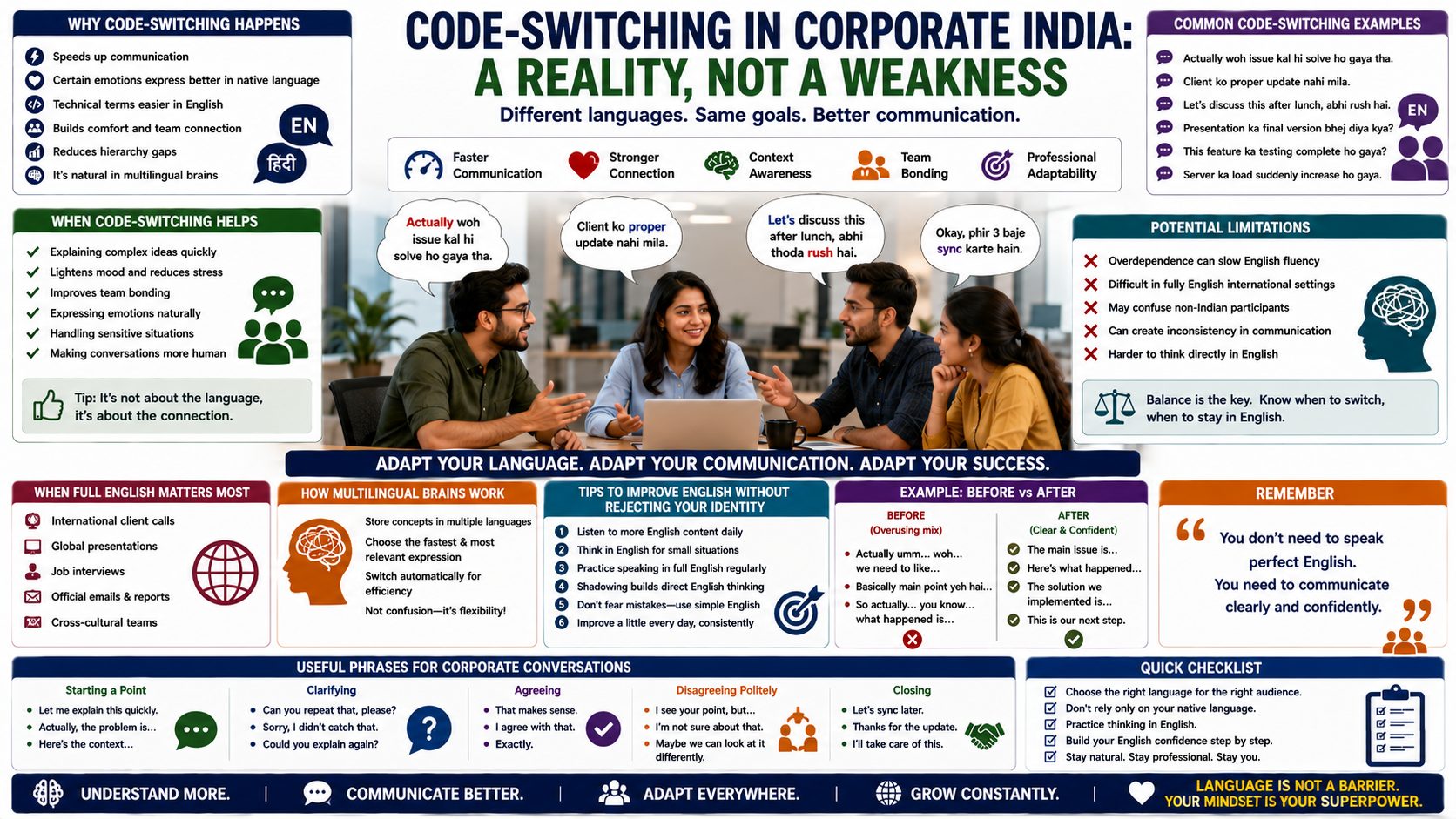
“Actually woh issue kal hi solve ho gaya tha.”
Another person replies:
“Yeah but client ko proper update nahi mila.”
Then someone else jumps in:
“Let’s discuss this after lunch, abhi thoda rush chal raha hai.”
And without anybody formally deciding it, the conversation keeps flowing naturally between English and another language.
This phenomenon is called:
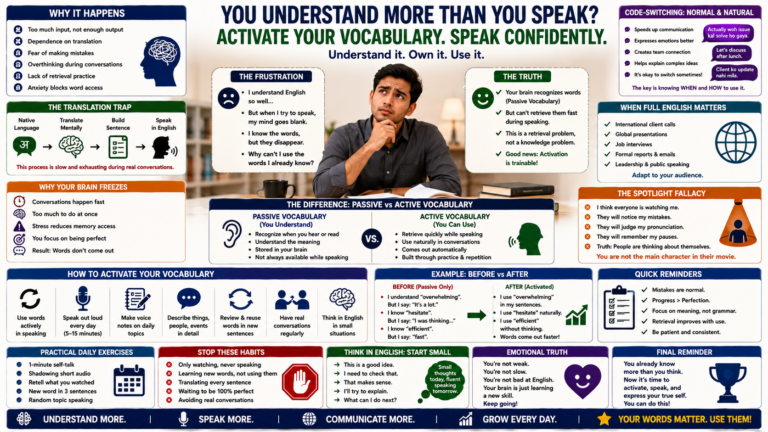
code-switching.
And honestly, in corporate India, it is everywhere.
IT companies.
Startups.
Remote teams.
Freelancing calls.
Agencies.
Banking offices.
Sales teams.
Corporate meetings.
Slack chats.
Zoom calls.
Coffee-break conversations.
Even interviews sometimes.
People constantly move between English and languages like Hindi, Tamil, Telugu, Bengali, Kannada, Marathi, Punjabi, Malayalam, Gujarati, and many others depending on context, comfort, emotion, hierarchy, and social environment.
But what makes this topic emotionally interesting is that many professionals secretly feel confused about whether code-switching is “good English,” “bad English,” professional, unprofessional, helpful, harmful, confident, or embarrassing.
Some people feel guilty doing it.
Some feel insecure because they cannot speak “pure English” continuously.
Some feel pressured to sound fully Westernized professionally.
Others feel judged for mixing languages too much.
And honestly, this creates a surprisingly deep psychological struggle for many English learners and working professionals in India.
Because corporate communication in India exists in a very unique linguistic environment.
Unlike countries where one language dominates almost everything professionally, India functions through multilingual reality.
A software engineer may think in Hindi,
code in English,
talk to family in Bhojpuri,
write emails in English,
joke with coworkers in Hinglish,
and explain technical problems in mixed language — all within the same day.
That mental flexibility becomes normal over time.
But many learners still internally wonder:
“Am I speaking correctly?”
“Should I avoid mixing languages?”
“Do professionals speak like this?”
“Will international clients judge this?”
“Does code-switching reduce fluency?”
“Why do I sound less fluent in pure English conversations?”
These questions are extremely common.
And honestly, one of the biggest problems is that traditional English education rarely discusses real multilingual communication honestly.
Schools often present language as rigid and separate:
Now speak English.
Now speak Hindi.
Now speak Tamil.
But real human communication is often much messier, more emotional, and more flexible than textbooks suggest.
Especially in India.
Actually, one of the reasons code-switching becomes so natural in corporate India is because it increases communication efficiency emotionally and socially.
Certain emotions feel easier in native languages.
Certain technical terms feel easier in English.
Certain jokes work better mixed.
Certain explanations become faster when switching briefly.
For example:
“Client thoda frustrated lag raha tha.”
“Server ka load suddenly increase ho gaya.”
“Presentation ka final version bhej diya kya?”
These mixed-language sentences often feel more natural to Indian professionals than fully English alternatives.
And honestly, there is an important emotional truth here:
language is not only about grammar.
It is also about identity, comfort, speed, belonging, and social connection.
That’s why code-switching happens so automatically sometimes.
People are not sitting there consciously planning:
“Now I will switch languages.”
The brain simply chooses whichever word or phrase feels most emotionally efficient at that moment.
Actually, multilingual brains naturally organize language differently from monolingual brains.
A multilingual speaker often stores:
concepts,
emotions,
reactions,
technical vocabulary,
social expressions,
and humor
across multiple languages simultaneously.
So during fast conversation, the brain retrieves whichever expression arrives fastest and feels most contextually appropriate.
That is not necessarily confusion.
That is multilingual processing.
And honestly, understanding this can remove enormous unnecessary shame from English learners in India.
Because many people secretly think:
“If I mix languages, my English must be weak.”
But reality is much more complicated.
Even highly fluent bilingual professionals code-switch naturally sometimes.
Not because they cannot speak pure English.
But because mixed communication sometimes feels:
faster,
warmer,
more expressive,
or socially smoother.
At the same time, there is another side to this conversation too.
Overdependence on code-switching can sometimes slow English fluency growth if learners never practice direct English processing properly.
This is where many professionals become trapped psychologically.
Their English works comfortably inside Indian mixed-language environments but suddenly feels weaker during:
international meetings,
client calls,
global presentations,
foreign interviews,
or fully English-speaking environments.
Why?
Because their brain became dependent on linguistic support from their native language during communication.
And honestly, this transition shock can feel emotionally uncomfortable.
A person may feel highly confident in Indian office conversations but suddenly nervous during fully English international interaction.
Not because they lack intelligence.
Not because their English is “bad.”
But because communication context changed completely.
Actually, this explains why some professionals say things like:
“Yaar office mein toh English theek lagti hai, but foreign client call mein confidence chala jata hai.”
That experience is extremely common.
Because multilingual communication environments create different kinds of fluency.
There is:
mixed-language fluency,
social fluency,
professional fluency,
technical fluency,
and fully immersive English fluency.
These overlap — but they are not identical skills.
Another important thing many people misunderstand is assuming code-switching always signals poor communication.
Not true.
Sometimes code-switching actually demonstrates strong social intelligence.
For example, good managers in India often adjust language dynamically depending on:
team comfort,
client presence,
seniority,
emotional tension,
or communication goals.
A leader may speak fully English during formal presentation but shift into mixed language during relaxed team discussion to create warmth and accessibility.
That flexibility can actually improve communication effectiveness enormously.
Because communication is not only about correctness.
It is also about connection.
And honestly, this is why corporate communication in India feels so culturally unique compared to many Western workplace environments.
Language here is fluid.
Adaptive.
Layered.
Emotional.
Strategic.
Social.
And deeply connected to identity.
This article is going to explore all of this deeply.
We’re going to talk about:
why code-switching happens,
why Indian professionals mix languages so naturally,
when code-switching helps communication,
when it becomes a limitation,
how multilingual brains process language,
why many learners feel insecure about mixed-language speaking,
how to improve professional English without rejecting your identity,
how to communicate effectively in international environments,
and how to balance comfort with fluency growth.
Most importantly, we’re going to approach this honestly instead of pretending professional communication always happens in “perfect textbook English.”
Because honestly?
Corporate India does not function in one language alone.
It functions in layers of language constantly interacting with each other every single day.
What Exactly Is Code-Switching?
Code-switching means switching between two or more languages during communication.
Sometimes this happens:
between sentences.
Sometimes:
inside the same sentence.
For example:
“Can you send the report today? Kal client meeting hai.”
Or:
“Actually mujhe lagta hai this approach is safer.”
This is extremely common across multilingual societies worldwide.
But in India, code-switching became deeply integrated into professional culture itself.
Especially in urban workplaces.
Why Code-Switching Feels So Natural in India
India is naturally multilingual.
Many people grow up hearing:
multiple languages,
regional dialects,
English education,
Bollywood dialogue,
internet slang,
and mixed-language conversations simultaneously.
So the brain becomes flexible early.
Actually, many Indian professionals do not mentally separate languages rigidly during casual thinking anymore.
Communication becomes meaning-focused instead of language-purity-focused.
That’s why mixed communication often feels emotionally effortless.
Why Corporate English in India Sounds Different
Corporate Indian English has developed its own rhythm culturally.
Not only because of accent differences.
But because multilingual influence shapes:
sentence structure,
tone,
word choice,
humor,
and conversational style.
For example, phrases like:
“Do one thing…”
“Prepone the meeting.”
“Revert back.”
“Only na?”
“Out of station.”
“Passing out from college.”
These became normalized through Indian workplace communication patterns.
Some expressions sound unusual internationally.
Others are widely understood locally.
That creates a unique professional communication culture.
Why Many Learners Feel Guilty About Mixing Languages
A lot of learners secretly believe:
“Real fluency means speaking pure English continuously.”
So when they code-switch naturally, they feel ashamed.
But honestly, this guilt often comes from unrealistic fluency expectations shaped by:
schools,
social media,
or comparison culture.
Many multilingual speakers worldwide switch languages naturally.
Even highly educated professionals.
The important question is not:
“Do you ever code-switch?”
The important question is:
“Can you adapt communication appropriately when needed?”
That’s a much healthier perspective
When Code-Switching Actually Helps Communication
Code-switching can improve:
speed,
clarity,
comfort,
emotional warmth,
team bonding,
and humor.
For example, during stressful office moments, native-language phrases sometimes create emotional relaxation instantly.
Mixed communication can reduce tension socially.
Especially in teams where everyone shares similar linguistic backgrounds.
That’s why many Indian offices naturally drift between languages throughout the day.
When Code-Switching Becomes a Limitation
At the same time, excessive dependence on mixed communication can slow English fluency growth.
Especially if learners:
avoid full English conversations constantly,
translate excessively,
or panic without native-language support.
This becomes visible during:
international meetings,
foreign interviews,
global conferences,
or fully English-speaking environments.
Suddenly the brain feels unsupported.
That creates hesitation sometimes.
Why International Calls Feel Different Emotionally
Many Indian professionals communicate comfortably in Indian office English but feel nervous with foreign clients.
Why?
Because code-switching support disappears.
Now communication depends entirely on direct English processing.
That shift increases mental pressure.
Especially if the brain became heavily dependent on multilingual conversational scaffolding.
And honestly, this transition difficulty is extremely normal.
My Opinion
Honestly, I think many people oversimplify this topic emotionally.
Code-switching is not automatically:
unprofessional,
wrong,
lazy,
or weak.
Nor is it automatically ideal everywhere.
It’s simply a communication behavior.
The real skill is adaptability.
Strong communicators understand:
when mixed communication helps,
when full English is necessary,
and how to shift comfortably between both environments.
That flexibility matters more than rigid language purity.
Why Language and Identity Feel So Emotionally Connected
Language is deeply emotional.
Your native language carries:
humor,
comfort,
childhood memories,
cultural identity,
family interaction,
and emotional instinct.
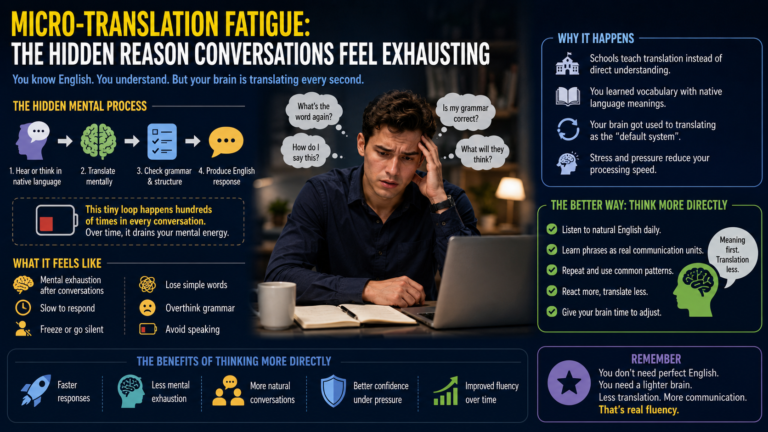
That’s why fully English environments sometimes feel mentally tiring emotionally for learners.
Not because English is “bad.”
But because emotional processing happens differently across languages.
And honestly, understanding this removes unnecessary self-judgment.
How Mixed Language Changes Workplace Relationships
Interestingly, code-switching often affects workplace dynamics socially.
Mixed language can:
create belonging,
increase friendliness,
reduce hierarchy tension,
and build team closeness.
For example, a manager shifting briefly into Hindi during stressful discussion may suddenly feel more approachable emotionally.
Language affects emotional atmosphere heavily.
Why Fully English Communication Still Matters
Even though code-switching is normal, strong English communication still matters professionally.
Especially for:
global freelancing,
international clients,
remote work,
leadership roles,
presentations,
and multinational collaboration.
The goal is not rejecting multilingual identity.
The goal is building enough English comfort to function confidently even without native-language support.
That’s a healthier goal.
How to Improve English Without Rejecting Your Natural Communication Style
Many learners think:
“To improve English, I must completely stop using my native language.”
That often creates frustration.
A better approach is gradual expansion.
For example:
practice more full-English listening,
consume English naturally,
join longer English conversations,
and slowly increase direct processing comfort.
Improvement works better through exposure than shame.
Why Some Professionals Sound Fluent Even With Simple English
Strong communicators often focus more on:
clarity,
tone,
confidence,
and flow
than advanced vocabulary.
Actually, many highly respected professionals speak relatively simple English very clearly.
Communication effectiveness matters more than sounding artificially sophisticated.
The Emotional Exhaustion of Constant Language Switching
Interestingly, frequent code-switching can sometimes create mental fatigue too.
Especially during:
high-pressure meetings,
multilingual environments,
or constant context switching.
Your brain continuously adjusts:
vocabulary,
tone,
social expectations,
and processing systems.
That cognitive flexibility is impressive — but tiring sometimes too.
How Global Teams Perceive Indian Corporate Communication
International teams usually care more about:
clarity,
professionalism,
and collaboration
than accent perfection.
But excessive local code-switching during global discussions can sometimes confuse non-Indian participants.
That’s why communication awareness matters.
Strong professionals adapt based on audience.
Why Introverts Sometimes Prefer Mixed-Language Communication
Introverted professionals often feel emotionally safer in mixed-language environments because emotional processing becomes easier.
Full-English environments may temporarily increase social pressure and self-monitoring.
That’s extremely common.
And honestly, comfort usually improves gradually through repeated exposure.
How Younger Corporate India Is Changing Communication
Interestingly, younger Indian professionals often move between languages even more fluidly than previous generations.
Internet culture,
memes,
social media,
remote work,
and global content consumption
created highly blended communication styles.
Especially in startups and digital industries.
Corporate communication itself is evolving continuously now.
FAQs
Is code-switching bad English?
Not necessarily. Code-switching is a natural multilingual communication behavior. The key issue is whether you can adapt appropriately when needed.
Why do Indian professionals mix English and native languages so much?
Because multilingual communication feels natural culturally, emotionally, and socially in India.
Does code-switching reduce English fluency?
Only if learners become completely dependent on it and avoid practicing direct English communication.
Why do I feel confident in Indian office English but nervous with foreign clients?
Because mixed-language conversational support disappears in fully English international environments.
Should I stop mixing languages completely?
Not necessarily. The healthier goal is adaptability, not language shame.
Is Hinglish unprofessional?
Context matters. In casual internal communication, Hinglish is extremely common. In formal international settings, clearer English may be more appropriate.
Why does pure English feel emotionally tiring sometimes?
Because emotional processing often feels more automatic in native languages.
Can someone be fluent and still code-switch?
Absolutely. Many highly fluent multilingual speakers code-switch naturally.
How can I improve full-English communication comfort?
Increase exposure gradually through listening, speaking practice, meetings, and direct English interaction.
What is the most important communication skill in multilingual workplaces?
Adaptability combined with clarity and emotional awareness.
CONCLUSION
Code-switching in corporate India is much more than “mixing languages.”
It reflects:
culture,
identity,
social comfort,
professional adaptation,
emotional intelligence,
and multilingual thinking itself.
And honestly, understanding this topic properly can remove enormous unnecessary insecurity from English learners and professionals.
Because many people spend years feeling ashamed of communication patterns that are actually extremely normal in multilingual societies.
The real goal is not becoming artificially “pure.”
The real goal is becoming adaptable.
Being able to:
switch comfortably when appropriate,
communicate clearly in professional situations,
function confidently in full-English environments,
and still remain emotionally natural in your own communication style.
That balance matters much more than perfection.
And honestly, strong communication is rarely about rigid language rules alone.
It’s about:
clarity,
connection,
awareness,
comfort,
and context.
Corporate India functions through linguistic flexibility every single day.
Meetings shift languages.
Teams blend expressions.
Humor moves between cultures.
Professional identity itself becomes multilingual.
That’s not failure.
That’s modern communication reality.
And once learners stop treating multilingual communication like a weakness, something important happens:
Confidence improves.
Because they stop fighting their brain constantly.
Instead, they begin developing the real professional skill that matters most:
The ability to communicate effectively across different people, environments, and cultural situations.
And honestly?
That is far more valuable than sounding artificially perfect all the time.