Why You Freeze in Casual Conversations: Overcoming Small Talk Anxiety in English as a Non-Native Professional
There is a very specific kind of discomfort that almost nobody prepares you for when you start using English in real life.
It is not the fear of grammar mistakes.
It is not the fear of pronunciation.
It is not even the fear of speaking in front of people.
It is something much more subtle, much more invisible, and honestly much more psychologically complex.
It is the moment when conversation is not about work, not about tasks, not about solving anything, but simply about being a human in front of another human.
That’s where the real tension appears.
Because suddenly the structure disappears.
There is no script.
No clear objective.
No technical direction.
Just two people standing in a conversational space where anything can be said… or nothing at all.
And for many people, especially non-native English speakers, freelancers, introverts, and professionals working in global environments, this is exactly where anxiety quietly enters.
Not loudly.
Not dramatically.
But silently.
Like a hesitation before speaking.
A pause that lasts a little too long.
A mind that suddenly becomes “too aware” of itself.
A simple question like:
“How are you?”
suddenly becomes mentally heavy.
Not because the question is difficult.
But because the mind starts processing too many layers at once.
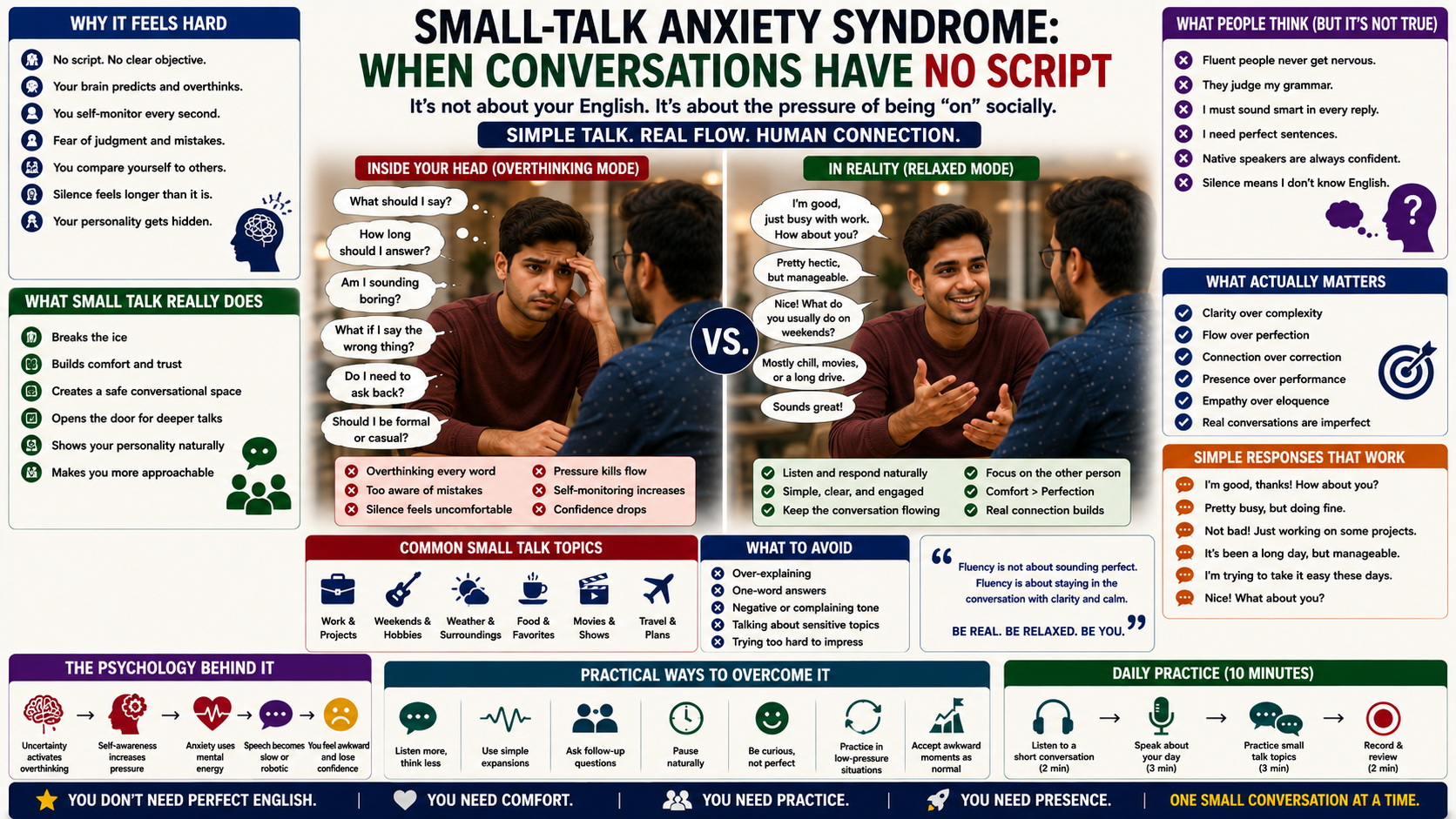
What should I say?
How long should I answer?
Should I sound formal or casual?
Is “good” enough?
Do I need to ask back?
What if I sound boring?
What if I sound unnatural?
And in that moment, communication stops being natural and starts becoming self-observation.
That shift is the root of what we can call the Small-Talk Anxiety Syndrome.
It is not a lack of English ability.
It is a disruption of conversational flow caused by self-monitoring pressure.
And what makes this even more interesting is that small talk is actually one of the most important social tools in professional environments today.
People underestimate it because it looks “useless” on the surface.
But in reality, small talk is the emotional gateway of communication.
Before trust is built through work…
Before clarity is built through explanations…
Before professionalism is judged through performance…
Comfort is built through small human signals.
A simple greeting.
A natural response.
A relaxed tone.
A soft acknowledgment.
A short personal connection.
These things do not look important on paper.
But in real conversations, they silently decide how safe and comfortable the interaction feels.
And safety is the foundation of communication.
If a conversation feels safe, people open up.
If it feels awkward, people close down.
If it feels natural, people engage.
If it feels forced, people disconnect.
This is why small talk has such a powerful psychological impact even though it looks extremely simple from outside.
But for many learners, the real challenge is not understanding small talk.
It is participating in it naturally in real time.
Because small talk does not wait.
It does not slow down.
It does not give you preparation time.
It happens instantly.
A greeting appears → you must respond.
A question appears → you must react.
A silence appears → you must decide whether to fill it or not.
And this real-time pressure creates a unique mental overload.
Your brain starts running multiple processes together:
Understanding language
Translating meaning
Choosing response
Controlling tone
Managing social perception
Avoiding mistakes
Maintaining confidence
And while all of this is happening internally, the conversation continues externally.
That mismatch between internal processing and external flow creates discomfort.
And discomfort creates hesitation.
And hesitation breaks natural communication rhythm.
That is why even fluent English learners sometimes struggle specifically with small talk.
Because small talk is not about knowledge.
It is about instant emotional response.
And most people are never trained for that.
Education systems usually teach structured English:
Writing essays
Formal letters
Grammar exercises
Prepared speeches
But real-world communication is not structured.
Especially small talk.
It is unpredictable, emotional, and fluid.
And anything that is fluid increases cognitive load for the brain.
This is why many people experience something like this:
In work conversations → they feel confident
In technical explanations → they feel capable
In writing → they feel controlled
But in small talk → they suddenly feel unsure
Because small talk activates something different:
It activates social awareness instead of logical thinking.
And social awareness is much harder to control.
You start thinking about perception:
Am I sounding friendly enough?
Am I being too formal?
Am I responding too slowly?
Am I saying too little?
Am I saying too much?
This internal monitoring creates friction in speech.
And friction destroys flow.
That is why Small-Talk Anxiety Syndrome is not really a language issue.
It is a flow disruption issue caused by over-awareness of self during spontaneous conversation.
And once this pattern becomes consistent, people start developing behavioral habits:
They shorten responses too much
They avoid expanding conversations
They wait for others to lead
They prefer silence over initiation
They feel relieved when conversation becomes technical again
Slowly, small talk becomes something to “survive” instead of something to participate in.
And that emotional shift is where confidence starts shrinking.
Because communication confidence is not only about speaking ability.
It is about comfort in spontaneous interaction.
And small talk is the purest form of spontaneous interaction.
No preparation.
No structure.
No predictability.
Just presence.
And presence is what most anxious speakers struggle with.
Not language.
Not intelligence.
Not knowledge.
Just presence in the moment.
But here is the important truth:
Small talk is not a performance skill.
It is a relaxation skill.
The more relaxed your mind becomes, the more natural your responses become.
And the more you stop trying to “perform correctly,” the more fluent you actually sound.
Because natural communication is not built from perfect sentences.
It is built from simple, continuous flow.
Even imperfect English can sound extremely natural if the flow is intact.
And even perfect English can sound awkward if flow is missing.
That is the paradox most learners never realize.
And this is exactly why Small-Talk Anxiety Syndrome is so important to understand.
Because once you recognize that the problem is not English itself but the pressure of spontaneous social response, your entire approach changes.
You stop preparing “perfect replies.”
You start practicing “natural continuation.”
You stop aiming for correctness.
You start aiming for flow.
And slowly, small talk stops feeling like a mental test.
It starts feeling like a normal human interaction again.
Deeper Understanding: Why Small Talk Feels Emotionally Heavy
Small talk feels heavy because it carries no task-based anchor. The brain prefers structured communication because structure reduces uncertainty. Without structure, the brain shifts into social prediction mode, trying to analyze tone, intention, and expected response patterns. This increases cognitive load, especially in second-language communication where processing speed is already divided.
Why Silence Feels More Awkward Than Wrong Answers
In small talk, silence is often perceived as hesitation or discomfort. This makes people rush responses or overthink unnecessarily. Interestingly, incorrect answers are usually less damaging than unnatural silence because conversations value flow more than perfection.
The Real Skill Behind Small Talk
The real skill is not “what to say,” but “how to stay in motion.” Motion means continuing the conversational rhythm even with simple phrases, short responses, or small acknowledgments.
My Opinion
From my perspective, small talk anxiety reduces mainly through emotional exposure, not study. The more you experience casual conversations, the more your brain normalizes uncertainty, and the less threatening it feels.
FAQs
Why do I freeze during small talk even if I know English?
Because freezing is caused by social pressure, not language limitation.
FAQ 2: Is small talk necessary in professional life?
Yes, it helps establish comfort and trust before serious communication.
FAQ 3: What is the best response to “How are you?”
A slightly expanded natural response works best, like “I’m good, just busy with work.”
FAQ 4: Why does my mind go blank during casual conversations?
Because your brain switches from structured thinking to spontaneous response mode.
FAQ 5: Can small talk improve with practice?
Yes, repeated exposure gradually reduces anxiety and builds automatic responses.
FAQ 6: Should I prepare small talk sentences?
Not necessary. It is better to develop flexible response habits.
FAQ 7: Why do I sound robotic in small talk?
Because you are consciously controlling sentences instead of speaking naturally.
FAQ 8: Do native speakers struggle with small talk?
Yes, but they rely on familiarity and automatic conversational habits.
FAQ 9: How do I make small talk more natural?
Use simple expansions and follow-up questions instead of short answers.
FAQ 10: What is the fastest improvement method?
Frequent low-pressure real conversations without overthinking performance.
CONCLUSION
Small talk is often misunderstood as a trivial part of communication, but in reality it is one of the most psychologically sensitive areas of human interaction. It is the space where language meets emotion, where structure disappears, and where natural flow becomes the only real requirement.
When you stop treating small talk as a performance and start treating it as a relaxed conversational flow, something important changes internally. The pressure reduces. The hesitation decreases. The mind stops over-monitoring itself. And communication begins to feel more human again.
And that is the real shift.
Not perfect English.
Not advanced vocabulary.
Not flawless grammar.
But natural presence in conversation.
And once that happens, small talk stops being a problem.
It becomes just another normal part of speaking.