Why Technical Support Conversations Feel So Emotionally Intense – Understanding the Conversation
One of the strangest things about modern life is how quickly a small technical issue can completely change your emotional state. Everything feels normal, your day is going fine, work is moving smoothly, payments are working properly, the internet is stable, and then suddenly something breaks. Your Wi-Fi disconnects during an important client call. Your banking app stops working right before a payment. Your card transaction fails while money still gets deducted. Your freelance payout becomes delayed. Your email suddenly refuses to send messages. Your hosting server crashes unexpectedly. And immediately your brain shifts into stress mode.
Now imagine adding English communication pressure on top of all that.
Honestly, this is where many English learners experience a completely different type of nervousness compared to normal conversations. Casual English practice feels manageable sometimes because mistakes do not feel dangerous there. But support conversations feel high-pressure because the situation already matters emotionally before the call even begins.
And this emotional pressure changes how your brain performs.
Suddenly simple sentences become difficult.
You start overthinking vocabulary.
You forget words you normally know easily.
You speak too fast.
You panic internally when the support agent talks quickly.
Sometimes your mind even freezes completely for a few seconds.
And honestly, this experience is incredibly common.
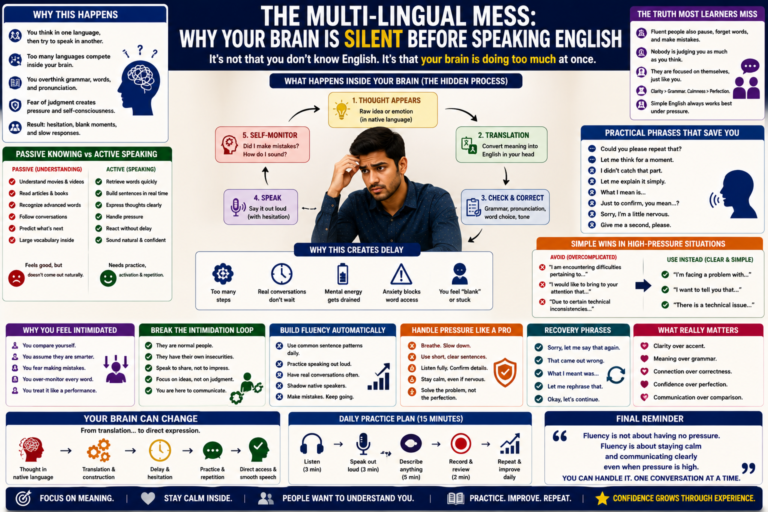
A lot of learners mistakenly think these moments mean their English is weak. But usually the bigger issue is emotional overload, not language knowledge. Because during stressful support conversations, your brain is trying to do many things at once:
understand the issue,
remember details,
listen carefully,
translate mentally,
manage frustration,
follow instructions,
and communicate clearly at the same time.
That is a huge amount of mental processing.
Actually, even native speakers sometimes struggle explaining problems clearly when they become stressed or frustrated. Now imagine handling the same pressure in a second language. Of course it feels harder.
One important thing many learners misunderstand is this:
Tech support conversations are not English exams.
Support agents are not sitting there judging grammar like teachers in a classroom.
Their job is simply to understand the issue and help solve it.
That’s it.
And honestly, support agents already communicate with people from different countries every single day. Different accents, different speaking speeds, different communication styles, different vocabulary levels — this is completely normal for them.
But learners often create unnecessary pressure for themselves because they think they must sound extremely professional or advanced during these conversations.
So instead of speaking simply, they start building long complicated sentences under stress.
And that usually makes communication harder.
For example, many learners think professional English should sound like this:
“I am encountering transactional complications associated with digital payment processing.”
But real-world communication usually sounds more natural like this:
“My online payment failed but the money was deducted.”
Simple.
Clear.
Easy to understand immediately.
And honestly, clarity matters far more than impressive vocabulary during support calls.
Another thing that makes these conversations emotionally difficult is unpredictability. During normal prepared conversations, you usually know the topic already. But support conversations can move in unexpected directions very quickly.
The agent may suddenly ask:
“When exactly did the issue start?”
“Could you verify the transaction amount?”
“What error message are you seeing?”
“Have you already restarted the router?”
“Can you confirm the last four digits?”
“Did you receive any SMS notification?”
Now your brain must instantly process the question, organize information, and respond clearly in English while still emotionally stressed about the actual problem itself.
That pressure causes many learners to panic internally.
Some start speaking too fast.
Some become overly silent.
Some begin rambling emotionally.
Some pretend to understand instructions even when they actually missed important information.
And honestly, pretending to understand is one of the biggest communication mistakes learners make during support calls.
Because mature communication is not about understanding everything perfectly on the first attempt.
It is about managing misunderstandings calmly.
That’s a huge difference.
Strong communicators regularly say things like:
“Sorry, could you repeat that?”
“Could you explain that more slowly?”
“Just to confirm, you mean…”
“I didn’t fully understand the last part.”
These are not signs of weak English.
These are signs of intelligent communication.
Even native speakers ask for clarification constantly during technical or banking conversations.
Another important reality is that support conversations follow patterns much more than learners realize.
Most calls usually include:
explaining the issue,
answering verification questions,
describing what happened,
following troubleshooting steps,
confirming account information,
asking for updates,
and understanding next actions.
The structure repeats again and again.
Which means you do not need perfect English fluency.
You need practical communication habits.
You need calmness.
You need listening skills.
You need clarity.
And honestly, one of the biggest mindset shifts that improves support-call communication is realizing this:
Simple English often sounds more professional during stressful situations.
Why?
Because stress reduces mental processing speed naturally.
Complicated language becomes harder for both sides to process.
Simple language creates smoother communication.
Actually, strong communicators during stressful situations often sound surprisingly simple:
“My internet disconnects every five minutes.”
“I can’t access my account.”
“The payment is still pending.”
“I restarted everything already.”
“I’m not receiving verification messages.”
That type of communication works extremely well because it is direct and understandable.
One interesting thing many learners notice over time is that confidence during support calls does not come from knowing thousands of vocabulary words.
It comes from familiarity.
The more real support conversations you survive, the more emotionally normal they begin feeling.
At first, every call feels intimidating.
But eventually your brain realizes:
“Oh. These conversations follow similar patterns.”
And suddenly communication becomes less scary.
That emotional normalization matters enormously.
Because fear itself often blocks fluency more than language limitations do.
Another thing learners often underestimate is the importance of listening during support conversations. Many people focus so heavily on what they want to say that they stop listening properly. But support calls require active listening because agents often provide:
step-by-step instructions,
security verification details,
technical explanations,
case numbers,
reset procedures,
or troubleshooting guidance.
If your brain is busy panicking about grammar constantly, you may miss important information.
This is why calmness becomes such an important communication skill.
Not fake confidence.
Calm confidence.
There’s a difference.
Calm communicators allow conversations to move naturally. They pause when needed. They ask for clarification comfortably. They do not mentally collapse every time they miss one sentence.
And honestly, this emotional stability makes communication feel much more professional.
One thing I’ve personally noticed is that learners improve dramatically once they stop trying to sound “advanced” and start focusing on being understandable. Because during real-life stressful situations, practical communication matters much more than elegant vocabulary.
The goal is not sounding impressive.
The goal is solving the problem clearly.
And honestly?
That mindset change makes support conversations much easier psychologically.
Why Stress Makes English Feel Worse Suddenly
Many learners become confused because their English ability seems to “disappear” during stressful support conversations.
But this is actually psychological.
Stress affects memory, concentration, listening, and speaking speed.
When people become anxious, their brain focuses more on danger and emotion than smooth communication.
That’s why you may suddenly forget simple words you normally know perfectly.
Or misunderstand sentences you would usually understand easily.
This does not mean your English became bad overnight.
It simply means stress temporarily affected performance.
And honestly, this happens in every language sometimes.
The important thing is learning how to stay calm enough to communicate clearly despite pressure.
The Biggest Communication Mistake During Support Calls
One major mistake many learners make is explaining too much emotionally.
For example:
“My internet is terrible and nothing works and this is ruining everything and I already tried many things and now I don’t know what’s happening…”
When people panic, their explanations become chaotic.
Strong communication is calmer and more structured:
“My internet started disconnecting this morning. I restarted the router twice, but the issue is still happening.”
Clear.
Organized.
Easy to follow.
Support agents solve problems faster when explanations stay structured.
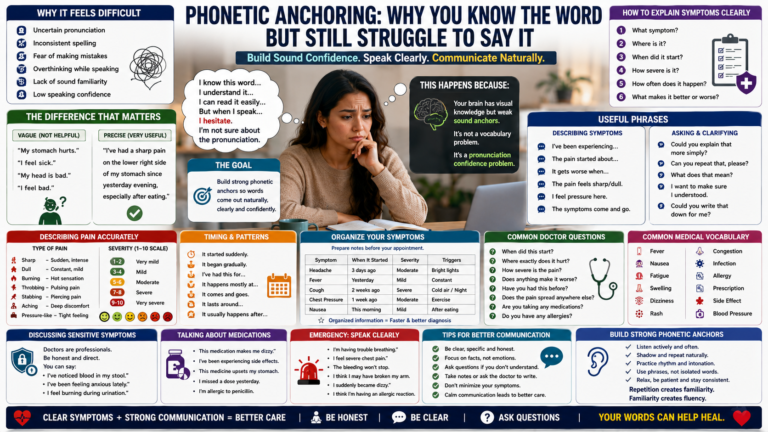
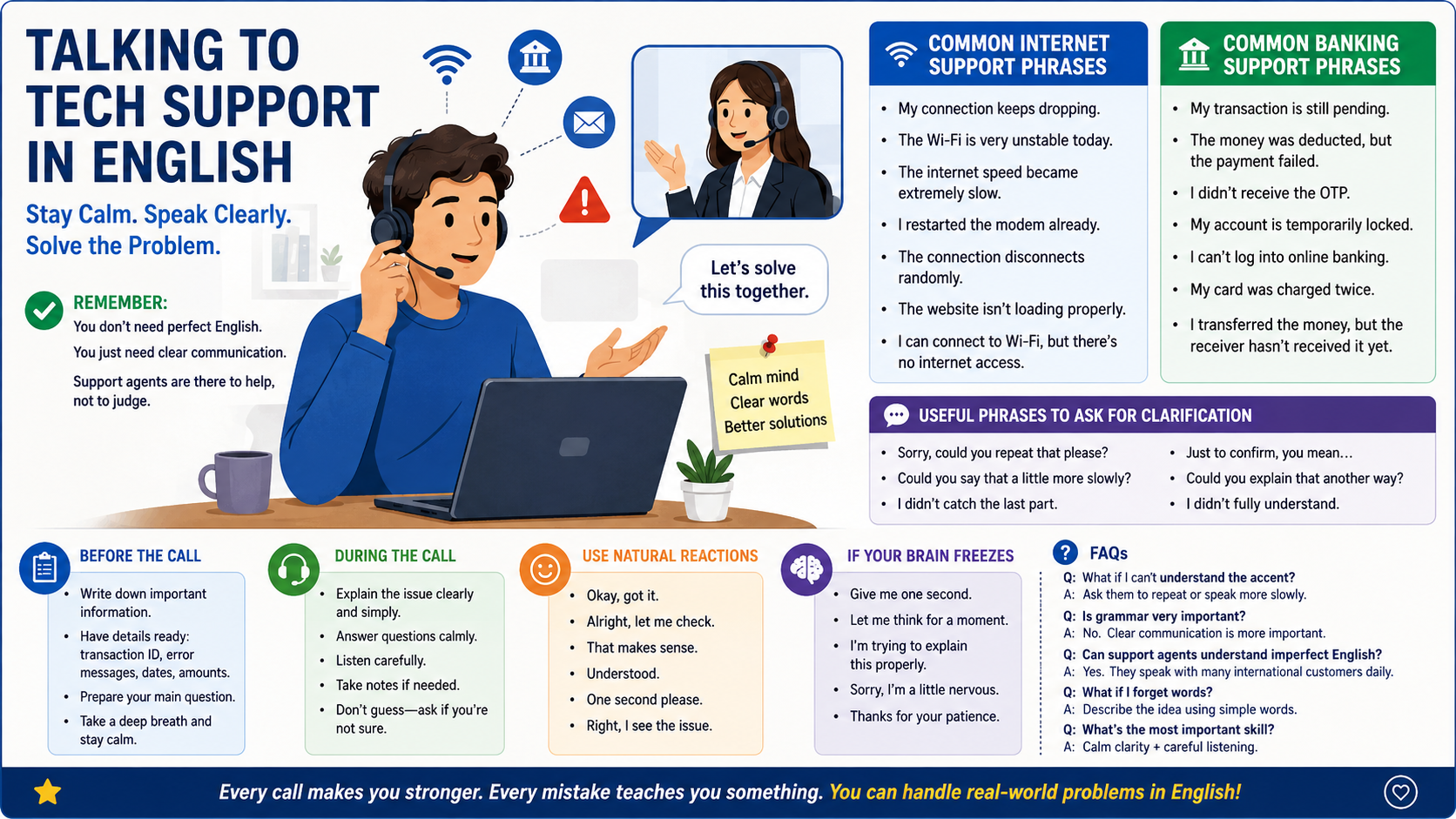
Common Internet Support English Phrases
Very common internet-related phrases include:
“My connection keeps dropping.”
“The Wi-Fi is very unstable today.”
“The internet speed became extremely slow.”
“I restarted the modem already.”
“The connection disconnects randomly.”
“The website isn’t loading properly.”
“I can connect to Wi-Fi, but there’s no internet access.”
These are practical real-world phrases that sound natural during support conversations.
Common Banking Support English Phrases
Banking conversations also follow predictable patterns.
Useful examples include:
“My transaction is still pending.”
“The money was deducted, but the payment failed.”
“I didn’t receive the OTP.”
“My account is temporarily locked.”
“I can’t log into online banking.”
“My card was charged twice.”
“I transferred the money, but the receiver hasn’t received it yet.”
Again, notice how simple the language is.
Professional communication does not need complicated vocabulary.
My Opinion: Calm Communication Solves More Problems Than Perfect English
Honestly, I think emotional calmness is one of the most underrated English communication skills in modern life.
Because people often focus entirely on vocabulary and grammar while ignoring emotional control completely.
But during stressful support conversations, calmness matters enormously.
Panic creates confusion.
Confusion creates poor explanations.
Poor explanations slow down solutions.
Meanwhile calm communication sounds professional even with basic English.
Actually, some of the best communicators intentionally simplify their language during stressful situations because simpler communication reduces misunderstanding.
And honestly, support agents usually appreciate calm customers too.
The conversation becomes easier for everyone involved.
How to Ask for Repetition Without Feeling Embarrassed
This is an extremely important skill.
Never pretend to understand instructions you missed.
Useful phrases include:
“Sorry, could you repeat that please?”
“Could you say that a little more slowly?”
“I didn’t catch the last part.”
“Just to confirm, you mean…”
“Could you explain that another way?”
These phrases are normal.
Professional.
Useful.
And honestly, even native speakers use them constantly.
Why Listening Carefully Matters So Much
Support calls often involve important details:
account numbers,
dates,
confirmation codes,
verification steps,
troubleshooting instructions,
security information,
or payment details.
Strong listening reduces mistakes significantly.
And one interesting thing about confident communicators is that they usually listen more carefully because they are not internally panicking every second.
Their attention stays on the conversation instead of on self-judgment constantly.
How to Sound More Natural During Calls
Real support conversations are usually conversational, not robotic.
Natural phrases include:
“Okay, got it.”
“Alright, let me check.”
“That makes sense.”
“Understood.”
“One second please.”
“Right, I see the issue.”
These small reactions create conversational rhythm naturally.
Without them, speech can sound stiff and unnatural.
What to Do If Your Brain Completely Freezes
This happens to many learners during stressful calls.
Honestly, don’t panic.
Use small buffer phrases:
“Give me one second.”
“Let me think for a moment.”
“I’m trying to explain this properly.”
“Sorry, I’m a little nervous.”
Human honesty often relaxes conversations surprisingly quickly.
Most support agents become more patient once they understand someone is slightly struggling with communication.
FAQs
What if I cannot understand the support agent’s accent?
This is extremely common. Politely ask them to repeat or slow down. Focus on understanding key information instead of every single word.
Is grammar extremely important during support calls?
Not really. Clear understandable communication matters much more than perfect grammar.
Why do I panic during support conversations even when I know English?
Because stress affects fluency. This is emotional pressure, not lack of intelligence.
Should I use very formal English?
Usually no. Simple professional English sounds more natural and easier to understand.
What if I forget vocabulary?
Describe the idea using simpler words. Communication is about meaning, not perfect vocabulary recall.
Can support agents understand imperfect English?
Yes. Most agents regularly speak with international customers from many language backgrounds.
How can I improve my listening skills?
Practice listening to natural spoken English regularly: podcasts, interviews, customer support examples, and conversations.
Should I prepare before important support calls?
Absolutely. Write down important information beforehand:
transaction details,
error messages,
dates,
amounts,
and key questions.
Preparation reduces panic significantly.
What should I do if I misunderstand instructions?
Clarify immediately instead of pretending. Asking again is much better than making the problem worse.
What is the most important support-call communication skill?
Probably calm clarity. Clear explanations combined with careful listening solve most communication problems effectively.
CONCLUSION
Talking to a tech support agent in English can feel stressful in the beginning, especially when the issue already feels urgent, frustrating, or emotionally exhausting.
But honestly, these conversations become dramatically easier once you stop trying to sound perfect and start focusing on something much more practical:
Clear communication.
That’s the real goal.
Not impressive vocabulary.
Not flawless grammar.
Not fake confidence.
Just calm, understandable communication.
Because most support conversations follow predictable patterns once you experience enough of them. You explain the problem, answer questions, follow instructions, clarify misunderstandings, and confirm solutions.
That’s usually the flow.
And slowly, through repeated real-world experience, your brain stops treating these conversations like danger.
That’s when communication starts feeling easier naturally.
You stop freezing as much.
You stop overthinking every sentence.
You stop panicking when someone asks unexpected questions.
Instead, you begin focusing on solving the problem calmly.
And honestly, that shift changes everything because modern life depends heavily on digital systems now.
Internet services.
Banking apps.
Online payments.
Freelancing platforms.
Cloud tools.
Subscriptions.
Technology is everywhere.
Which means practical English communication skills matter everywhere too.
Thankfully, these skills improve through experience.
Every support call helps.
Every awkward moment helps.
Every clarification helps.
Every stressful conversation teaches your brain something important:
“I can handle real-world problems in English.”
And eventually, instead of feeling terrified every time something goes wrong online, you simply think:
“Alright. Let’s explain the issue clearly and solve it.”