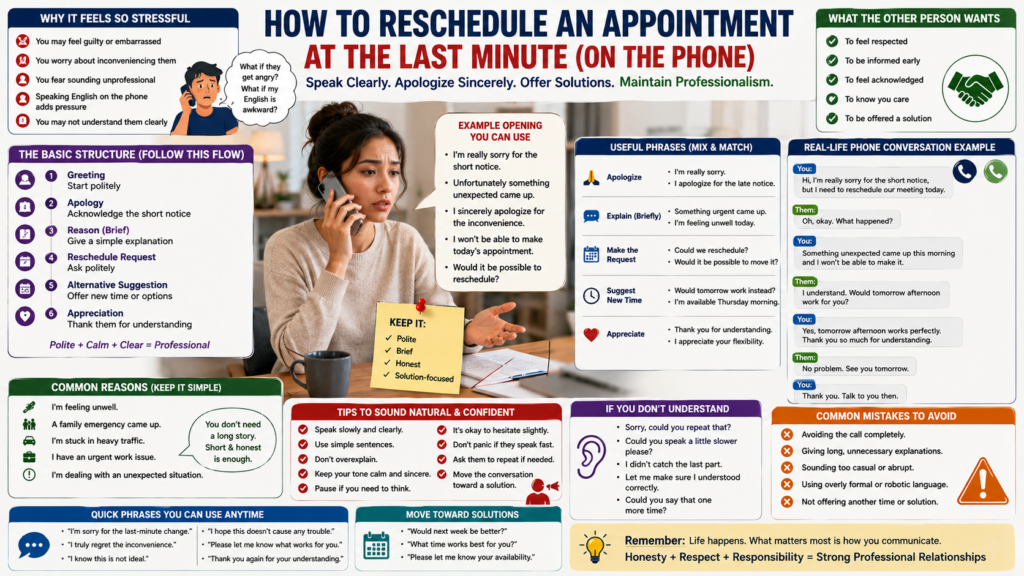
The Rescheduling Panic: How to Change Appointments at the Last Minute in English via Phone Call Without Sounding Unprofessional or Evaporating Trust
One of the most emotionally uncomfortable real-life English communication situations is calling someone at the last minute to reschedule an appointment. Honestly, even native English speakers sometimes feel nervous during these conversations because they combine several stressful emotions together at the same time. You may already feel guilty for changing plans late, worried about inconveniencing someone, anxious about sounding irresponsible, stressed about explaining the reason clearly, and nervous about handling the conversation professionally. When English is not your first language, the pressure often becomes much heavier because now your brain is also trying to manage pronunciation, listening comprehension, vocabulary, confidence, tone, speed, and real-time thinking simultaneously during a live phone call.
Many English learners fear phone conversations much more than face-to-face communication. This is extremely common. During in-person conversations, your brain receives many extra support signals naturally. You can see facial expressions, body language, gestures, eye contact, lip movement, and emotional reactions. All of these things help communication feel easier because understanding does not depend only on words. But during a phone call, all visual support disappears completely. Suddenly, communication depends almost entirely on:
- listening ability
- speaking clarity
- pronunciation
- processing speed
- confidence
- emotional control
This is why many learners feel nervous even before dialing the number.
Now add “last-minute rescheduling” into the situation.
Immediately the emotional pressure becomes stronger.
Your mind may start creating stressful thoughts like:
- “What if they get angry?”
- “What if they think I’m unprofessional?”
- “What if my English sounds awkward?”
- “What if I freeze during the conversation?”
- “What if they ask unexpected questions?”
- “What if I cannot understand them properly?”
- “What if they speak too fast?”
- “What if I sound rude accidentally?”
Because of this anxiety, many people delay the call longer and longer.
Ironically, delaying the conversation usually makes the situation worse because the appointment becomes even closer. Some people even avoid the call completely and simply do not show up, which damages trust far more than honest communication ever would.
This happens constantly in real life.
A student suddenly becomes sick before an exam consultation.
A freelancer faces a family emergency before a client meeting.
A job candidate gets stuck in heavy traffic before an interview.
A patient realizes they cannot arrive on time for a medical appointment.
A remote employee loses internet connection before an important Zoom call.
A parent needs to reschedule a school meeting because of a child emergency.
Life becomes unpredictable sometimes.
Strong communication is not about never having scheduling problems.
Strong communication is about handling those situations responsibly, respectfully, calmly, and clearly.
One of the biggest misunderstandings many English learners have is believing they need extremely advanced business English during these conversations. But honestly, real professional communication is usually much simpler and more human than learners imagine. Native speakers rarely sound like corporate textbooks during stressful phone calls. Instead, they normally speak naturally, politely, and directly.
For example:
- “I’m really sorry for the short notice.”
- “Unfortunately something unexpected came up.”
- “Would it be possible to reschedule?”
- “I sincerely apologize for the inconvenience.”
- “I won’t be able to make today’s appointment.”
These sentences are simple.
But emotionally, they sound professional and respectful.
Another important thing to understand is that rescheduling conversations are not only about information.
They are also about emotional professionalism.
The other person mainly wants to feel:
- respected
- informed
- acknowledged
- considered
- not ignored
This means your tone matters heavily.
Compare these two approaches.
Cold Version
“I can’t come today.”
Professional Version
“I’m really sorry for the short notice, but unfortunately something urgent came up and I won’t be able to make today’s appointment.”
Both communicate cancellation.
But emotionally, they feel completely different.
The second version shows:
- responsibility
- respect
- professionalism
- emotional awareness
Another major challenge for English learners is overexplaining nervously.
When people feel guilty, they often start giving huge emotional stories:
- “My cousin called and then traffic happened and actually yesterday…”
- “The weather and my neighbor and my train…”
But professional rescheduling conversations usually work better when they stay:
- polite
- calm
- concise
- solution-focused
In most situations, simple explanations are enough.
Examples:
- “I’m feeling unwell today.”
- “A family emergency came up.”
- “I’m dealing with an unexpected work issue.”
- “I’m running significantly behind schedule.”
- “Something urgent happened this morning.”
That is usually sufficient.
Another thing learners fear is accidentally sounding rude.
Since phone calls happen quickly, many people overanalyze their tone afterward:
- “Did I sound too direct?”
- “Did I apologize enough?”
- “Did I sound cold?”
- “Was my voice too nervous?”
This fear is understandable because spoken English depends heavily on tone, rhythm, and emotional delivery.
But honestly, calm respectful phrases naturally soften conversations.
Useful phrases include:
- “I sincerely apologize.”
- “I appreciate your understanding.”
- “I know this is short notice.”
- “Thank you for being flexible.”
- “I’m very sorry for the inconvenience.”
These expressions create emotional professionalism naturally.
Another major challenge is understanding the other person during the phone call itself.
Many learners practice speaking alone but panic when real responses come unexpectedly.
The other person may:
- ask questions quickly
- suggest new times
- mention cancellation policies
- speak faster than expected
- interrupt naturally
- ask follow-up questions
This creates mental overload because your brain is trying to:
- listen
- translate mentally
- think
- organize answers
- speak
all at the same time.
But one extremely important professional communication skill is learning how to slow conversations down politely.
Useful phrases include:
- “Sorry, could you repeat that?”
- “Could you speak a little slower please?”
- “Let me make sure I understood correctly.”
- “Would next Thursday work instead?”
- “Could you say that one more time?”
These are normal communication tools.
Not signs of weakness.
Another important reality is that rescheduling conversations happen constantly across modern life:
- medical appointments
- business meetings
- online consultations
- job interviews
- tutoring sessions
- freelance calls
- salon appointments
- customer bookings
- coaching sessions
- Zoom meetings
Because these situations are so common, learning these communication patterns improves practical English confidence enormously.
One thing strong communicators understand deeply is that professionalism is not perfection.
Professionalism means:
- communicating early
- respecting other people’s time
- taking responsibility
- staying calm under pressure
- offering solutions respectfully
Even when unexpected problems happen.
This guide will explore:
- how to reschedule appointments politely in English
- how to sound natural during phone calls
- how to apologize professionally
- how to suggest new times confidently
- how to manage phone anxiety
- how to handle difficult responses calmly
- how to avoid sounding robotic
- how to communicate clearly under pressure
Most importantly, we are going to approach this like real-world human communication instead of stiff textbook English.
Because honestly?
One of the strongest signs of real conversational fluency is the ability to handle uncomfortable situations calmly in English.
Why Phone Calls Feel More Stressful Than Texting
Phone calls create pressure because conversations happen live.
There is:
- no delete button
- no editing
- no extra thinking time
- no grammar correction option
Your brain must:
- listen
- understand
- process meaning
- prepare responses
- speak clearly
almost instantly.
This feels mentally exhausting for many learners initially.
Especially during emotional situations.
Why Last-Minute Rescheduling Feels Emotionally Awkward
Humans naturally dislike inconveniencing others.
That is why rescheduling late often creates emotions like:
- guilt
- embarrassment
- anxiety
- nervousness
- discomfort
This emotional discomfort sometimes makes communication harder than the language itself.
Ironically, calm honest communication usually solves situations much faster than avoidance.
The Psychology of Phone Anxiety
Many learners fear phone conversations because they cannot predict the interaction fully.
Text messages feel safer because:
- you can think slowly
- reread messages
- edit mistakes
- use translation tools
Phone calls remove that safety.
But confidence improves dramatically when conversational patterns become familiar.
The more you practice:
- greetings
- apologies
- rescheduling requests
- clarification phrases
the less frightening phone calls become.
Common Real-Life Rescheduling Situations
| Situation | Typical Reason |
|---|---|
| Doctor Appointment | Feeling sick |
| Job Interview | Traffic delay |
| Client Meeting | Emergency work issue |
| Online Class | Internet failure |
| Salon Booking | Personal emergency |
| School Meeting | Child-related issue |
| Zoom Call | Technical problem |
| Freelance Consultation | Schedule conflict |
Understanding real situations helps conversations feel more realistic and less robotic.
The Basic Structure of Rescheduling Conversations
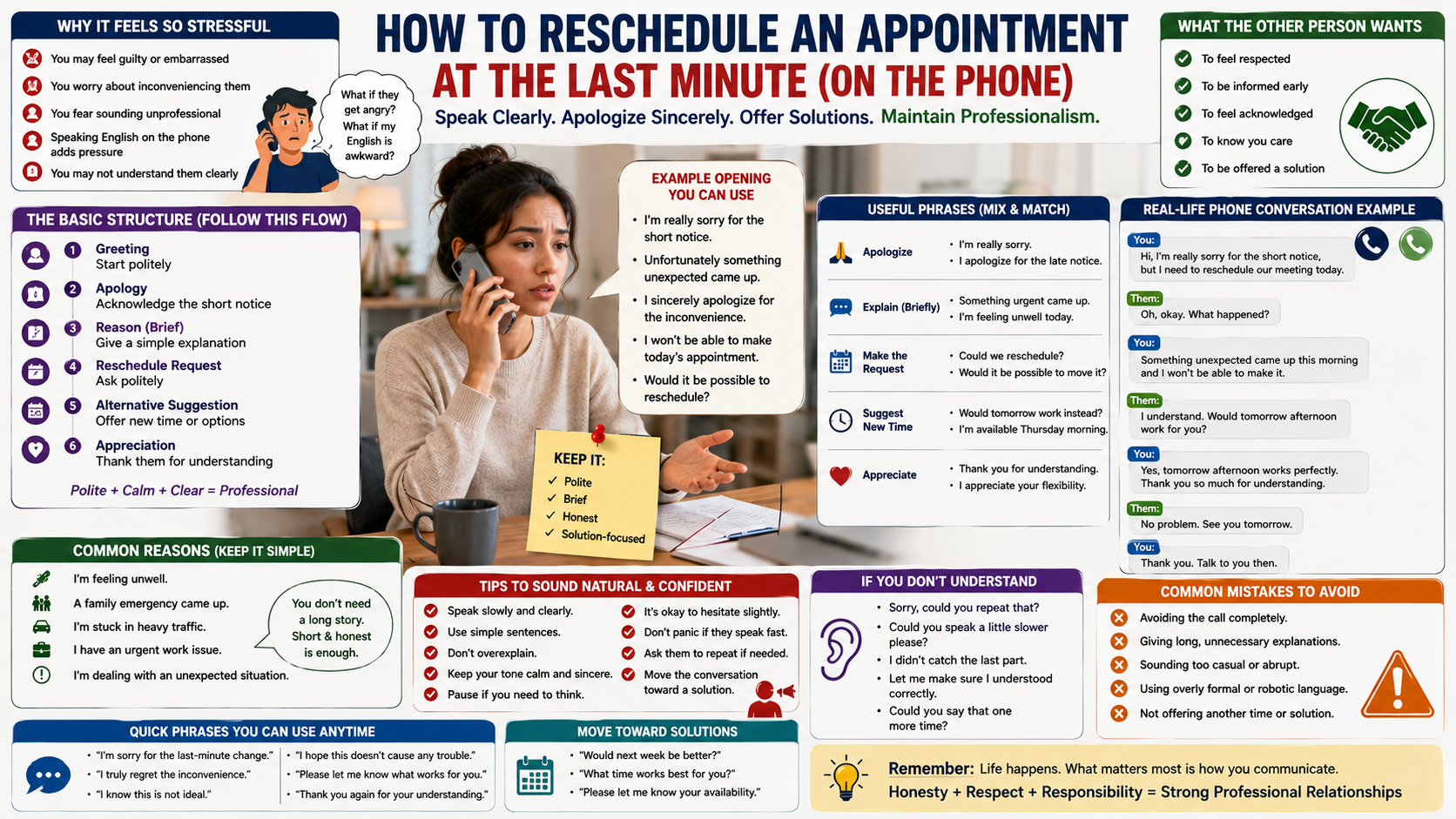
Most professional rescheduling calls follow this simple structure:
| Step | Purpose |
|---|---|
| Greeting | Start politely |
| Apology | Acknowledge inconvenience |
| Explanation | Brief reason |
| Reschedule Request | Ask respectfully |
| Alternative Suggestion | Offer new time |
| Appreciation | End positively |
Once learners understand this structure, anxiety often decreases dramatically.
Practical English Phrases for Rescheduling
Useful natural phrases include:
- “I’m really sorry for the short notice.”
- “Unfortunately something unexpected came up.”
- “Would it be possible to reschedule?”
- “I won’t be able to make today’s appointment.”
- “I sincerely apologize for the inconvenience.”
- “Could we move the appointment to another day?”
- “Would next week work instead?”
- “Thank you for understanding.”
- “I appreciate your flexibility.”
These phrases sound:
- polite
- calm
- realistic
- professional
- human
Formal vs Natural English
Many learners memorize extremely formal textbook phrases like:
“I regret to inform you that I shall be unable to attend the scheduled appointment.”
Technically correct?
Yes.
Natural in daily life?
Not usually.
Most native speakers say something simpler:
“I’m really sorry, but I need to reschedule today’s appointment.”
Professional communication does NOT require sounding robotic.
Real-Life Example Conversation
Example 1: Medical Appointment
Caller
“Hi, I’m really sorry for the short notice, but unfortunately I need to reschedule today’s appointment.”
Receptionist
“No problem. What happened?”
Caller
“I’m feeling unwell this morning and don’t think I’ll be able to make it.”
Receptionist
“Okay, would next Monday work instead?”
Caller
“Yes, that would be perfect. Thank you for understanding.”
Simple.
Natural.
Professional.
Example 2: Client Meeting
Caller
“Hello, I sincerely apologize for the late notice, but I’m dealing with an unexpected situation today and won’t be able to attend our scheduled meeting.”
Client
“I understand. Would tomorrow afternoon work?”
Caller
“Yes, tomorrow afternoon would work well for me. I appreciate your flexibility.”
Notice the emotional tone:
- respectful
- calm
- solution-focused
Why Tone Matters More Than Perfect Grammar
Many learners worry too much about grammar mistakes.
But during phone calls, emotional tone matters heavily too.
People mainly notice:
- politeness
- sincerity
- calmness
- clarity
A small grammar mistake usually matters far less than sounding careless or rude.
How to Sound Calm Even If You Feel Nervous
One useful trick is slowing your speaking speed slightly.
Nervous people often:
- speak too fast
- mumble
- overexplain
- panic-fill silence
Instead:
- pause briefly
- breathe slowly
- speak clearly
- keep sentences simple
Calm delivery automatically sounds more confident.
Common Mistakes During Rescheduling Calls
Mistake 1: Avoiding the Call Completely
This damages trust far more than honest communication.
Mistake 2: Overexplaining Nervously
You usually do NOT need your entire life story.
Short explanations work better.
Mistake 3: Sounding Too Casual
Example:
“Yeah I can’t come today bye.”
Too abrupt.
Mistake 4: Sounding Too Robotic
Example:
“I regret to formally notify you…”
Too unnatural.
Balanced natural professionalism works best.
My Opinion
Honestly, one of the biggest mistakes learners make is believing they must sound extremely impressive during stressful phone calls.
But real professionalism usually sounds:
- simple
- calm
- respectful
- direct
For example:
“I’m sorry for the late notice, but I’m feeling unwell today and need to reschedule.”
This already sounds responsible and mature.
No need for dramatic overexplanations.
How to Ask Someone to Repeat Information
Fast English feels difficult during phone calls because there are no visual clues.
Useful phrases include:
- “Sorry, could you repeat that please?”
- “I didn’t catch the last part.”
- “Could you speak a little slower?”
- “Let me write that down.”
- “Could you say that one more time?”
These are completely normal professional communication tools.
How to Suggest a New Time Naturally
Strong communicators quickly move toward solutions.
Useful examples:
- “Would tomorrow afternoon work instead?”
- “I’m available Thursday morning.”
- “Could we reschedule for next week?”
- “Please let me know what works best for you.”
- “Would sometime after 3 PM be possible?”
This keeps conversations productive instead of awkward.
Real-Life Human Communication Matters
One major problem with textbook English learning is that conversations often sound emotionally unrealistic.
Real humans:
- hesitate slightly
- apologize naturally
- sound imperfect sometimes
- speak emotionally
- adjust tone dynamically
That is normal.
And understanding this makes real conversations feel much less intimidating.