Phonetic Anchoring for Non-Native Speakers – Full Process Understand
One of the strangest and most frustrating experiences many English learners face is this:
You know the word.
You understand the meaning.
You have seen the word many times before.
You can even read it comfortably.
But the moment you try to say it during a real conversation, your brain suddenly becomes uncertain.
Your pronunciation feels unstable.
Your confidence drops.
You start second-guessing yourself.
And suddenly a very simple word feels emotionally difficult.
Honestly, this experience is incredibly common among non-native English speakers, especially adults who learned English academically instead of conversationally.
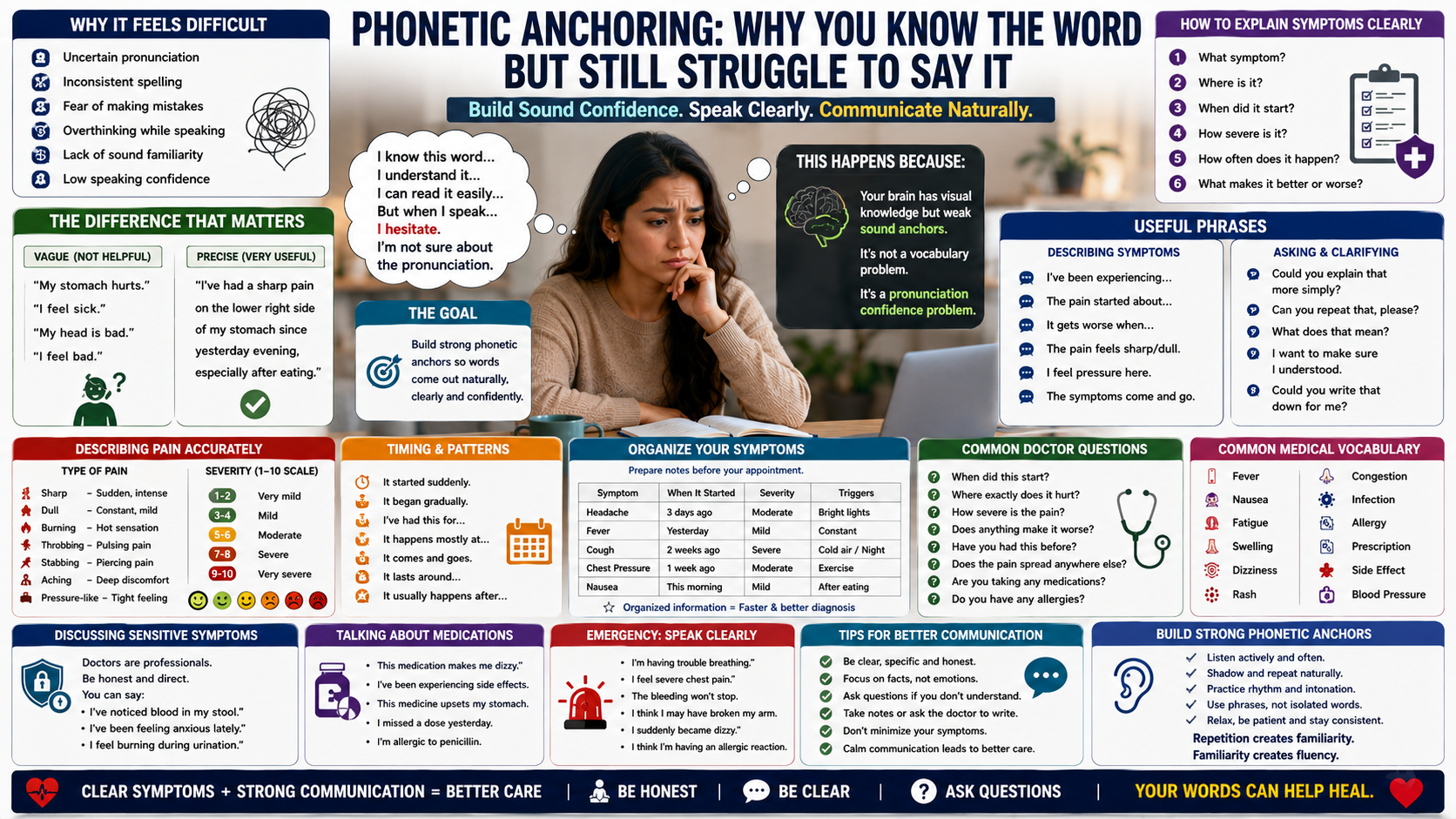
A lot of learners secretly believe pronunciation problems happen because they are “bad at English” or because they lack natural speaking ability. But in reality, pronunciation struggles are often deeply connected to something much more psychological:
Your brain does not yet have stable sound anchors for English.
That is where the idea of phonetic anchoring becomes extremely important.
And honestly, most learners are never taught this concept properly.
Traditional English education focuses heavily on grammar, vocabulary, reading comprehension, and writing exercises. But pronunciation training is usually very shallow. Students memorize spelling, definitions, and grammar structures while receiving very little guidance about how English actually feels physically and rhythmically when spoken naturally.
Because of this, many learners grow up with unstable pronunciation habits.
They recognize English visually.
But they do not feel English phonetically.
That difference matters enormously.
Actually, one of the biggest reasons learners hesitate while speaking is not vocabulary weakness. It is pronunciation uncertainty.
Your brain pauses because it is not fully sure how the word should sound.
And once hesitation begins, conversational confidence starts collapsing very quickly.
For example, imagine a learner who knows the word “comfortable.”
They understand it perfectly while reading.
But when speaking, their brain suddenly starts asking:
“Is it COM-fort-a-ble?”
“Cumf-ter-bul?”
“Com-for-table?”
“Am I saying this correctly?”
That tiny uncertainty creates mental interruption.
Now multiply this experience across hundreds of words during real conversations.
Of course speaking starts feeling stressful.
And honestly, this is why many English learners sound less confident than they actually are intellectually. Their ideas may be excellent internally, but pronunciation uncertainty interrupts natural speech flow constantly.
This becomes even more difficult because English spelling is deeply inconsistent.
Many languages have predictable pronunciation systems where words sound almost exactly how they are written. English does not behave that way consistently.
For example:
“Though”
“Through”
“Thought”
“Tough”
“Cough”
These words look somewhat similar visually.
But phonetically?
Completely different.
For learners, this creates chaos mentally.
Your brain stops trusting spelling completely.
And honestly, this is where many people begin developing emotional tension around speaking English itself.
They become hyper-aware of pronunciation mistakes.
They start fearing judgment.
They over-monitor every word.
They speak too slowly.
Or they avoid speaking entirely.
Some learners even develop a strange habit where they know words confidently in their head but avoid using them in conversations because they are unsure about pronunciation.
That psychological avoidance quietly limits spoken vocabulary.
And over time, learners begin believing:
“My speaking is weak.”
But often the real problem is not vocabulary knowledge.
It is unstable phonetic confidence.
Now here’s something extremely important many learners do not realize:
Fluent speakers usually do not consciously “build pronunciation” word-by-word during conversations.
Their brain already contains stored sound patterns.
The word appears automatically as a sound unit.
That automaticity creates smoothness.
Non-native speakers often lack this automatic sound stability because they learned English mainly through visual exposure instead of spoken repetition.
This is why some learners can understand advanced English articles perfectly but still hesitate badly during basic conversations.
Reading recognition and phonetic comfort are different skills.
And honestly, one of the most powerful ways to improve spoken confidence is strengthening phonetic anchors inside the brain.
A phonetic anchor is basically a stable sound memory connected to a word, phrase, rhythm, or pronunciation pattern.
Once the brain strongly anchors a sound, speaking becomes dramatically easier because pronunciation stops feeling uncertain.
You no longer mentally “search” for the sound every time.
The word simply arrives naturally.
Actually, native speakers rely heavily on sound memory unconsciously.
They do not spell words mentally during conversations.
They retrieve sound patterns automatically.
This is why shadowing, repetition, mimicry, rhythm training, and listening immersion help speaking so much more than grammar study alone.
Because speaking is physical and auditory, not only intellectual.
And honestly, many learners accidentally train themselves incorrectly because they over-focus on visual English.
They read constantly.
Study vocabulary lists.
Memorize definitions.
Practice grammar exercises.
But rarely build strong spoken sound familiarity.
Then they wonder:
“Why can’t I speak naturally even though I know so many words?”
The answer is often phonetic instability.
Your brain has visual recognition but weak auditory ownership.
Another interesting thing happens psychologically too.
When learners feel uncertain about pronunciation, they often start simplifying their speaking unnaturally.
They avoid useful vocabulary.
Avoid longer sentences.
Avoid spontaneous conversation.
Avoid live speaking situations.
Their communication becomes smaller and safer emotionally.
Not because they lack intelligence.
Because uncertainty creates tension.
And honestly, pronunciation anxiety can become exhausting over time.
Some learners replay conversations mentally afterward thinking:
“Did I pronounce that word wrong?”
“Did they notice my accent?”
“Did I sound strange?”
“Maybe I should stop speaking so much.”
That emotional self-monitoring damages fluency heavily.
Because fluent speech requires flow.
And flow becomes impossible when your brain constantly interrupts itself with pronunciation fear.
This is why phonetic anchoring matters far beyond accent improvement.
It directly affects:
confidence,
speech rhythm,
conversational speed,
clarity,
emotional comfort,
and spontaneous communication ability.
Actually, one of the biggest myths learners believe is that pronunciation improvement means sounding American or British perfectly.
But that is not the real goal for most non-native speakers.
The real goal is stable understandable speech.
Stable pronunciation creates confidence.
Confidence creates smoother communication.
And smoother communication improves fluency naturally.
That’s the important chain reaction.
Another fascinating reality is that pronunciation confidence often improves faster through repetition of small familiar patterns rather than endless random vocabulary learning.
Because the brain loves repetition.
When you repeatedly hear and say the same sound structures, your nervous system gradually stops treating them as “foreign.”
They begin feeling physically normal.
That emotional normalization is extremely important.
Actually, many learners are shocked when they realize that after enough repetition, some English phrases suddenly stop feeling like “English” and start feeling automatic.
That is phonetic anchoring happening.
And honestly, this process is deeply connected to listening quality too.
Many learners “hear English” without truly noticing sound patterns carefully.
They focus only on meaning.
But strong pronunciation development requires noticing:
stress,
rhythm,
linking,
intonation,
sound reductions,
and mouth movement patterns.
Because spoken English is not just vocabulary.
It is musical movement.
Native speech flows rhythmically.
Words connect.
Sounds disappear.
Syllables compress.
Stress changes emotional tone.
And non-native speakers who learn to hear these patterns gradually develop much stronger speaking instincts.
This article is going to explore all of this deeply.
We are going to discuss:
what phonetic anchoring actually is,
why pronunciation uncertainty damages fluency,
how the brain stores spoken sound patterns,
why many learners freeze during speaking,
how to stabilize pronunciation naturally,
how repetition changes speech confidence,
how to create stronger sound memory,
how listening affects pronunciation,
how to stop fearing difficult words,
and how non-native speakers can build calm spoken English without obsessing over accent perfection.
Most importantly, we are going to approach pronunciation like a real psychological communication skill instead of a strict classroom subject.
Because honestly?
The moment English starts feeling physically familiar in your mouth and ears, speaking becomes dramatically less frightening.
What Is Phonetic Anchoring?
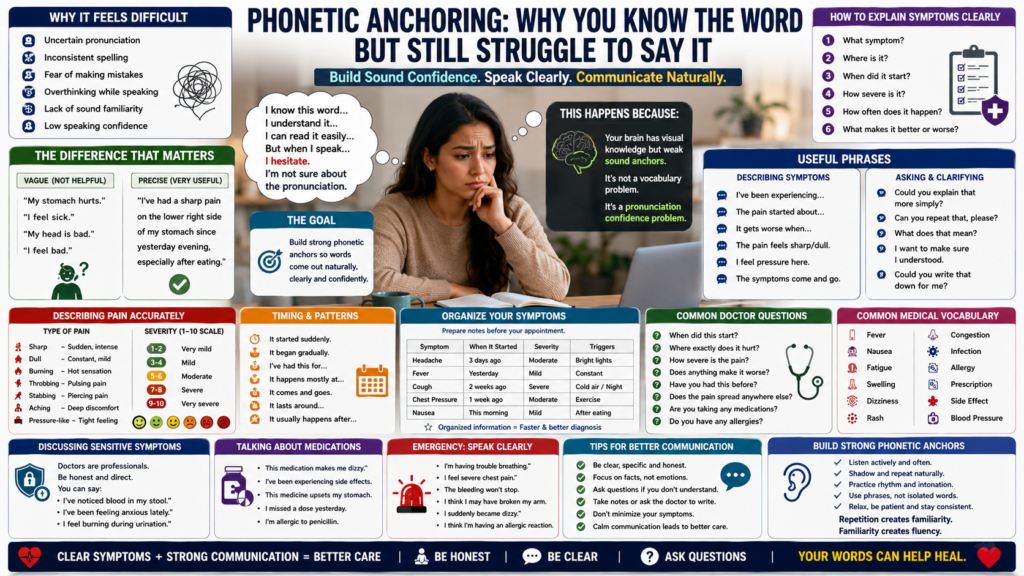
Phonetic anchoring means creating strong mental and physical familiarity with English sound patterns.
In simple words:
Your brain stops “guessing” pronunciation every time.
Instead, the sound already feels known.
Stable.
Recognizable.
Automatic.
For example, imagine hearing and repeating the phrase:
“That makes sense.”
hundreds of times naturally.
Eventually your brain no longer constructs the phrase consciously.
The sound arrives automatically as one comfortable unit.
That is phonetic anchoring.
Strong speakers rely heavily on these stored sound patterns during conversations.
Why Many Non-Native Speakers Hesitate While Speaking
A huge amount of speaking hesitation actually comes from pronunciation uncertainty.
The brain pauses because it is checking sound confidence internally.
For example:
“How do I pronounce this?”
“Am I stressing the correct syllable?”
“Does this sound strange?”
That micro-second hesitation interrupts fluency constantly.
And honestly, many learners incorrectly blame grammar for this problem when the real issue is phonetic instability.
Once sound patterns become more familiar, speaking speed often improves naturally without massive grammar changes.
Why English Spelling Creates Pronunciation Chaos
English spelling is emotionally confusing for many learners because visual patterns do not consistently match sound patterns.
For example:
“Colonel”
“Queue”
“Wednesday”
“Choir”
These words do not sound the way many learners expect visually.
Because of this, learners stop trusting pronunciation instinct.
And once trust disappears, hesitation increases.
That’s why listening repetition matters more than spelling memorization for spoken fluency.
The Brain Learns Spoken Language Through Sound Memory
This is extremely important.
Human brains store spoken language differently from written language.
Speaking depends heavily on:
rhythm memory,
sound familiarity,
muscle memory,
intonation recognition,
and repeated auditory exposure.
That’s why children learn speaking primarily through listening and imitation first.
Not grammar study.
Non-native speakers often need to rebuild some of this natural sound familiarity intentionally.
Why Reading Alone Rarely Creates Strong Pronunciation
Many learners consume huge amounts of written English but very little spoken repetition.
This creates uneven development.
The brain recognizes words visually but lacks stable spoken familiarity.
So during conversations, words feel mentally available but physically unstable.
That creates hesitation.
And honestly, this explains why some learners read advanced articles comfortably but struggle speaking basic sentences naturally.
Pronunciation Confidence Matters More Than Accent Perfection
Honestly, one of the most damaging beliefs many learners have is:
“I need a native accent to sound fluent.”
That mindset creates unnecessary emotional pressure.
Most international communication does not require accent perfection.
It requires clarity and stability.
Actually, many global professionals speak English with noticeable accents very successfully because their pronunciation is consistent and understandable.
Confidence matters enormously.
And confidence grows faster when learners focus on stable communication instead of impossible perfection.
How Repetition Creates Phonetic Stability
Repetition changes pronunciation emotionally.
At first, a phrase feels foreign.
Then familiar.
Then automatic.
For example:
“At the end of the day…”
“How’s it going?”
“Let me think about that.”
Repeated exposure gradually reduces mental resistance.
The sounds stop feeling strange physically.
And honestly, this emotional familiarity is one of the biggest hidden secrets behind spoken fluency.
Why Shadowing Helps So Much
Shadowing is one of the strongest phonetic anchoring techniques.
You immediately repeat spoken English while listening carefully.
This trains:
timing,
stress,
rhythm,
intonation,
and pronunciation flow simultaneously.
More importantly, it teaches your brain to feel English physically instead of analyzing English intellectually all the time.
That changes speaking comfort dramatically.
The Importance of Rhythm in Spoken English
English is stress-timed.
That means rhythm matters heavily.
Native speakers naturally stress certain syllables while reducing others.
For example:
“I WANT to GO.”
Stress creates emotional meaning and natural flow.
Non-native speakers sometimes pronounce every syllable equally, which can sound robotic or unnatural.
Learning rhythm improves pronunciation much faster than obsessing over isolated sounds constantly.
Why Some Words Feel “Unsafe” to Say
Many learners unconsciously avoid words they feel uncertain pronouncing.
This creates spoken vocabulary limitation.
For example, a learner may understand a word perfectly but never use it conversationally because the pronunciation feels emotionally risky.
That fear quietly shrinks fluency.
Phonetic anchoring helps remove this emotional danger feeling gradually through repeated comfortable exposure.
How Listening Quality Affects Pronunciation
Passive listening is not enough sometimes.
Strong pronunciation improvement often requires active noticing.
Pay attention to:
how words connect,
which sounds disappear,
where stress changes,
how native speakers pause,
how emotional tone changes rhythm.
Because spoken English is dynamic movement.
Not isolated dictionary words.
Why Slow Clear Repetition Works Better Than Speed
Many learners rush pronunciation practice trying to sound fluent quickly.
But speed without stability creates messy speech habits.
Calm repetition builds stronger sound memory.
Actually, slower confident pronunciation often sounds much more professional than fast nervous speech.
How Introverted Learners Can Build Strong Pronunciation Quietly
Not everybody enjoys loud speaking practice.
And honestly, that’s completely okay.
Phonetic anchoring can happen quietly too.
Soft shadowing.
Private repetition.
Listening mimicry.
Internal sound rehearsal.
Low-pressure speaking.
Introverted learners often improve extremely well once they remove social pressure from pronunciation practice.
Why Emotional Relaxation Improves Pronunciation
Tension affects speech physically.
Jaw tension.
Breathing tension.
Tongue stiffness.
Speaking anxiety.
All of these affect pronunciation clarity.
Relaxed communicators usually sound smoother because their speech muscles move more naturally.
This is why confidence and pronunciation are deeply connected psychologically.
Practical Ways to Build Stronger Phonetic Anchors
Some highly effective methods include:
repeating small phrases daily,
shadowing podcasts,
copying movie dialogue,
reading aloud slowly,
listening repeatedly to familiar speakers,
recording yourself,
imitating rhythm instead of individual words,
and practicing conversational chunks instead of isolated vocabulary.
Consistency matters more than intensity.
Why Conversational Chunks Matter So Much
Native speakers often retrieve entire phrase units automatically.
For example:
“To be honest…”
“At the same time…”
“I’m not really sure.”
“What do you mean?”
These chunks create smoother speech because the brain retrieves one sound unit instead of constructing every sentence from scratch.
The Difference Between Understanding a Word and Owning a Word
This distinction is powerful.
Many learners recognize words intellectually but do not “own” them phonetically.
Ownership happens when:
you hear the word comfortably,
say it comfortably,
recognize it instantly,
and retrieve it naturally during conversation.
That requires repeated sound exposure.
How to Stop Obsessing Over Tiny Pronunciation Mistakes
Perfection obsession damages fluency heavily.
Actually, many learners become harder to understand when they over-focus on every sound because speech loses natural rhythm.
Clear relaxed communication usually matters more than microscopic pronunciation perfection.
Understandability is the real goal.
Why Your Native Accent Is Not the Enemy
Many learners emotionally fight their accent constantly.
But accents themselves are not communication failures.
Unclear inconsistent pronunciation causes bigger problems than accents.
Global English already includes enormous pronunciation diversity.
Focus on stability and clarity first.
Not identity erasure.
How Phonetic Anchoring Improves Confidence Automatically
Once words feel physically familiar, speaking becomes emotionally safer.
The brain stops panicking constantly.
Sentences arrive faster.
Speech flows more naturally.
Confidence improves almost automatically because uncertainty decreases.
That’s why pronunciation training affects far more than sound itself.
FAQs
What exactly is phonetic anchoring?
Phonetic anchoring means building strong mental familiarity with English sound patterns so pronunciation feels automatic and stable instead of uncertain.
Why do I know words but still hesitate saying them?
Usually because your brain recognizes the word visually but lacks strong sound confidence for spoken use.
Is accent reduction necessary for fluency?
Not necessarily. Clear stable pronunciation matters much more than sounding perfectly native.
Why does English pronunciation feel unpredictable?
Because English spelling and pronunciation are highly inconsistent compared to many other languages.
How does shadowing improve pronunciation?
Shadowing trains rhythm, stress, timing, linking, and natural speech flow through imitation and repetition.
Why do I freeze while speaking English?
Often because your brain is simultaneously checking pronunciation, grammar, vocabulary, and confidence under pressure.
Can adults still improve pronunciation significantly?
Absolutely. Adults improve pronunciation very successfully through repetition, listening, imitation, and phonetic familiarity training.
Why does listening matter so much for speaking?
Because speaking depends heavily on stored sound memory. The brain needs repeated auditory exposure to build stable pronunciation instincts.
How can I stop fearing difficult words?
Repeat them calmly many times in low-pressure situations until the sounds begin feeling emotionally familiar and safe.
What matters most for understandable English pronunciation?
Probably rhythm, clarity, consistency, and calm speech delivery more than perfect accent imitation.
CONCLUSION
Phonetic anchoring is one of the most powerful pronunciation concepts many English learners never formally learn.
And honestly, understanding it changes speaking improvement completely.
Because suddenly you realize something important:
Your speaking problems are not always about intelligence.
Not always about grammar.
Not always about vocabulary.
Sometimes your brain simply lacks stable sound familiarity.
That’s all.
And thankfully, sound familiarity can absolutely be trained.
Through repetition.
Listening.
Shadowing.
Rhythm awareness.
Phrase practice.
And relaxed consistent exposure.
The more English sounds become emotionally familiar, the less your brain treats speaking like danger.
That changes everything.
You stop hesitating so much.
You stop fearing difficult words constantly.
You stop over-monitoring every sentence.
And gradually, English begins feeling less like a foreign performance and more like a natural communication tool.
That’s the real transformation.
Not becoming perfect.
Not erasing your identity.
Not sounding exactly native.
But developing calm stable spoken confidence.
Because honestly?
Fluent communication is not only about knowing English intellectually.
It is about feeling English comfortably in your ears, mouth, rhythm, and nervous system.
And once that comfort begins developing, speaking becomes dramatically easier.