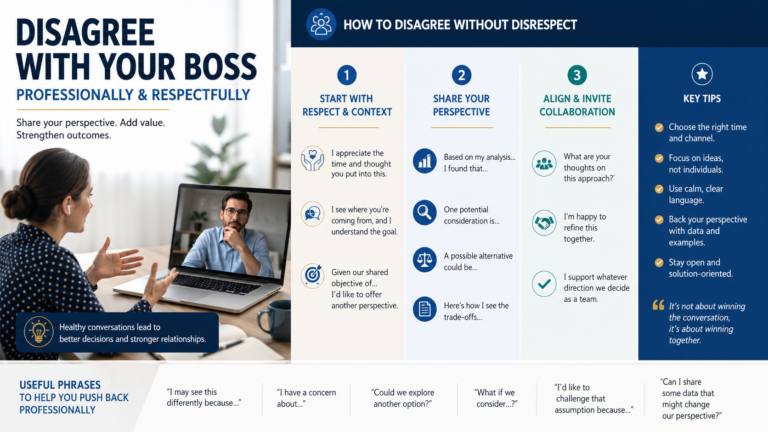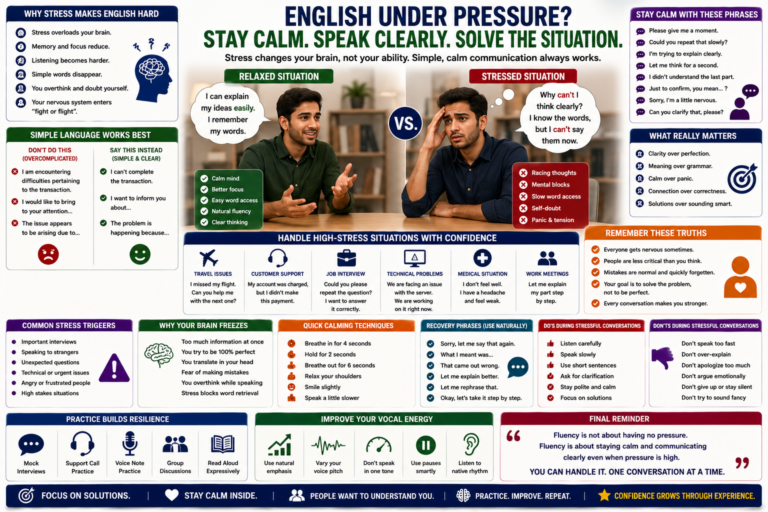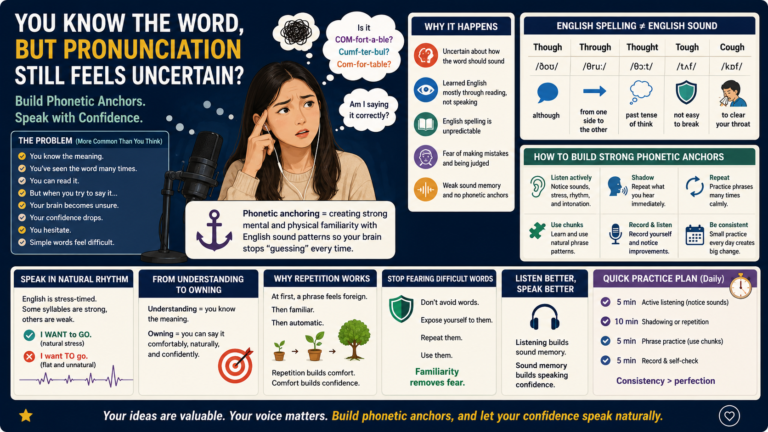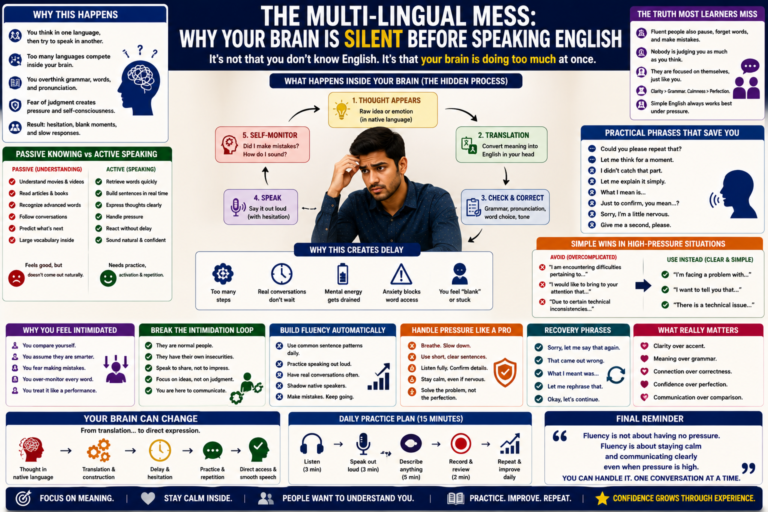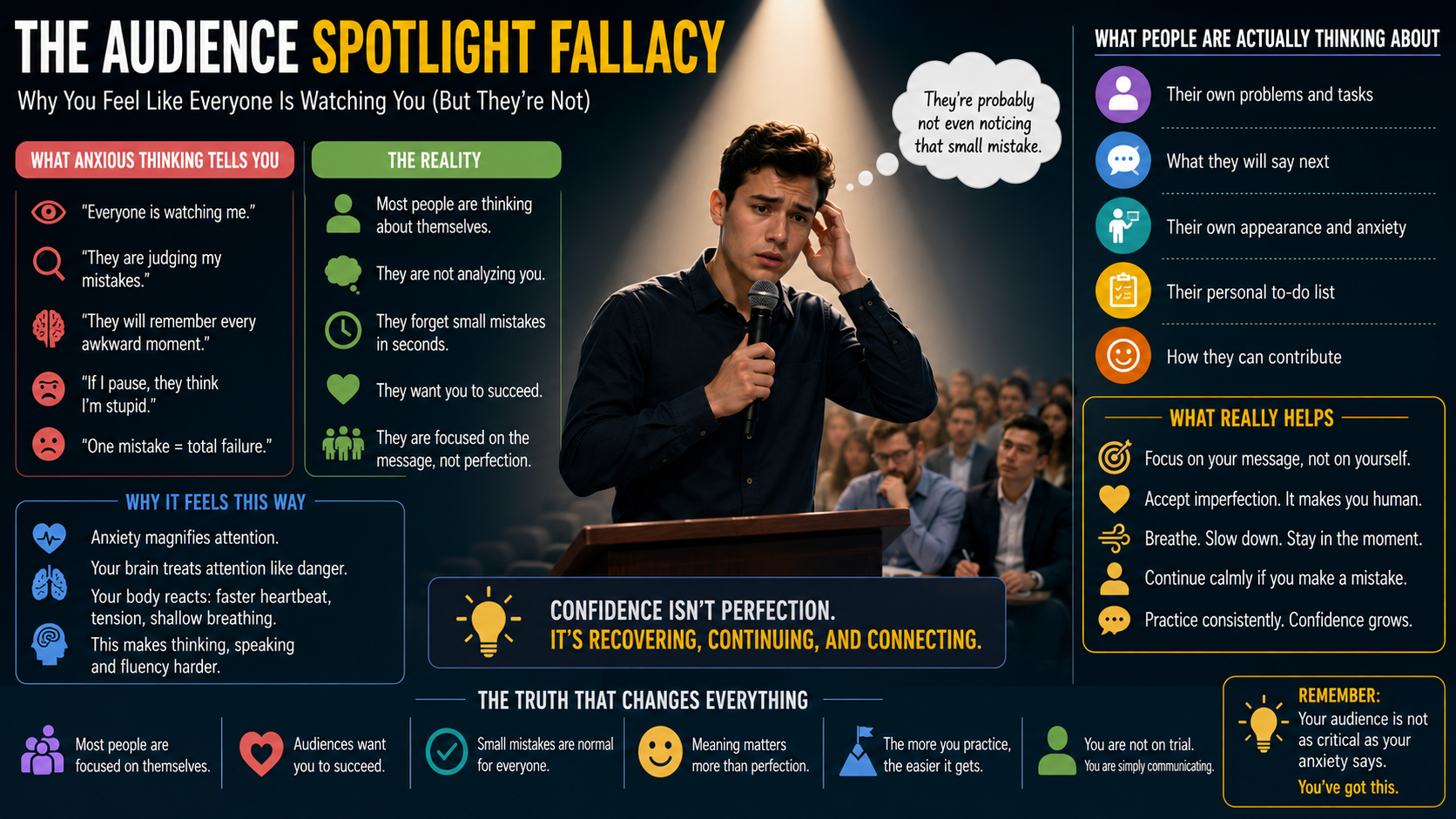
The Audience Spotlight Fallacy: Why You Feel Constantly Judged When Speaking English
One of the most psychologically exhausting experiences for English learners, public speakers, professionals, students, freelancers, creators, and even highly intelligent people is the strange feeling that everybody is constantly watching them, judging them, analyzing their mistakes, noticing every hesitation, and mentally recording every awkward moment during conversations or presentations.
Honestly, this feeling can become so intense sometimes that it completely changes the way people communicate.
A person may know exactly what they want to say internally.
They may understand the topic perfectly.
They may have strong ideas.
Good knowledge.
Clear opinions.
Real intelligence.
But the moment attention shifts toward them socially, something strange happens psychologically.
Their breathing changes.
Their thoughts become chaotic.
Their awareness becomes painfully sharp.
Suddenly they notice:
their voice,
their pronunciation,
their grammar,
their posture,
their pauses,
their facial expressions,
their hand movement,
their eye contact,
their accent,
their speed,
their confidence level,
and even tiny physical reactions that nobody else was probably noticing at all.
And honestly, this internal experience feels extremely real.
That’s what makes it so emotionally powerful.
Many learners secretly believe:
“If I make even one awkward mistake, everybody will notice immediately.”
“If I pause too long, people will think I’m stupid.”
“If my pronunciation sounds strange, everyone will remember it.”
“If my voice shakes slightly, the entire room will feel uncomfortable.”
“If I forget one word, people will judge my intelligence.”
These thoughts create enormous pressure.
And unfortunately, the brain starts behaving differently under that pressure.
Speech becomes less natural.
Fluency drops.
Thinking slows down.
Simple words disappear temporarily.
Sentences become robotic.
The person becomes hyper-self-aware.
And ironically, the harder they try to avoid embarrassment, the more mentally tense they become.
This psychological pattern is deeply connected to something called the spotlight effect.
But in communication and language learning, it often becomes even more emotionally intense because many learners already feel vulnerable while speaking English.
Especially non-native speakers.
Because speaking another language already creates a feeling of exposure.
You are not only expressing ideas.
You are expressing those ideas through a system where you may already feel slightly uncertain.
That uncertainty creates emotional sensitivity.
And honestly, many learners quietly suffer because of this.
They replay conversations repeatedly afterward.
They mentally relive tiny moments nobody else even remembers.
They overanalyze facial reactions.
Overanalyze pauses.
Overanalyze tone.
Sometimes they even avoid future speaking opportunities entirely because one slightly awkward moment felt emotionally huge internally.
This happens constantly in:
meetings,
presentations,
Zoom calls,
interviews,
classrooms,
social gatherings,
client conversations,
office discussions,
and even casual English practice situations.
Actually, one of the most important things many learners eventually realize is this:
Most people are thinking about themselves far more than they are thinking about you.
That realization changes communication dramatically.
But emotionally, this truth is difficult to feel at first.
Because anxiety creates psychological magnification.
When people become nervous socially, their brain starts treating attention like danger.
Every silence feels enormous.
Every mistake feels public.
Every hesitation feels visible.
And honestly, the body reacts physically too.
Heart rate increases.
Muscle tension increases.
Breathing changes.
Mouth becomes dry.
Thinking becomes fragmented.
This is why some people suddenly become less fluent during presentations even though they speak comfortably in private conversations.
Their intelligence did not disappear.
Their nervous system became overloaded.
Actually, one of the biggest misunderstandings about confident speakers is this idea that they never feel nervous.
That’s usually not true.
Many confident communicators still experience nervousness internally sometimes.
The difference is often psychological interpretation.
Strong communicators usually do not interpret small imperfections as social disasters.
They allow themselves to sound human.
Meanwhile anxious communicators often treat every tiny mistake like evidence of failure.
That emotional difference changes performance enormously.
And honestly, the audience spotlight fallacy becomes especially dangerous for English learners because many educational systems accidentally train people to fear mistakes emotionally.
Students become hyper-focused on correctness.
Correct grammar.
Correct pronunciation.
Correct answers.
Correct sentence structure.
Over time, many learners stop viewing communication as human interaction and start viewing it as constant evaluation.
That mindset destroys conversational comfort.
Because real conversations are naturally imperfect.
Even native speakers:
pause,
restart sentences,
forget words,
misspeak,
correct themselves,
use filler sounds,
lose track of thoughts,
and say awkward things sometimes.
That’s normal human communication.
But anxious learners often imagine fluent speakers as perfectly smooth machines who never struggle socially.
And because of this unrealistic comparison, they become even more self-conscious.
Actually, if you carefully observe real conversations between confident native speakers, you’ll notice something fascinating.
People are surprisingly forgiving.
Most conversations continue naturally even after small mistakes.
Nobody stops the interaction dramatically because someone hesitated slightly.
Nobody mentally records every tiny pronunciation issue.
Nobody is analyzing your grammar sentence-by-sentence the way anxious learners imagine.
In reality, most listeners focus mainly on meaning and emotional flow.
Not microscopic perfection.
This realization becomes life-changing once learners emotionally accept it.
Because the audience spotlight fallacy creates a very distorted social reality internally.
It convinces people:
“Everyone is focused on me.”
But most people are focused on:
their own thoughts,
their own insecurities,
their own workload,
their own appearance,
their own speaking,
their own anxiety,
their own performance,
their own life problems.
Human beings naturally self-monitor heavily.
That means audiences are usually much less critical and observant than nervous speakers imagine.
And honestly, understanding this psychologically can dramatically reduce communication fear.
Another important thing many learners misunderstand is that audiences usually want speakers to succeed.
This is extremely important.
Most listeners are not sitting there hoping you fail.
Actually, most people prefer smooth comfortable interactions emotionally.
They naturally cooperate with communication.
They fill gaps mentally.
Ignore tiny mistakes.
Follow meaning contextually.
And continue conversations normally.
But anxious speakers often imagine audiences as cold evaluators constantly searching for flaws.
That perception creates defensive communication habits.
For example:
over-explaining,
speaking too fast,
apologizing excessively,
monitoring every sentence,
avoiding eye contact,
speaking too quietly,
or becoming overly formal.
Ironically, these defensive habits often create more communication tension than the original mistakes themselves.
One fascinating reality about communication psychology is this:
Confidence often looks much simpler externally than anxious people imagine internally.
Many strong communicators are not technically perfect speakers.
They simply remain emotionally steady during imperfect moments.
That emotional steadiness creates perceived confidence.
For example, imagine two speakers making the exact same pronunciation mistake.
The first speaker panics immediately:
“Sorry sorry sorry my English is bad.”
Now the emotional energy becomes awkward.
The second speaker casually continues speaking normally.
Most listeners barely care.
Same mistake.
Completely different emotional impact.
That difference is psychological.
Not linguistic.
And honestly, one of the biggest turning points in communication confidence happens when learners stop treating every social interaction like a survival situation.
Because many anxious communicators unconsciously enter conversations already expecting embarrassment.
Their nervous system prepares for danger before speaking even begins.
Then naturally, self-consciousness increases.
Actually, this is why anticipation anxiety becomes so exhausting.
Sometimes learners suffer more before conversations than during the conversations themselves.
They mentally rehearse failure scenarios.
“What if I freeze?”
“What if everyone becomes silent?”
“What if they laugh internally?”
“What if I sound unintelligent?”
“What if I forget everything?”
These thoughts create emotional fatigue long before the actual interaction happens.
And honestly, this mental pressure can become exhausting over time.
Some learners eventually avoid opportunities entirely:
avoiding presentations,
avoiding meetings,
avoiding networking,
avoiding voice calls,
avoiding interviews,
avoiding group discussions,
avoiding leadership roles,
or avoiding speaking English publicly altogether.
Not because they lack ability.
Because the imagined social spotlight feels psychologically overwhelming.
But thankfully, the audience spotlight fallacy is largely a distorted perception.
And once people begin understanding that distortion, communication starts becoming much lighter emotionally.
You begin realizing something deeply important:
Most people are not watching you nearly as intensely as your anxiety claims.
Actually, many listeners forget small mistakes within seconds.
Many people barely notice them at all.
And honestly, communication becomes dramatically easier once your brain stops treating attention like danger.
Because fluency depends heavily on psychological freedom.
The more relaxed your nervous system becomes socially, the more naturally your language ability appears.
That’s why some learners suddenly sound fluent with close friends but nervous during presentations.
The language knowledge existed already.
The emotional environment changed.
This article is going to explore all of this deeply.
We are going to discuss:
what the audience spotlight fallacy actually is,
why social anxiety magnifies mistakes psychologically,
why English learners overestimate audience judgment,
how nervousness affects fluency,
why audiences are usually less critical than imagined,
how perfectionism damages communication,
how confident speakers think differently,
how to stop replaying conversations obsessively,
how to reduce social self-consciousness,
and how to communicate more naturally without constantly feeling “on display.”
Most importantly, we are going to approach this like a real human psychological experience instead of a motivational slogan.
Because honestly?
One of the biggest communication breakthroughs happens the moment you realize people are usually far less focused on your imperfections than your mind believes.
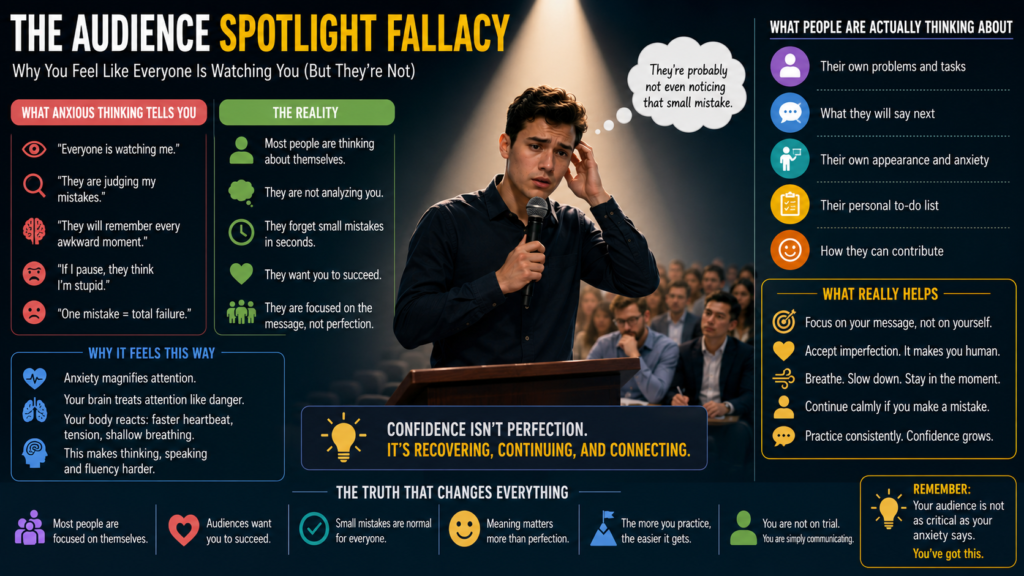
What Is the Audience Spotlight Fallacy?
The audience spotlight fallacy is the exaggerated belief that other people are constantly noticing, judging, and remembering your mistakes during communication.
It feels like a social spotlight is permanently aimed at you.
Every hesitation feels visible.
Every awkward pause feels public.
Every pronunciation mistake feels huge.
But psychologically, this perception is usually highly distorted.
Most people are much less focused on you than anxious thinking assumes.
Why English Learners Experience This So Strongly
Speaking another language naturally creates vulnerability.
You may already feel uncertain about:
grammar,
pronunciation,
vocabulary,
accent,
or fluency.
Because of this, attention feels emotionally dangerous.
The brain starts scanning constantly for possible embarrassment.
That hyper-awareness increases anxiety and reduces natural communication flow.
The Brain Magnifies Mistakes Under Anxiety
Anxiety changes perception dramatically.
Tiny imperfections suddenly feel enormous internally.
For example:
a two-second pause may feel like thirty seconds emotionally.
A small pronunciation issue may feel catastrophic.
A forgotten word may feel humiliating.
But externally?
Most listeners barely notice.
And even if they notice, they usually move on immediately.
Why People Replay Conversations Obsessively
Many learners mentally replay conversations afterward searching for mistakes.
This happens because the brain tries to “protect” you socially by analyzing potential embarrassment.
Unfortunately, this creates emotional exhaustion.
And honestly, most of the moments people obsess over are forgotten by others almost instantly.
The Truth: Most People Are Busy Thinking About Themselves
This realization is psychologically freeing.
Most people are heavily focused on:
their own speaking,
their own appearance,
their own anxiety,
their own thoughts,
their own responsibilities.
Human beings naturally self-monitor constantly.
That means audiences are usually far less observant than nervous speakers imagine.
Why Perfectionism Makes Communication Worse
Perfectionism creates tension.
Tension interrupts fluency.
When people try too hard to sound perfect, speech becomes:
slower,
stiffer,
more robotic,
and emotionally unnatural.
Ironically, relaxed imperfect communication often sounds much more confident than tense perfectionism.
My Opinion
Honestly, many people misunderstand confidence completely.
Confidence is not flawless speaking.
It is emotional steadiness during imperfect moments.
Strong communicators continue calmly even when mistakes happen.
They do not emotionally collapse over tiny issues.
That calmness creates perceived confidence naturally.
Why Audiences Usually Want You to Succeed
Most listeners are not waiting for failure.
Actually, audiences generally prefer comfortable successful interactions.
People naturally cooperate with communication.
They follow context.
Ignore small mistakes.
And focus mainly on meaning.
This changes communication psychology enormously once you truly believe it.
How Nervousness Physically Affects Speech
Communication anxiety affects the body directly.
Faster heartbeat.
Shallow breathing.
Dry mouth.
Muscle tension.
Mental overload.
All of this affects fluency temporarily.
That’s why intelligent people sometimes sound less fluent under pressure.
The problem is physiological stress.
Not lack of intelligence.
Why Small Mistakes Feel Bigger to You Than Others
You experience your own communication internally.
That makes every hesitation feel emotionally loud.
But listeners experience you externally and contextually.
They are focused mostly on overall communication flow.
Not microscopic analysis.
This creates a huge perception gap.
How Confident Speakers Recover Naturally
Strong communicators do not panic over imperfections.
They continue.
Correct casually if needed.
Laugh lightly sometimes.
And move forward naturally.
This recovery ability matters more than perfect performance.
The Danger of Constant Self-Monitoring
Over-monitoring destroys conversational flow.
If your brain constantly checks:
grammar,
pronunciation,
tone,
speed,
and audience reactions simultaneously,
fluency becomes extremely difficult.
Natural communication requires some psychological freedom.
Why Public Speaking Feels More Intense
Group attention activates survival psychology deeply.
Humans evolved to care about social acceptance.
That’s why presentations and meetings can trigger strong nervous system reactions even in capable people.
Understanding this makes communication fear feel less mysterious.
How to Reduce Spotlight Anxiety Gradually
Improvement usually comes through repeated exposure.
Your brain slowly learns:
“I survived.”
Then:
“Nothing terrible happened.”
Eventually:
“This is uncomfortable sometimes, but manageable.”
That emotional adaptation builds real confidence.
Why Authenticity Sounds More Relaxed Than Performance
People often sound stiff because they are performing English instead of communicating naturally.
Real communication includes:
imperfection,
pauses,
emotion,
reactions,
and flexibility.
Audiences usually connect more with authenticity than polished perfection.
The Power of Continuing Anyway
One of the strongest communication skills is continuing calmly after awkward moments.
Not apologizing endlessly.
Not panicking.
Not mentally collapsing.
Just continuing.
That resilience changes everything psychologically.
How Social Media Increased Spotlight Anxiety
Modern communication culture increased self-consciousness heavily.
People constantly compare themselves to polished videos, edited clips, and curated public speaking moments.
Real conversations are much messier than internet perfection suggests.
Remembering this helps reduce unrealistic expectations.
Why Fluency Improves When Fear Decreases
Many learners already know enough English to communicate well.
But fear blocks access to natural fluency.
Once anxiety decreases, speaking ability often improves surprisingly fast.
Because the knowledge was already there internally.
The Difference Between Embarrassment and Danger
This distinction matters enormously psychologically.
Embarrassment feels emotionally intense.
But embarrassment is not actual danger.
Your nervous system sometimes treats social imperfection like physical threat.
Learning to separate these helps communication confidence grow.
FAQs
What is the audience spotlight fallacy?
It is the exaggerated belief that other people are constantly noticing and judging your mistakes much more than they actually are.
Why do small mistakes feel huge during conversations?
Because anxiety magnifies self-awareness and makes imperfections feel emotionally larger internally.
Do audiences really notice every mistake?
Usually no. Most people focus mainly on overall meaning and communication flow, not tiny imperfections.
Why do I replay conversations afterward?
Your brain is trying to analyze possible social embarrassment, even though most moments were probably insignificant to others.
FAQ 5: Does nervousness reduce fluency?
Yes. Stress affects memory retrieval, breathing, concentration, and speech flow directly.
Why do I sound fluent alone but nervous publicly?
Because social pressure changes emotional state and nervous system response.
Are confident speakers never nervous?
Not necessarily. Many confident speakers still feel nervous sometimes but handle imperfections calmly.
How can I stop over-monitoring myself while speaking?
Focus more on communication meaning and listener connection instead of constant self-analysis.
Why does perfectionism hurt communication?
Because excessive self-monitoring creates tension, stiffness, and interrupted speech flow.
What matters most for communication confidence?
Probably emotional comfort with imperfection. Calm recovery matters more than flawless performance.
CONCLUSION
The audience spotlight fallacy quietly affects millions of people during communication.
Especially English learners.
Especially anxious speakers.
Especially perfectionists.
And honestly, it creates enormous unnecessary suffering because people begin believing everyone is analyzing them constantly.
But most of the time?
That perception is deeply exaggerated.
People are usually much more focused on themselves than on your tiny mistakes.
They are not recording your pauses mentally.
They are not obsessing over your pronunciation afterward.
They are not replaying your grammar internally for days.
Your brain simply magnifies social attention under anxiety.
And once you begin understanding this psychologically, communication starts feeling lighter.
Safer.
More human.
You stop treating every conversation like public judgment.
You stop expecting perfection constantly.
You stop mentally collapsing over tiny awkward moments.
Instead, you begin realizing something powerful:
Good communication is not flawless performance.
It is relaxed human connection.
And honestly?
The moment you stop imagining a giant spotlight constantly exposing your imperfections is often the exact moment your real personality finally starts appearing naturally during conversations.