Polite English Phrases to Disagree with Your Boss or Team Leader – Conversation In Professional English
Difficult communication situations in professional life is disagreeing with your boss, manager, senior colleague, or team leader in English. Honestly, many professionals feel nervous even before these conversations begin because disagreement naturally creates psychological pressure. Human beings usually want social approval, workplace stability, and professional respect. Because of this, expressing a different opinion to someone senior often feels risky emotionally, especially in international work environments where English itself already requires mental effort.
For English learners, this situation becomes even more stressful because now the brain is trying to manage multiple things at once simultaneously. You are not only thinking about your opinion. You are also thinking about grammar, tone, vocabulary, confidence, pronunciation, hierarchy, professionalism, and emotional delivery all at the same time. Internally, many people already know they disagree with a decision, but they hesitate because they fear sounding rude, disrespectful, aggressive, emotional, arrogant, or difficult to work with.
This is extremely common in global workplaces.
A developer notices a technical issue in the proposed architecture but stays silent because they do not know how to challenge the idea politely in English. A project manager realizes the deadline is unrealistic but avoids expressing concern because they worry it may sound negative. A designer disagrees with a client’s direction but says nothing because they fear conflict. A junior employee sees potential risks in a strategy but remains quiet because the boss sounds confident and experienced.
Over time, these silent disagreements often create larger problems.
Deadlines fail.
Bugs increase.
Teams become frustrated.
Misunderstandings grow.
And internally, employees feel emotionally disconnected because they are constantly suppressing honest professional opinions.
One of the biggest misunderstandings people have about workplace communication is believing that professionalism means agreeing with everything automatically. But mature professional environments usually do not work that way. Strong teams often depend on thoughtful discussion, constructive disagreement, risk identification, alternative ideas, and honest feedback. Experienced leaders usually understand that perfect agreement from everybody all the time is unrealistic and sometimes even dangerous because important problems may remain invisible if nobody feels comfortable speaking honestly.
However, the way disagreement is communicated matters enormously.
There is a massive emotional difference between:
challenging a person,
and discussing an idea.
For example:
“This plan makes no sense.”
feels emotionally confrontational.
Meanwhile:
“I’m slightly concerned about how this approach may affect scalability later.”
feels collaborative and professional.
Both sentences communicate disagreement.
But emotionally they create completely different reactions.
This emotional framing is one of the most important aspects of professional English communication. Many learners focus heavily on grammar and vocabulary but underestimate how strongly tone affects conversations. In real workplaces, people do not only react to your words logically. They also react emotionally to how those words feel.
Another challenge many learners face is direct translation from their native language. In some cultures, direct disagreement sounds normal and efficient. But when translated directly into English, the same communication style may sound emotionally stronger than intended. For example, some learners say:
“No, this is wrong.”
“You misunderstood.”
“This approach will fail.”
“That doesn’t make sense.”
Now maybe their intention is not rude at all.
Maybe they simply value honesty and speed.
But professionally, these sentences can feel emotionally sharp, especially in international corporate environments where collaborative tone matters heavily.
Because of this fear, many learners move toward the opposite extreme.
They become too passive.
They stop expressing opinions completely.
They say “okay” to everything.
They avoid difficult conversations.
They remain silent even when they see clear problems.
And honestly, this can hurt professional growth long-term because communication visibility matters heavily in modern workplaces. People who communicate ideas thoughtfully are often perceived as more engaged, responsible, analytical, and leadership-oriented.
Another important thing many professionals misunderstand is that polite disagreement does not mean weakness. Some people believe softening language makes them sound uncertain or less intelligent. But actually, emotionally intelligent communicators often sound calmer precisely because they know how to reduce unnecessary tension during difficult discussions.
Strong communication is not about dominating conversations emotionally.
It is about helping conversations remain productive.
For example:
“I see your point, although I think there may be another perspective here.”
sounds mature and balanced.
Meanwhile:
“No, that’s completely wrong.”
sounds emotionally reactive.
Professional credibility often comes from calmness rather than intensity.
Interestingly, many respected professionals are not the loudest people in meetings. Often, they are the calmest communicators during stressful discussions. They know how to disagree respectfully without creating emotional chaos. They know how to express concerns without sounding defensive. They know how to challenge ideas while still sounding collaborative.
That balance is an incredibly valuable workplace skill.
Especially in remote teams.
Especially in international companies.
Especially in English-speaking professional environments.
Another reason disagreement feels difficult is fear of negative judgment. Many learners internally panic with thoughts like:
“What if my boss gets offended?”
“What if my English sounds too direct?”
“What if everybody becomes silent awkwardly?”
“What if they think I’m difficult?”
“What if this damages my reputation?”
“What if I cannot explain my reasoning clearly?”
Because of these fears, many professionals either stay silent completely or speak in an overly emotional way once frustration builds too much internally.
But mature communication usually exists between these extremes.
Professional disagreement is not about:
fighting,
winning,
dominating,
or humiliating someone.
It is about:
clarifying concerns,
improving decisions,
reducing risks,
offering perspective,
and protecting project quality respectfully.
And honestly, once learners begin understanding disagreement as collaboration instead of confrontation, communication becomes dramatically easier emotionally.
This article is going to explore how to disagree politely with your boss or team leader in English, how to sound confident without sounding aggressive, how to soften disagreement naturally, how to express concerns professionally, how to survive stressful discussions calmly, how to handle rejection maturely, and how to communicate different opinions in a way that builds respect instead of tension.
Most importantly, we are going to approach this like real human workplace communication instead of robotic corporate textbook English.
Because honestly?
The ability to disagree respectfully is one of the most powerful professional communication skills a person can develop.
Understanding the Difference Between Disagreement and Disrespect
One of the biggest emotional mistakes many professionals make is unconsciously treating disagreement like personal disrespect. They feel that challenging a manager’s idea automatically means challenging the manager personally.
But these are not the same thing.
Professional disagreement focuses on:
ideas,
plans,
processes,
timelines,
risks,
or strategies.
Disrespect attacks the person emotionally.
For example:
“This timeline is ridiculous.”
feels emotionally harsh.
Meanwhile:
“I’m slightly concerned the timeline may affect quality later.”
focuses on the operational concern instead.
That difference matters enormously professionally.
Strong communicators usually separate:
the person,
from the problem.
And honestly, mature leaders often appreciate this communication style because it helps discussions remain productive instead of emotional.
Why English Learners Accidentally Sound Too Direct
This happens constantly in international workplaces.
Many learners translate disagreement patterns directly from their native language into English. But emotional tone changes across languages and cultures. What feels efficient and normal in one language may sound emotionally sharp in English.
For example:
“No, that won’t work.”
“You misunderstood the issue.”
“This approach is bad.”
“That’s incorrect.”
These sentences sound very absolute emotionally.
Professional English usually softens disagreement slightly using phrases like:
“I may be mistaken, but…”
“I wonder if we should also consider…”
“I’m not completely sure this will scale well.”
“One possible concern might be…”
These structures reduce emotional tension immediately.
And honestly, native English speakers use these softening patterns constantly in professional environments.
The Psychology Behind Softening Language
Softening language is not weakness.
It is emotional intelligence.
Human beings naturally become defensive when communication feels emotionally aggressive. Even intelligent professionals react emotionally sometimes when conversations suddenly feel confrontational.
Softening language helps keep people mentally open during discussion.
Compare:
“This idea is wrong.”
Versus:
“I think there may be some challenges with this approach.”
The second sentence feels collaborative because it leaves room for discussion instead of sounding emotionally final.
Professional communication often sounds less emotionally absolute and more discussion-oriented.
That creates psychological safety inside conversations.
Practical English Phrases for Professional Disagreement
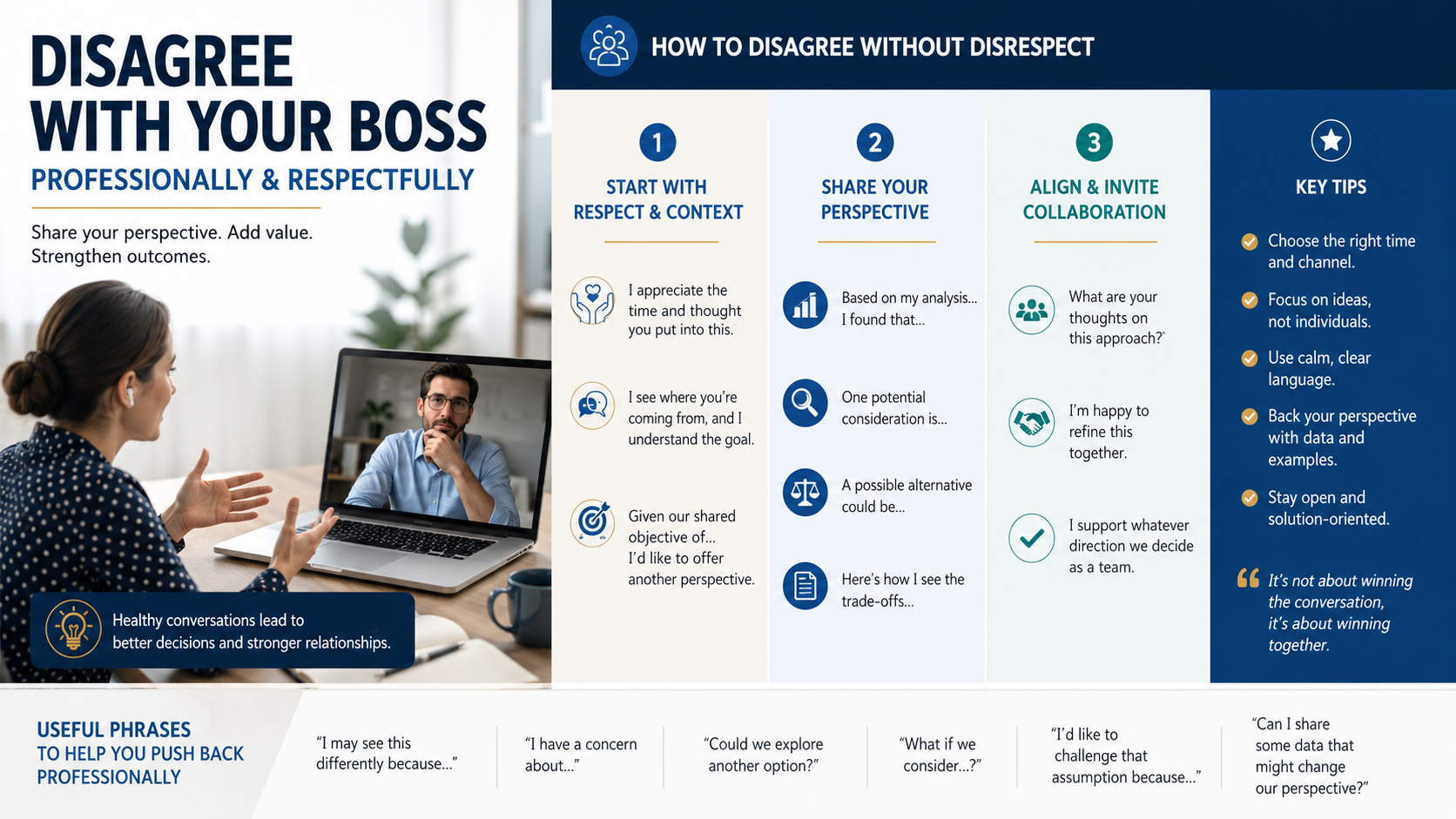
Some extremely useful workplace disagreement phrases include:
“I understand your perspective, but I’m slightly concerned about…”
“I see what you mean. At the same time, I think we should also consider…”
“That makes sense. I’m just wondering if there’s another approach we could explore.”
“I agree with part of the idea, although I think there may be some risks involved.”
“One thing I’m slightly worried about is…”
“I could be wrong, but I think this may affect performance later.”
“Would it make sense to revisit this part?”
“I’m looking at it a little differently.”
“From my perspective, there may be another option.”
“I completely understand the reasoning behind it. My only concern is…”
Notice how these phrases sound:
calm,
collaborative,
and respectful.
That emotional tone matters enormously.
My Opinion: Calm Communicators Usually Earn More Respect
Honestly, one thing I’ve noticed repeatedly in professional environments is that emotionally calm communicators usually earn more long-term respect than emotionally aggressive communicators.
Some people think strong communication means:
arguing loudly,
dominating conversations,
interrupting constantly,
or sounding forceful.
But real professional maturity usually looks much calmer.
Prepared.
Thoughtful.
Emotionally stable.
Solution-focused.
Strong communicators usually focus more on:
solving problems,
than winning arguments.
And honestly, that communication style builds trust much faster in professional environments.
How to Disagree During Meetings Without Panicking
Live meetings create huge pressure for many English learners.
Suddenly your manager says:
“What do you think?”
And immediately your brain starts racing internally.
You disagree.
But now you panic about:
tone,
wording,
timing,
and hierarchy.
This is extremely common.
One very useful strategy is buying yourself thinking time naturally.
Professional communicators do this constantly.
Useful phrases include:
“That’s an interesting point.”
“Let me think about that for a second.”
“I understand the reasoning behind that.”
“I’m seeing the situation a little differently.”
“One thing that comes to mind is…”
These phrases create mental breathing space.
And honestly, calm pauses usually sound more professional than nervous rushed speaking.
How to Express Concerns Professionally
One of the safest ways to disagree professionally is framing disagreement as concern rather than emotional opposition.
For example:
“I’m slightly concerned about the long-term maintenance.”
“One concern I have is scalability.”
“I think this could create delays later.”
“There may be some operational risks here.”
“I’m just worried this timeline might affect testing quality.”
This style sounds constructive because the focus stays on:
the issue,
the outcome,
or the process.
Not on attacking people emotionally.
Professional conversations usually work better when communication stays solution-oriented.
Why Listening Matters During Disagreement
Many people focus only on speaking during disagreement conversations.
But listening matters just as much.
Strong communicators usually:
listen carefully,
acknowledge perspectives,
clarify misunderstandings,
and then respond thoughtfully.
Sometimes conversations become tense simply because people stop listening and start preparing defensive replies mentally instead.
Useful listening responses include:
“That’s fair.”
“I understand your reasoning.”
“That makes sense from that perspective.”
“I see why that approach was considered.”
Acknowledgment reduces tension dramatically.
How to Stay Confident Without Sounding Arrogant
Confidence does not require emotional dominance.
Real professional confidence usually sounds:
calm,
clear,
and steady.
For example:
“I understand the current direction. Personally, I think there may be a more efficient option.”
This sounds confident because the speaker communicates clearly.
Meanwhile arrogance often sounds emotionally absolute:
“This is the wrong decision.”
Professional confidence usually leaves room for discussion instead of sounding emotionally final.
What to Do If Your Boss Rejects Your Opinion
This is emotionally important because not every disagreement ends with your idea being accepted.
And honestly?
That’s completely normal.
Professional communication is not about “winning” every discussion.
Sometimes managers have:
business pressures,
budget limitations,
client constraints,
or strategic information
you may not fully see.
Mature professionals handle rejection calmly too.
Useful responses include:
“Understood.”
“That’s fair.”
“I appreciate the clarification.”
“Thanks for explaining the reasoning.”
“That makes sense from the broader perspective.”
Professionalism during disagreement matters even after the final decision is made.
How to Sound More Natural During Difficult Conversations
Real workplace English conversations often include softer natural phrases like:
“Honestly…”
“To some extent…”
“From my perspective…”
“At least based on my experience…”
“I could be misunderstanding…”
“One thing I’ve noticed is…”
These phrases make communication feel more human and conversational instead of robotic.
And honestly, natural communication usually sounds more confident than overly formal communication.
How Introverts Can Disagree More Comfortably
Many introverts struggle with disagreement because they naturally avoid conflict emotionally.
But disagreement does not require aggression.
Even calm small contributions matter professionally.
For example:
“One concern I have is…”
“I’m just wondering if…”
“Maybe we should also consider…”
These are still valuable professional contributions.
You do not need to dominate conversations to communicate thoughtfully.
FAQs
Is it disrespectful to disagree with your boss?
Not automatically. In many professional environments, respectful disagreement is considered valuable because it improves discussion quality and helps identify risks early.
What is the safest disagreement phrase in English?
“I understand your point, but I’m slightly concerned about…” is one of the safest and most professional structures.
How do I avoid sounding aggressive?
Avoid emotionally absolute language like:
“This is wrong.”
Instead use softer collaborative phrasing like:
“I think there may be a challenge here.”
Why do I panic during disagreement conversations?
Because disagreement naturally creates social and emotional pressure, especially with authority figures and in another language simultaneously.
Should I always agree with my manager?
No. Mature workplaces usually benefit from respectful discussion and honest communication.
What if my English accidentally sounds rude?
Use softening phrases regularly:
“perhaps,”
“maybe,”
“I think,”
“I wonder if,”
“I’m slightly concerned…”
These naturally reduce harshness.
Is indirect communication better professionally?
Professional English usually softens disagreement somewhat because emotional tone matters heavily in collaborative workplaces.
How can I practice polite disagreement?
Practice workplace scenarios aloud repeatedly. Familiarity reduces nervousness dramatically.
What if my boss reacts negatively anyway?
You cannot fully control other people’s reactions. Focus on communicating respectfully and professionally from your side.
What is the most important disagreement skill?
Probably emotional calmness combined with respectful clarity.
CONCLUSION
Disagreeing with your boss or team leader in English can feel intimidating initially, especially when language pressure, workplace hierarchy, and emotional tension all exist together. But honestly, mature professional communication is not about agreeing silently with everything forever.
It is about learning how to:
express concerns calmly,
share perspectives respectfully,
and participate honestly in discussions without creating unnecessary emotional conflict.
The strongest professionals are usually not the loudest people in meetings.
Often, they are the calmest communicators.
They know how to challenge ideas respectfully.
They know how to discuss risks without sounding emotional.
They know how to communicate concerns without attacking people personally.
That is real communication maturity.
And thankfully, this skill improves rapidly with practice.
The more you participate in respectful professional discussions, the more emotionally normal disagreement begins to feel. Slowly, your brain stops treating disagreement like danger.
You stop panicking every time you have a different opinion from someone senior.
You stop overthinking every sentence.
You stop fearing respectful honesty.
Instead, you begin focusing on something much more valuable:
Clear,
balanced,
emotionally intelligent communication.
And honestly?
That communication style earns trust in almost every professional environment.